Paikea’s Refit
Paikea is a Catana 42 built in 1990. When we bought her she had done 45,000 miles, was fitted with one original rudder and an emergency rudder, and had hull damage that had been repaired with the wrong materials by someone who didn’t want to admit what had happened. She was also structurally sound where it mattered, had good bones, and was exactly the platform we wanted to build from.
The refit philosophy has been consistent throughout: we don’t buy new when the best materials in the world are being thrown away. Paikea’s rotating carbon rig came from a grand prix campaign. Her front beam, longeron, seagull striker, and bow pole are built from America’s Cup mast sections that were heading for landfill. Her sails came from Team New Zealand, Alinghi, VOR, TP52, RC44, Mini Maxi, and Carkeek 47 campaigns. The interior composite work uses salvaged carbon and honeycomb nomex from the same sources.
Everything done to Paikea is done to professional standard, documented honestly, and explained in full.
The build is ongoing. This page indexes the major project areas — click through to the full build story for each one.
2023 Boat Tour
A snapshot in time. These videos show Paikea in 2023 while in the Caribbean and our refit up until that stage.
Latest from Paikea’s Refit
- Inside the Fabrica Workshop: How Synthetic Rigging Is Actually Made
 Inside the Fabrica Workshop: How Synthetic Rigging Is Actually Made In the last post we walked through why Paikea’s stays needed replacing, and why we landed on continuous filament, unidirectional Dyneema DM20 rather than going like-for-like with wire. That post ended with a promise: we’d head to the Fabrica factory to see how these stays… Read more: Inside the Fabrica Workshop: How Synthetic Rigging Is Actually Made
Rotating Carbon Fibre Mast
Paikea’s original aluminium rig was replaced with a rotating carbon fibre mast from a grand prix campaign — a structural and performance upgrade that changed how the boat sails. The mast series covers the sourcing, the engineering decisions, the installation, and what a rotating rig actually means for sail trim and performance on a cruising catamaran.
Paikea’s Synthetic Rigging
A broken strand on one of Paikea’s wire sidestays set off a full rethink of how the rig is held up. We moved the whole boat to continuous filament, unidirectional Dyneema DM20 standing rigging, and took the headstay along with it — solving the furling problem that comes with going synthetic up front.
Read the full rigging build story →
Cockpit
The cockpit’s biggest modifications: a hardtop built from salvaged America’s Cup foredeck, and why the exposed helm stations are a genuine feature rather than a compromise.
Carbon Front End Rebuild
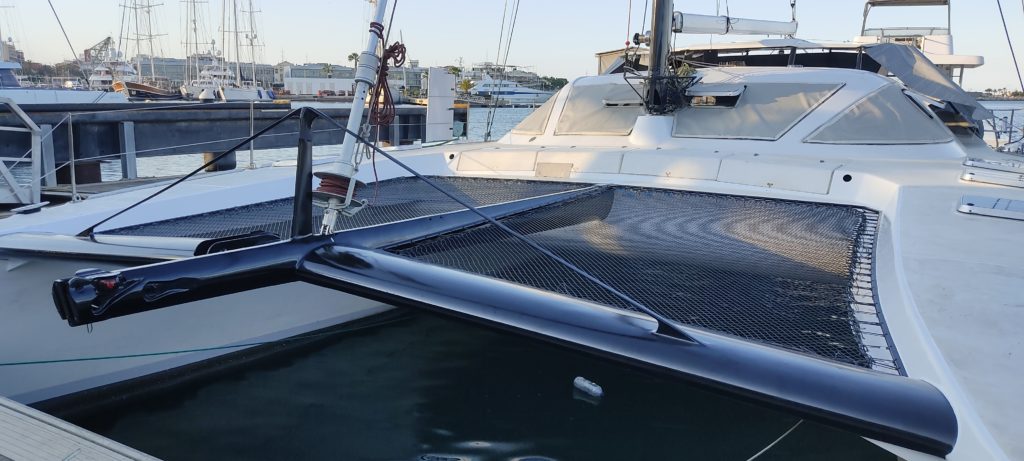
The original aluminium front beam, walkway, and connecting hardware were replaced entirely with a carbon system built from recycled America’s Cup mast sections. The new front end gave Paikea a centreline spinnaker and code zero platform, an inner forestay for heavy weather, a stiffer rig attachment, and a cleaner faster bow. The full series covers the beam, longeron, seagull striker, martingale, bow pole, trampoline, anchor system, and sea trial.
Read the full front end build story →
Rudders
Both rudders had to go. The previous owner had hit something hard at speed, punched a hole through the inner skin on both sides, and repaired the damage with non-structural polyurethane foam. We found it when we ground back the hull. The replacement rudders are custom carbon — designed by Shayne, built in Valencia using salvaged grand prix tooling, and fitted with a sacrificial tip system so a future impact breaks the tip rather than driving the shaft into the hull.
One of those rudders was lost entirely, 800 miles from land, mid-Atlantic. Follow the full crossing story →
Read the full rudder build story →
Servicing Vetus Hydraulic Steering Rams →
Carbon Fibre Chainplates
The original chainplates were bolted stainless steel straps — fully threaded bolts sawing slowly into a rotting plywood core, discovered only once the damage was already advanced. Both sides were rebuilt from scratch as a single laminated carbon fibre system, bonded directly into a new section of bulkhead rather than bolted through it. The full series covers the diagnosis, the engineering behind why a bonded carbon system works, and both builds start to finish.
Read the full chainplate build story →
Carbon Fibre Stanchion Sockets
The stainless steel stanchion sockets were replaced with carbon — part of the same weight reduction programme as the chainplates, and an opportunity to improve the structural integration with the hull. It also addressed the issue of leaking from bolts penetrating through the deck into the interior.
Read the full stanchion socket build story →
Composite Hatches
Paikea’s original hatches were replaced with our own flush design made completely from composites with custom 3D printed hinges — custom made, lighter, and better sealed than the production originals.
Read the full hatch build story →
Interior Refit
The Caribbean to Barcelona: An Atlantic Crossing
The return crossing for Shayne’s new role as head of rigging for the French America’s Cup team — and the passage that ended with a hull crack discovery on haul-out, kicking off the most significant refit yet.
The Scope of the Refit
The timber interior — original to a 30+-year-old boat — is being replaced entirely with lightweight composite: floors, bulkheads, doors, and furniture, all rebuilt lighter, stronger, and impervious to the moisture that destroys timber in a liveaboard boat over time. It’s the single biggest weight-reduction effort of the whole refit, and it’s still ongoing.
Read the full interior refit story →
Or deep dive into a specific area of the build here:
- Furniture: composite cabinetry that stiffens the boat →
- Bulkheads: the structural engineering behind every cut →
- Floors: replacing timber with structural composite →
- Doors: fit-for-purpose composite over timber →
Paikea’s Systems
Full equipment reference for Paikea as she is today — navigation, power, water systems, sail inventory, deck hardware, and the engineering and design tools behind the refit.
Electrical & Power Systems
The boat’s electrical system rebuilt from the ground up — a lithium battery pack with dual BMS units, a 24-volt conversion to reduce wiring loads and cable size, and a growing solar array designed to more than quadruple Paikea’s original power capacity.
Why we chose a 24-volt system→
Read about Paikea’s electrical systems→
Paikea’s Sails
Paikea’s full sail inventory, wind ranges, and the story behind our recycled grand prix sails.
Behind the Scenes: Members Content
The build documentation on this page covers the headline story for each project. In the members library you’ll find the engineering detail and behind the scenes footage that didn’t make it into the public videos — the carbon mast build diary, rudder ventilation diagnosis and second generation design, composite stanchion load testing with real pull test data, and ongoing interior refit documentation.
Already a member? Go to the Paikea Project → | Not yet a member? Join here →