Paikea’s Chainplates – The Full Story
Chainplates don’t get much attention until they fail — and on Paikea, ours failed slowly, in a way that took years to become visible and then very little time to become urgent. This is the story of how we found the problem, understood it properly, and rebuilt both sides of the boat with a system that’s fundamentally stronger and simpler than what came before it.
How It Started
The first sign of trouble came almost by accident. Shayne had sealed the chainplate at deck level with Sikaflex during an unrelated job — closing up a gap that had always been there. That sealant bead turned out to be an unintentional reference line. Without it, there was no way to see whether the chainplate was moving relative to the deck. With it, movement became impossible to miss.
What we found underneath was a combination of two problems working together. The original bolts were fully threaded rather than shanked — meaning the thread itself, not a smooth solid shaft, was bearing directly against the composite bulkhead. Under years of normal rig loading, that thread behaves like a saw, slowly cutting into the material around it. At the same time, the plywood core inside the bulkhead had been quietly rotting, accelerated badly once the boat reached the humidity of the Caribbean after years in drier conditions.
Neither problem alone would have been catastrophic. Together, they meant a chainplate that had genuinely moved several millimetres over time, discovered only because of a sealant line that happened to make it visible.
Read: Discovering Chainplate Movement — Bolt Failure and Bulkhead Rot →
Rebuilding in Carbon: Port Side
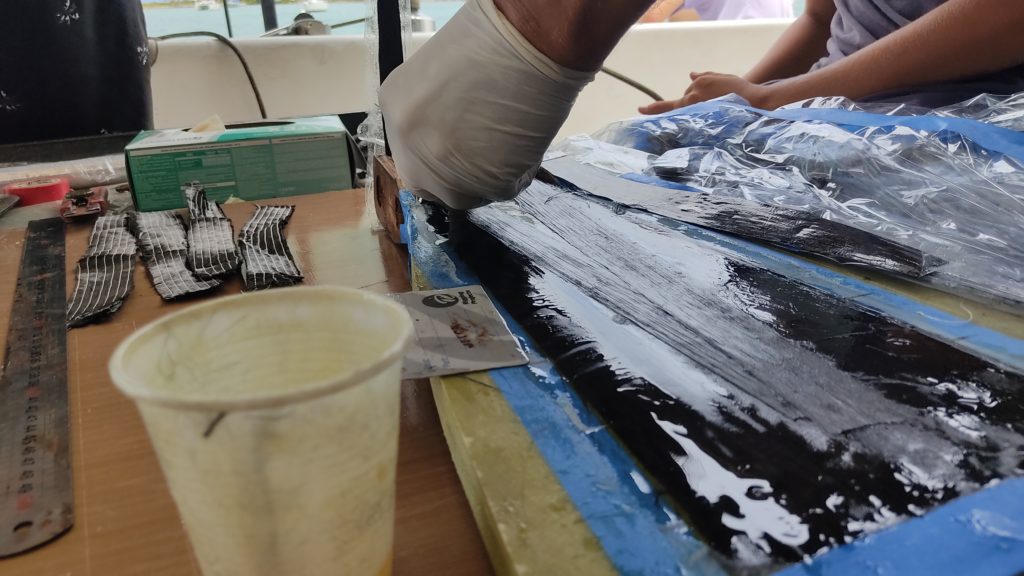
Once the extent of the problem was clear, a straight repair wasn’t the right answer — the underlying bulkhead structure needed to change, not just the hardware holding it. The solution was a full carbon fibre chainplate, laminated directly into a new, purpose-built section of bulkhead, replacing the stainless steel bolted strap entirely.
This meant proper templating against the existing structure, a two-stage lamination to manage both short resin gel times and the exotherm risk in a laminate finishing around 10mm thick, and careful attention to surface preparation between stages — sanding peel ply before every secondary bond, never trusting a fresh peel-ply surface to bond well on its own. Opening up the old bulkhead confirmed just how far the rot had gone: what remained holding the chainplate location together was little more than the outer glass skins, with almost nothing structural left in between.
Read: Building Carbon Fibre Chainplates — Part One →
How It Actually Stays In
The most common question this project generated was also the most important one: how does a laminated carbon strap actually stay attached to the boat with no bolts at all? The answer is the same principle underlying almost everything in composite structural design — distributing load over the largest possible bonded area, rather than concentrating it at a small number of hard points.
The carbon strap is sandwiched between two layers of E-glass double bias, doubling the effective bonding area gripping it. Load travels from the stainless steel pin at the top, into the carbon, into the fibreglass skin, and out into the surrounding hull structure — deck, topsides, and the rest of the shell all sharing the load rather than a handful of bolts fighting it alone. Splicing the new bulkhead section into the old one mattered just as much as the lamination itself, with fibreglass overlaps carrying load cleanly across the joint rather than relying on a simple butt join to do that work.
If you want to see this same bonding principle applied in a very different context, our post on the inside of a modern carbon race boat covers a chainplate bonded directly to the hull rather than a bulkhead — same load-distribution logic, different structural application.
Read: Building Carbon Fibre Chainplates — Part Two →
Rebuilding in Carbon: Starboard Side
The starboard chainplate followed not long after, discovered failing the same way, under real time pressure — six days to finish every open project on the boat before an Atlantic crossing back to Europe. The port-side template, cut on the assumption that the boat was symmetric fore-and-aft at this bulkhead, turned out to be reusable directly, saving real time on a job that didn’t have much to spare.
This build also surfaced a detail worth knowing on its own: proper edge capping around a bulkhead isn’t cosmetic, it’s structural — tying the two fibreglass skins together so they can’t peel apart from the core under load. The original edge capping on this boat, once inspected, turned out to be chop strand mat dressed around the edge: it looked finished, but chop strand’s discontinuous fibre gives it no real capacity to tie one skin to the other. The replacement edge capping, laminated properly in continuous double bias fibreglass, does the job the original only appeared to do.
Read: Building Carbon Fibre Chainplates — Part Three — The Starboard Side →
Why Carbon, Not Kevlar or Glass
Every carbon chainplate build draws the same question: why not Kevlar, given its excellent shear tear resistance? The honest answer is that Kevlar is a genuinely difficult material to work with well — poor fibre impregnation even under vacuum infusion, close to impossible to properly wet out by hand lamination, and difficult even to cut cleanly. E-glass would have worked structurally too; carbon was chosen mainly for a real, if relatively modest, weight advantage over glass.
Where This Leaves Us
Both chainplates are now rebuilt to the same system: load distributed through bonded surface area instead of concentrated at bolted hard points, structurally sound edge capping tying the bulkhead skins together, and a safety margin built in well beyond what the rig will ever actually demand of it. It’s a stronger, simpler system than what Paikea came with — one less thing to worry about crossing an ocean.
In the Members Library
We’ve put together the complete photo build log for this one — start to finish, from the first bolt that told us something was wrong through to the finished, painted chainplate. Eleven stages covering the design template, the vacuum bag lamination, pulling the old bulkhead apart at anchor in Guadeloupe, and fitting the new carbon chainplate in place.