
Paikea’s Carbon Mast: The Full Story
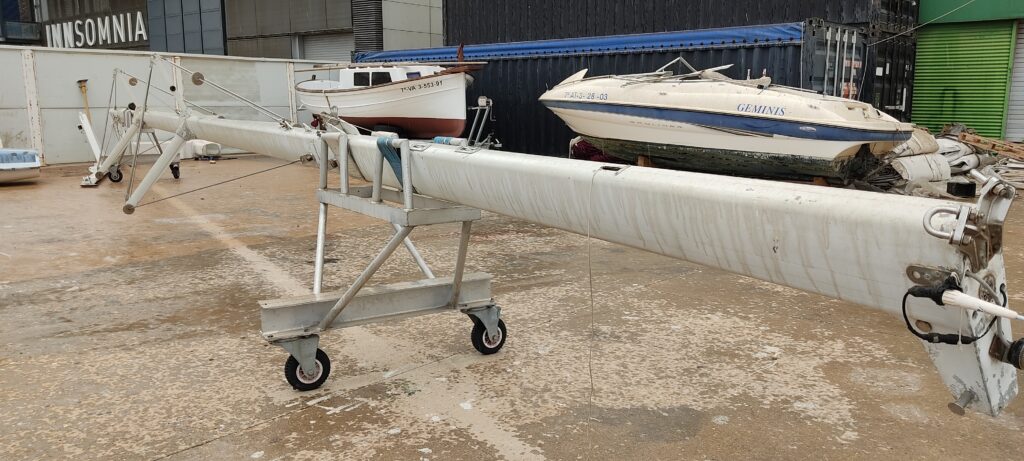
There’s a mast in the old Team New Zealand boatyard in Valencia. It’s been there for fifteen years. It’s Rig #12 from their 2000 America’s Cup campaign — high modulus carbon fibre, IACC section, built to grand prix specification and sailed at the highest level of the sport. The French team bought it for their 2007 challenge, didn’t make the finals, and left it behind. The yard changed hands. The new owners were cleaning house.
It was going to be chopped up and put in the bin.
We were stuck in Valencia during the COVID lockdown when we found it. We couldn’t let that happen.
What We Had to Work With
An IACC mast is not a cruising mast. It’s 33 metres long, designed for a 24-metre grand prix racing yacht with a full professional crew, built for one campaign and then either passed on or discarded. The chord dimension — the depth of the section from leading edge to trailing edge — is significant. The wall thickness, the reinforcing at the hounds, the titanium fittings throughout: all of it built to a standard that doesn’t exist in the cruising world.
None of it belonged in a skip.
Shayne had already been thinking about replacing Paikea’s aluminium rig. The original mast was functional but heavy, draggy, and limited. An IACC section — cut down, adapted, re-engineered for a family cruising catamaran — is a fundamentally different piece of hardware. The stiffness, the aerodynamic profile, the weight savings at the top of the rig where they matter most. Walking away wasn’t a serious option.
The lockdown gave us the time to do it properly.
The Salvage: What Came Off the Mast
One of the things that makes this project unusual is how much of the original hardware was worth keeping. Shayne went through everything before a single cut was made.
The gooseneck is original Cup boat hardware — titanium and aluminium, massively overbuilt for a Catana 42, held in place with twelve M10 titanium bolts all potted in place. It will never break. The titanium padeye at the base came off it too. The 26mm Frederiksen track stayed on the mast — pulling it off and replacing it would have been more work than it was worth, though finding the right cars to suit the profile turned out to be expensive and time-consuming. The Barlow 24 winch came with our original mast — old and rough, but solid Australian engineering that Shayne rebuilt rather than replaced.
The nitronic rod sidestays from the original Cup rigging were recycled as dog bones and forestay pin components. The carbon wind wand was a find in itself: a vertical carbon unit with a broken sensor that Shayne stripped down, extended the wiring on, fitted a new BnG sensor to, clear coated, and remounted at the masthead. It’s the tallest thing on the rig and Shayne’s favourite part of the whole build.
→ The full acquisition story and what the mast came with: From America’s Cup to Our Catamaran: Rescuing a Carbon Legend
Cutting It Down
A 33-metre mast needs to become something Paikea can actually carry. The cutting decisions were the most consequential of the whole project — get them wrong and you cut through the most heavily reinforced sections of the tube, losing the attachment points for the forestay and sidestays.
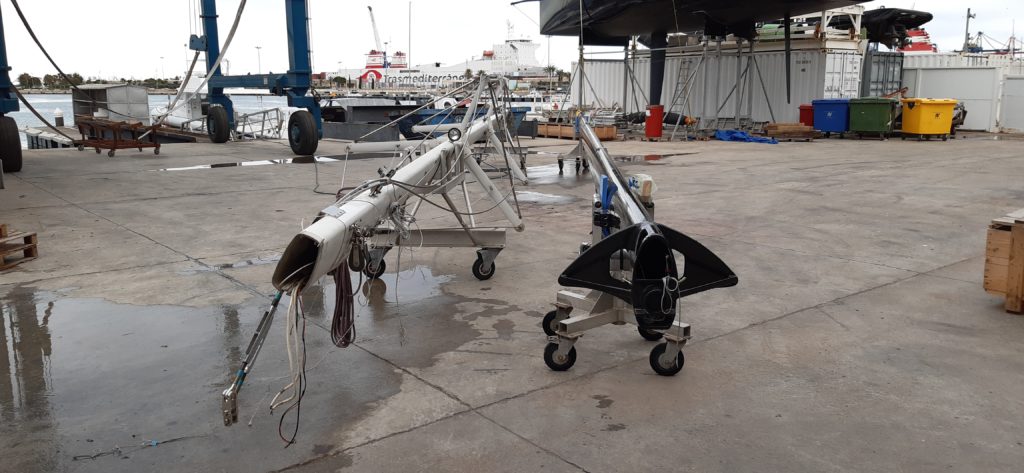
Shayne worked from the hounds. The original Cup boat hounds had substantial internal reinforcing and a tie bar through the section — exactly the structure you need for attaching the forestay and sidestays. He picked up on those existing reinforced areas and used the hounds as the datum from which everything else was measured. The masthead position was determined from there, working down rather than up, to make sure the tip section wasn’t compromised. A lot of metres came off the bottom.
We lost most of the cutting footage when a hard drive died during the build. What survived is in the members build diary.
The Engineering Decisions
Every system on the original rig was designed for a grand prix racing programme. None of it translated directly to Paikea. Shayne made every decision from first principles.
Rotate or fix. The chord dimension creates significant windage when the sail isn’t up. In a 50-knot anchorage, being able to feather the mast into the wind removes real load from the anchor system. For offshore sailing, the ability to control the mast’s presented area is a safety tool. The ball sits on an oil-impregnated nylon socket inside a carbon cup bonded to the mast foot — aluminium ball rather than stainless, chosen for weight and because the bearing area is large enough that wear is minimal.
Spreaders or lowers. Six wires in a double diamond spreader setup create six drag sources. Shayne did a deflection test before committing — propped the mast horizontally, hung weight off the middle, measured the bend. The fore-aft stiffness of this section is high enough that spreaders aren’t structurally necessary. The new setup runs two sidestays and two lowers. The drag reduction is measurable — the most obvious place you see it is at anchor, where the load on the chain dropped noticeably compared to the spreader rig.
The rotation spanner. A standard arm out the front would catch every leg and interfere with every locker. The solution is the wing arms either side of the mast — rotation control and deck steps in one fitting. Even if the mast were fixed, Shayne says he’d keep them.
Winch on the mast. Everything involving the spinnakers, code sails, and jib gets handled at the mast. Having the winch there means hoisting, controlling, and dropping all happen in the same place. Reefing and furling go back to the cockpit because that’s where you are when conditions change.
The jib halyard system. No dedicated clutch or winch at the mast base. The halyard ends in a snap shackle lashed to the tack at the furler. Luff tension is adjusted from the bottom using the lashing, not from the top using the halyard. It trades a small amount of emergency drop speed for significantly reduced complexity. For a modern furling jib, the trade-off is justified.
→ The full engineering breakdown: Engineering Paikea’s Rig: Adapting America’s Cup Technology for Cruising
Stepping the Rig
Getting a mast this size onto a Catana 42 required planning the lift carefully. The step itself went onto Paikea’s custom carbon mast base — the ball and socket arrangement Shayne had designed and built during the lockdown build period. Once it was in place and the standing rigging was attached, the rig was tuned and Paikea went back in the water.
→ Video of the mast being stepped is embedded in the rescue post above.
Tuning: Correcting the Mast Rake
Two years after stepping the new rig, we replaced Paikea’s front beam with a custom carbon one. The new beam was angled upwards — better trampoline clearance, better performance. What we didn’t fully account for was that raising the beam also raised the forestay attachment point, making the forestay effectively too long and adding excessive aft rake to the mast.
We sailed like that for two years. The turnbuckle was maxed out. The boat had weather helm — not dangerous, but noticeable, and making every upwind sail harder than it needed to be. In Sint Maarten, with access to a good rigging shop, we shortened the forestay, fabricated new soft shackle strops for the sidestays, and got the rig back to where it should have been.
→ The full explanation of mast rake and what happens when it’s wrong: Why We Had to Fix Our Mast Rake
Where We Are Now
Paikea has been sailing on this rig since 2021. It’s crossed the Atlantic twice, carried the family through the Caribbean, the Canaries, and back. The rig is currently in Valencia on Paikea while the interior refit progresses.
Two modifications are still planned. The masthead position — Shayne would bring it down to the orange band to reduce the lever arm when the code zero is fully powered up. And a centre pulling point on the cabin top for the rotation spanner, to improve mechanical advantage at high rotation angles. Neither has been done yet.
The rig that came out of a Valencia scrapyard destined for destruction is the best thing on the boat. It will be for a long time.
Behind the Scenes: Members Content
The public posts and videos tell the story of what we built and why. The members build diary shows how — the footage from the shed in Valencia, the fabrication detail, the decisions made in real time, the things that didn’t go perfectly and how they got sorted.
It covers the cutting, the base construction, the nitronic dog bones, the rotation spanner fabrication, the forestay and sidestay fittings, the halyard exit slots, the winch rebuild, and the finished mast walkaround before it left the shed.
This is professional-grade composite and rigging work documented by the people who did it. It’s not available anywhere else.
→ Paikea’s Carbon Mast: Build Diary — Members Hub
Not a member yet? Join here Members Hub