
Correcting Mast Rake: Why It Matters and How We Fixed Two Years of Too Much
When we built and fitted Paikea’s new carbon front beam, we knew we were changing more than just the beam. The original beam, like most catamaran front beams, sat flat. Ours doesn’t — we couldn’t source a single piece of carbon long enough to run it flat in one piece, so the beam ended up built from two shorter sections joined at an angle instead. It’s turned out to be one of those happy accidents; we’re genuinely glad it went this way, because it looks fantastic. But it also changed the geometry the forestay has to work with, and that’s been sitting as an unresolved problem for two years.
How We Ended Up With Too Much Rake
With the beam angled up rather than flat, the forestay needed to be shorter than before to keep the mast at the correct rake. The turnbuckle could only take up so much of that difference — it eventually bottomed out, threads fully closed, with no more adjustment left to give. That left us with more rake in the mast than we wanted, and we’ve known about it since the beam went in. It hasn’t been enough of a problem to stop sailing, but it’s not been set up properly either, and with someone nearby able to re-swage the wire, it was finally worth doing the job right after two years of working around it.
Doing the Job Properly
Fixing it meant cutting the swaged fitting off the forestay’s opposite end to free up enough wire to actually shorten it. That’s not as simple as trimming a bit off — the wire inside a swaged terminal is buried into the fitting and cold-fused in place under pressure, so removing the terminal means cutting off that buried section along with it. On wire this size — half-inch, 12 millimetre — that buried section runs about 250 millimetres, so any time you remove a swage terminal on wire that size, you lose that length whether you want to or not.
We replaced the cut end with a toggle rather than a new threaded terminal, mostly because a toggle was what we could actually source locally — a straightforward, practical call rather than the ideal one, but the wire itself still had plenty of service life left, so there was no reason to replace the whole thing for the sake of a fitting.
Shortening the forestay on its own would have thrown the turnbuckle out of its normal working range in the other direction, so we lengthened the sidestays to match — new soft-link strops made up by hand between the mast and the stainless steel wire, sized to bring everything back to where the turnbuckle sits comfortably mid-range again. Straightforward in principle. Considerably less straightforward in practice, done in the middle of the Caribbean with limited materials, at anchor, against a deadline.
Why Rake Matters More Than You’d Think
It’s worth explaining why any of this is worth the effort. Mast rake — whether it leans aft, stands upright, or has too little of either — directly affects how balanced a boat feels and sails, and that’s true regardless of the type of boat. You can partially disguise a badly-tuned rig by compensating through sail trim, but that’s a workaround, not a fix, and it costs you real performance. We’ve seen this taken to an extreme on a client trimaran with too much rake — so far out of tune that the boat would round up and head into irons the moment the mainsail was properly trimmed on, with no way to sail it as designed until the underlying rake problem was addressed.
The mechanism behind it: more rake moves the mast, and with it the combined center of effort of the sails, further aft. If that center of effort moves too far aft relative to the boat’s center of lateral resistance — the underwater pivot point the whole boat turns around — it creates a lever that constantly wants to turn the bow into the wind. The practical symptoms are a heavy, over-loaded helm feel when hand-steering, or on hydraulic steering like ours where you don’t get that direct feedback, a boat that keeps wanting to round up or won’t come out of a tack cleanly. It also shows up during slow-speed manoeuvres — coming off anchor, bearing away, and sailing off cleanly becomes noticeably harder when there’s too much rake fighting you.
Too Much Rake vs. Not Enough
Too much rake is a performance and handling annoyance. Not enough rake is a genuinely dangerous situation, and one worth addressing quickly if it shows up. Insufficient rake produces lee helm — the boat wanting to bear away downwind rather than round up. That matters because a yacht rounding up into the wind naturally depowers itself, while a yacht bearing away downwind powers itself up further. Lee helm compounds in exactly the wrong direction, and it’s not something to leave unaddressed if you notice it.
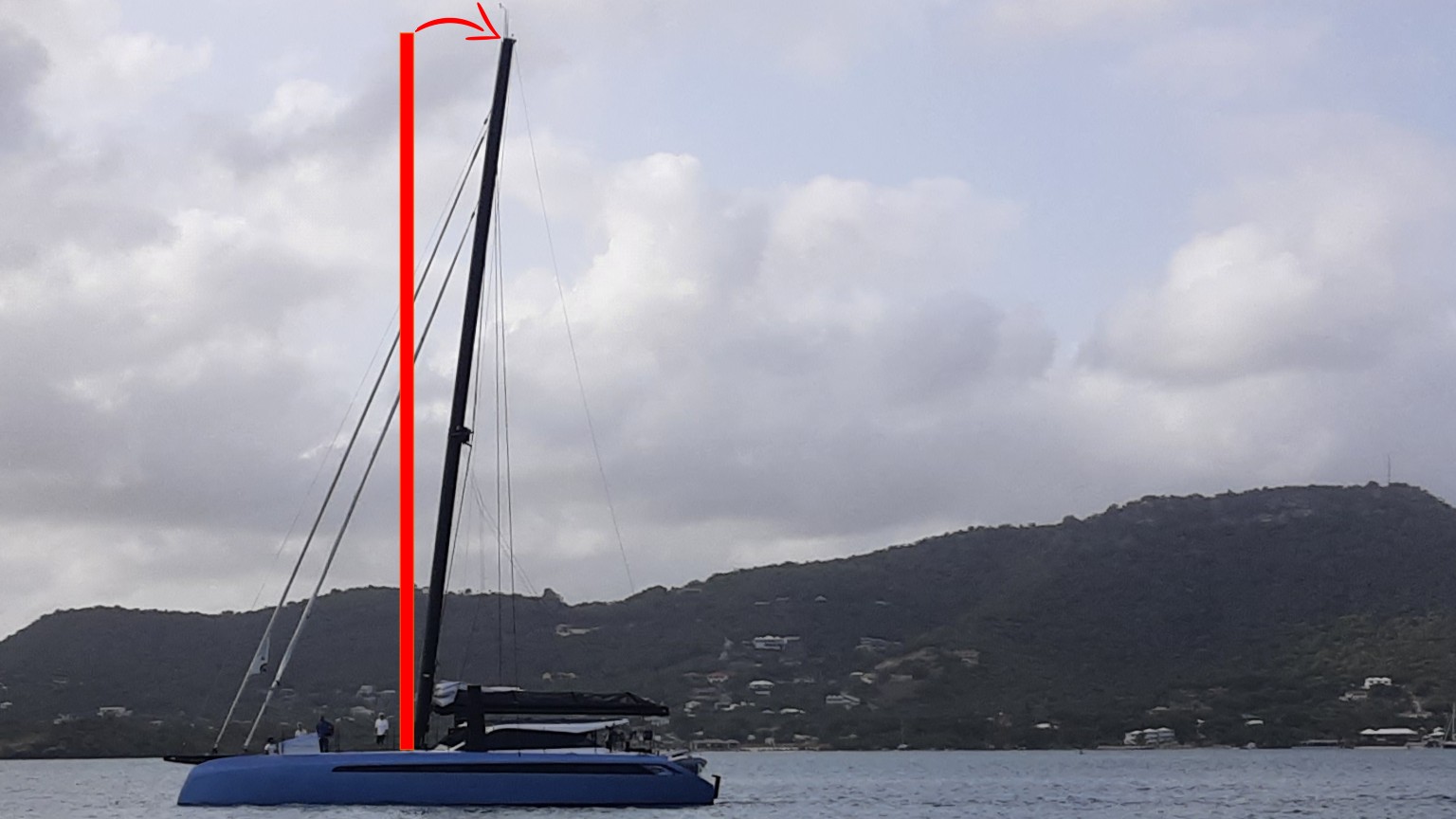
Gunboat 68 Mast Rake
Mast rake is the angle at which the mast leans fore or aft from a vertical position. It’s the single most important setting for controlling the fore-and-aft position of your entire sail plan.
The Knock-On Effects of Changing It
Adjusting rake is never an isolated change — it ripples through the rest of the rig and deck layout. Add rake and you can expect the boom to swing closer to whatever’s in its path that it previously cleared; remove rake and the boom sits with more clearance than it had before. A headsail clew that runs close to a track or car can end up touching the deck with more rake, or moving further away with less. Every sheeting angle on the boat shifts as the sails rotate around the new mast position, which means upwind trim settings that were previously dialled in need to be reconsidered from scratch. None of that makes rake adjustment not worth doing when it’s genuinely needed — it just means treating it as a whole-rig job, not a single isolated tweak.
In the Library
The full rig-tuning picture, including how rake interacts with rudder angle and rig load, ties in with How to Tune a Catamaran Rig, Cap Tang Misalignment: Diagnosing Rod Rigging Problems, and Should Your Sidestays Break Before You Fly a Hull? — start with those free posts if you haven’t already. More details are in the Members Pages.
For the full story of Paikea’s carbon mast — from rescuing a Team New Zealand rig from a Valencia scrapyard through to the finished rotating rig — start here: Paikea’s Carbon Mast: The Full Story