Paikea’s Systems & Refit
Welcome to the central log of Paikea’s transformation. This is more than an inventory list; it’s the story of our ongoing project to refit and optimize our Catana 42 for performance cruising. Below, you’ll find every major system and upgrade, with links to detailed blog posts and videos where we dive into the “how,” “why,” and lessons learned.
Explore the categories below or scroll through our complete equipment list.
Paikea Systems and Upgrades
Interior Upgrades
Replacing heavy timber furniture and bulkheads with lightweight composite structures. The goal is not simply to make the boat lighter, but to recover payload capacity—allowing Paikea to carry full cruising gear, water, and stores while sailing at her original design weight. Every change considers balance, center of gravity, and structural integrity to ensure the boat remains strong, stable, and responsive under sail.
Weight, Performance, and Payload: The Logic Behind Our Catamaran Refit
- Custom shower floor with integrated drainage & access
- Solving the classic boat shower failure mode: a floor that drains properly, includes mandatory access hatches, and is designed so a pump failure never floods the bilge. The solution separates the pump into a dry compartment, adds a floating lid that signals clogs before water rises, and uses a composite floor panel with built-in slope. The result is a system where maintenance doesn’t become a crisis.
- The Boat Shower Floor Blueprint: Drainage, Hatches & Avoiding Bilge Floods
- Structural bulkhead & daggerboard load path optimization
- Identifying a fundamental flaw in how daggerboard loads were transferred into the hull—two off-center bulkheads missed the foil’s strongest structural point. The solution: replacing them with a single, strategically positioned vacuum-infused bulkhead weighing just 1.9 kg, designed to intersect the daggerboard’s 30-40% chord point. The result is optimized load paths, increased hull stiffness, and significant weight savings.
- Re-Engineering a Hull: Load Paths, Daggerboards, and a New Structural Bulkhead
- Daggerboard crash box
- Addressing a hidden vulnerability: the aft end of the daggerboard case. In a strike, the case can fail in two ways simultaneously—a corner acts as a stress concentrator while the tapered shape wedges the structure apart. The solution is a watertight secondary compartment bonded to the hull, case, and structural floor, designed to contain any flood and prevent catastrophic water ingress. The result is a passive safety system that turns a potential disaster into a manageable event.
- Engineering a Crash Box: Protecting Paikea from a Daggerboard Failure
- Bulkhead modification for increased headroom
- Cutting a structural door bulkhead to improve livability —a modification that reduces beam depth and increases loads on remaining structure. The engineering solution: adding unidirectional carbon fiber along the cut edge to create a new bottom flange, restoring stiffness and strength. The result is a more comfortable, safer interior without compromising the vessel’s ability to handle high-performance sailing loads.
- Modifying Boat Bulkheads: The Engineering Behind Increasing Headroom
- Composite Floor Replacement
- Replacing heavy timber floors with lightweight composite structures across the entire boat. Halfway through the project, over 300 kg of old material—25mm plywood with vinyl non-skid—has been removed. The process involves painstaking demolition, complex templating around the daggerboard case, and a family assembly line for fabrication and installation. The result is a dramatically lighter interior that transforms the boat’s payload capacity and livability.
- Mid-Refit Update: The Floor Replacement Hits Halfway
External Upgrades
- Carbon Fibre Rotating Wing Mast
- This was the pinnacle of Paikea’s performance transformation: designing and building a custom carbon fibre rotating wing mast. This wasn’t just a replacement; it was a fundamental re-engineering of the boat’s entire sailing profile.
- Read About Our Carbon Fiber Rotating Wing Mast
- Composite Rudders
- Rebuilding from scratch after losing a rudder mid-Atlantic. Rather than buying an off-the-shelf replacement, custom carbon fibre stocks were sourced from New Zealand and paired with hand-shaped foam blades, laminated with fibreglass and epoxy. The result is performance-oriented rudders designed specifically for Paikea’s hulls, using data collected from years of sailing to improve efficiency and control.
- Rudder Evolution: Shaping the Ultimate Foil
- Transom Modification
- By extending the top of the step to meet the hull line, we were able to create a comfortable lower platform and improve access from the transoms.
- Read about Transforming Paikea’s Transom
- Carbon/Nomex Solid Hardtop with Sunroof
- Constructed using solid carbon super yacht spreaders and the forward deck of the old Spanish 2007 America’s Cup yacht.Carbon/nomex solid hardtop for cockpit. Complete with a sunroof which was the old spinnaker launching hatch
- New steering consoles manufactured to fit into new hardtop arrangement
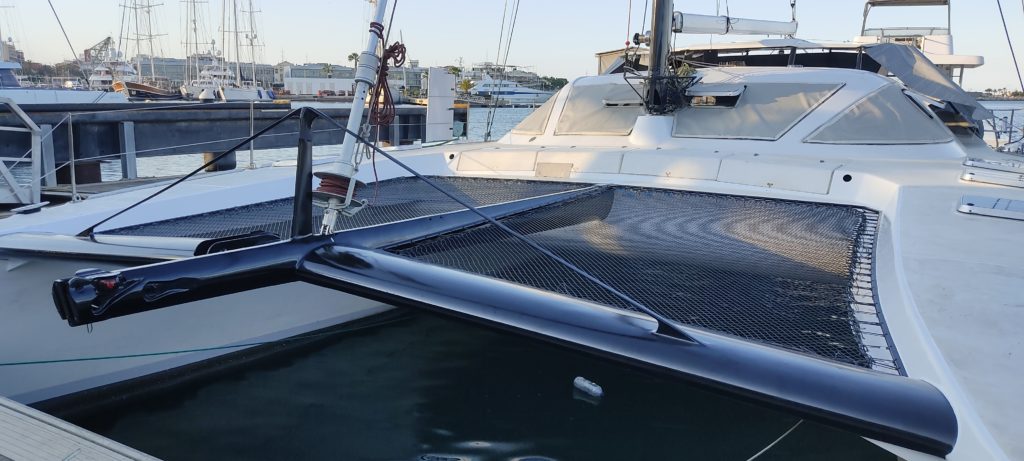
- New Carbon Fiber Front Beam and Longeron
- New carbon longeron and bow pole. Made using America’s Cup mast section. Bow pole extends a metre out from the boat and allows us the ability to fly a Code 0 and asymmetric mast head and fractional spinnakers. Replacing the original aluminum beam with a custom carbon fiber structure fabricated from salvaged America’s Cup mast sections. The beam inserts into the bows and is joined to the hull on both the inboard and outboard sides, fundamentally changing the load path and stiffening the entire front end. The result is a lighter, stronger system that provides dedicated attachment points for a modern sail inventory—unlocking new capabilities from storm sails to performance reaching sails.
- Engineering a Carbon Fiber Front Beam & Longeron from America’s Cup Masts
- Fitting placement for the inner forestay and storm sail.
- New Martingale & Seagull Striker
- The Seagull Striker and Martingale are a critical structural part of the forward beam on the vast majority of catamarans. They strengthen the front beam between the two bows and take the load from the forestay which is usually either attached to the beam or the longeron. In our case, we will make the forestay attachment on the longeron just behind the seagull striker. We also would like to improve our sailing range by adding an attachment for a storm sail. Carbon Seagul Striker was repurposed from a carbon spreader and we made the carbon Martingale strap using unidirectional carbon fiber.
- Reinforcing the Front Beam: Engineering a Carbon Fibre Martingale
- New Dynex Trampoline and Raised Placement of Netting
- Replacing sagging polyester netting with a Dyneema trampoline installed using separate lashings rather than continuous lacing. The material choice delivers UV stability, minimal stretch, and exceptional strength, while the lashing method provides redundancy—if one line fails, the rest remain secure. The result is a drum-tight, deck-like surface that has performed flawlessly through two oceans and years of tropical sun with virtually no degradation.
- Why We Chose Dyneema for Our Catamaran Trampoline
- Trampoline netting sourced from Netsystems
- Carbon Fibre Chainplates and new Bulkhead Inserts
- Replacing rotten bulkhead plywood and failing stainless steel chainplates with a monolithic carbon fibre structure. A minor leak evolved into a critical structural issue, requiring a complete engineering solution rather than more sealant. The result is an impervious, high-strength assembly engineered through precise templating, controlled wet-preg lamination, and vacuum bagging—eliminating the root cause and delivering quiet, confident strength under full sail.
- Engineering Superior Strength: How We Build Carbon Fiber Chainplates
- Composite Stanchion Sockets & Dyneema Lifelines
- Replacing the original hardware with custom composite sockets and high-tech lifelines. A successful upgrade to a critical safety system requires understanding not just how to build it, but why you choose specific materials and processes. The goal is a solution that is stronger, cleaner, and fails in a predictable, safe manner.
- Composite stanchion sockets with stainless steel stanchions build series.
- Composite Flush Fitting Hatches
- Replacing heavy, leaky, and snag-prone original hatches with custom, fully flush units. A successful redesign requires moving beyond off-the-shelf solutions to engineer a system that is lighter, structurally integral, and serviceable anywhere. The result is a hatch that is stronger, nearly half the weight, and built with custom 3D-printed hinges for lifelong repairability.
- Engineering Custom Composite Hatches: A Systematic Approach
- Anchor Upgrade – this took a lot of research but in the end the time spent was worthwhile. We love our Spade anchor. It enables us to anchor with quickly and gives us peace of mind.
Navigation and Instruments
- Weather Routing and daily forecast – Predict Wind.
- Click to join via our affiliate link.
- Navigation on Android tablet Navionics and PredictWind Offshore App
- Navigation on Laptop qtVlm
- Sailmon sailing display
- AIS – RaymarineAIS 500
- VHF – Garmin 100i
- Chartplotter – Raymarine E120W ,
- Autopilot – (We call him Steve) Raymarine multifunction display control unit Raymarine i70.
- Secondary autopilot – Raspberry Pi /arduino Pi pilot
- Iridium GO with external antenna
- Replacing a substandard off-the-shelf mounting solution with a custom fibreglass bracket. The original bracket lacked the durability and clean integration required for offshore reliability. Using a quick foam mould, a custom bracket was fabricated to securely hold the aerial while hiding cables neatly. The result is a robust, purpose-built mounting system that keeps essential satellite communication—weather routing, texts, and tracking—reliable in the marine environment.
- Making an IridiumGo aerial bracket
- Starlink maritime installation
Adding high-speed satellite internet to Paikea’s communications suite. Unlike the Iridium GO for text and weather, Starlink provides low-latency connectivity for real-time routing, video calls, and cloud-based navigation tools. The installation required [brief detail about mounting, power, or integration—add if you have a link or specific approach]. The result is a hybrid communications system that combines reliable offshore texting with high-bandwidth connectivity for near-shore and coastal passages.- Starlink for weather routing and all the other good stuff
- Anchor alarm – we use the Raymarine anchor alarm but also have Anchor Lite (free version installed on our Android mobile phones)
- Navily and Google Maps provide good information in addition to the above for places to anchor and resupply with gas, fuel and provisions.
- Secondary GPS 167 Channels USB GPS Receiver
Performance Tools
We use specialized performance software to analyze sail data, route efficiently, and track real-time vessel performance against theoretical polars
Live Polar Analyser / qtVlm
Real-time polar analysis and routing for passage planning and performance monitoring.
Excel & Project Libre Calc
Spreadsheet-based data analysis, project tracking, and refit planning.
Polar builder / OpenCPN
Custom polar diagram generation integrated with open-source navigation software.
Sail Performance Analysis & Design / Sailpack Vision
Advanced sail shape analysis and inventory optimization for offshore performance.
Design Tools
We rely on professional-grade design software to model, simulate, and refine every custom component before layup or fabrication.
XFLR5
Airfoil analysis and fluid dynamics for foil sections, rudders, and rig design.
NanoCAD
2D drafting for deck layouts, bulkhead patterns, and fabrication templates.
Solid Edge
3D CAD for structural components, hatch design, and precision part modeling.
MaxSurf
Naval architecture and hydrostatics for hull performance analysis.
3D Printer
3D printer carried onboard for manufacturing custom marine components. Prints carbon-filled nylon and PLA to create structural cores, replacement hardware, and precision mounting brackets.
Power
Our electrical system is built for offshore independence: enough solar to run refrigeration, electronics, and tools without a generator, backed by a robust lithium bank and full monitoring.
- Solar Array
1100 watts mounted on a frame overhanging the dinghy, with an additional 620 watts coming to the aft dodger. Total planned capacity: 1720 watts. - Battery Bank
LiFePO4: Lightweight, long cycle life, and high charge acceptance—ideal for performance cruising.- LiFePO4 | 360Ah at 24 volts = 8640 watt-hours of usable storage.
- Battery Management System
Protects the lithium bank with cell balancing, temperature monitoring, and automatic disconnect.
- Simarine PICO
Real-time battery monitoring with tank levels, power consumption tracking, and historical data.- Simarine PICO: Provides precise visibility into power usage across both 24V and 12V systems.
Water
- Water maker – Spectra watermaker.
- The Watermaker: Mounting our SPECTRA watermaker
- Water pump – Marco UP2/E
- Water filters – Purone
- 500 litre stainless steel water tank
- Hot water heater 50 litre Raretan
- Drain sumps Seaflo 750 GPH 12V 3.0A
- Bilge pumps Latin Aric Seaflo® Boot Port Electric 12V 1100 GPH Bilge Pump Lenz Pump, 104
Sail Inventory
- Main – Hydranet (spectra) 2 metre square top mainsail recut from mini maxi 72ft race boat delivery main. Squaretop Mainsail:Recycling a Superyacht Sail
- J1 (jib)- Carbon 3DI jib recut from mini maxi 72 ft race boat headsail
- Masthead asymmetric spinnaker aka Big A – recut from RC 44 spinnaker. The range in which we run this sail below is VERY weather dependent. In light airs we can go higher than in heavier winds.
- Wind range up to 10 kts true wind.
- TWA range approx 180 – 80 degrees
- AWA range approx 170 – 60 degrees
- Fractional asymmetric spinnaker – AKA Frankie recut from RC 44 spinnaker. The range in which we run this sail below is VERY weather dependent. In light airs we can go higher than in heavier winds.
- Wind range 10 – 25kts true
- TWA range approx 180 – 80 degrees
- AWA range approx 170 – 60 degrees
- Code 0 – recut from America’s Cup spinnaker staysail Code 0 Build: Recutting a spinnaker staysail into a Code 0
- Storm sail – Carbon 3DI jib recut from Carkeek 47
Deck Hardware
- KZ Marine 2t inshore furler. This KZ furler is Our First Choice for Furler. Contact Element Systems Mallorca for more information on their selection https://www.facebook.com/elementsystemsmallorca/
- Facnor halyard lock for inner forestay fitting
- Really handy Antal snap hook that we use for spinnaker and everything https://www.antal.it/ENG/hooks_en
- Dynex soft shackles used on bow, mainsheet system and other high load areas instead of metal shackles. Tylite soft shackles on halyards.
- Jib Furler Nemo. Maintaining Hardware: Servicing our Headstay Furler
- KZ Marine furler, Antal snap hooks, Dynex soft shackles.
Steering
- McGonaghy carbon fibre steering wheels x 2 which are actually modified ex- America’s Cup 2007 trim tab wheels
- Vetus hydraulic steering rams – original with the boat.
- New composite rudders with carbon fibre stock from C-tech New Zealand 1st gengeration made from taking a mould from an 2007 America’s Cup rudder and second generation rudders designed by Shayne.
Engines
- Volvo Penta 28 hp x 2 original with boat