
Why a Shower Floor Isn’t as Simple as It Looks
A shower floor sounds like the simplest thing on a boat to build. It isn’t — not once you account for a boat that never sits quite level.
The trim problem
A cruising catamaran doesn’t stay put transversely — she’s stable side to side, twin hulls seeing to that — but fore-and-aft trim is a different story entirely. Moving materials around during this refit — rolls of fibreglass, foam, gear shifted from aft cabins to forward ones — has shifted Paikea’s bow-to-stern trim by nearly 50 millimetres. That’s not a trivial number. Over a 12-metre boat length, 50mm of trim is enough to send water confidently toward one end of a flat shower floor or the other, regardless of where the drain actually sits.
The fix isn’t a flat floor with a single low point — it’s a floor with genuine fall built into two separate sections, meeting in a valley that channels water toward a sump regardless of which way the boat happens to be trimmed at the time. Get the fall wrong, and a shower floor becomes a shower floor that pools in the wrong corner — a problem serious enough on some cruising cats that trim itself becomes the workaround, deliberately loading weight into the bow just to keep water running the right way.
Access before aesthetics
Every section of floor on this boat carries a non-negotiable requirement: a hatch giving direct access to the hull shell underneath. Not for convenience — for the ability to inspect for damage or water ingress quickly, in an emergency, without having to tear anything apart first. That safety requirement drives the hatch size and placement more than anything else, and it’s the same reasoning already applied to the boat’s exterior deck hatches — matching gutter and drain principles, adapted for a wet interior space instead of open deck.
Why the pump doesn’t live under the hatch
The obvious plan — keep everything self-contained, put the sump pump directly under the main access hatch — turned out to be a bad idea in practice, discovered only by actually thinking through the failure mode rather than the success case. When a shower sump pump fails, the first sign is water pooling in the shower pan, often reaching several centimetres deep before anyone notices something’s wrong. If the pump sits under the same hatch used to access it, fixing the problem means opening that hatch — and opening a flooded hatch sends all that standing water straight into the bilge, turning a simple pump fix into a bigger cleanup than the original problem.
The solution: separate the pump into its own forward compartment entirely, away from the main shower hatch. Servicing it never requires opening a hatch that’s sitting under standing water.
Catching the hair before it becomes a problem
The single biggest cause of shower drain problems on any boat carrying more than one person is hair — plenty of it, inevitably. Rather than let that hair reach the pump and cause exactly the failure this whole design is trying to avoid, a stainless steel mesh grate sits as a first line of defence directly under a lightweight lid, positioned to catch debris before it ever reaches the plumbing.
That lid does double duty as a safety feature. Built from foam and glass, light enough to float, it’s designed to lift and drift free the moment the shower floods significantly — an immediate, impossible-to-miss visual signal that something’s wrong, without needing a sensor or an alarm to tell you. Once it’s floated clear, the mesh screen sits exposed and ready to be checked and cleared, addressing the most common cause of a flooded shower without ever requiring the main hatch to be opened.
A second pump strategy for a low-use space
Not every shower on the boat needs the same pump arrangement. For a shower that sees infrequent use, a sump-style pump setup makes more sense than the higher-capacity diaphragm pump used elsewhere — quieter in operation, and well suited to a space that isn’t working hard every day. It’s a genuine trade-off rather than a universal answer: the higher-capacity pump remains the right call for the shower in regular daily use.
Keeping the hatch removable without tools
One requirement Shayne set for himself early: the main access hatch needs to come off without needing a single tool. That constraint shaped the retention mechanism directly — the hatch has to hold firmly enough to stay sealed and in place through normal use and even flooding, without ever floating loose on its own, while still coming free instantly by hand when access is actually needed.
Wiring and plumbing, planned before they’re needed
With multiple systems — shower drain, toilet plumbing, and various wiring runs — all converging through the same bulkhead, getting the penetrations right meant working out exactly how many hoses and wires needed to pass through, in what shape, and at what size, before cutting anything. The goal: enough penetrations to run everything needed, without turning a structural bulkhead into Swiss cheese in the process. On a boat this deep into a refit, with systems congregating at natural pinch points like this one, planning those runs properly now avoids a much bigger headache later.
From cardboard to real geometry
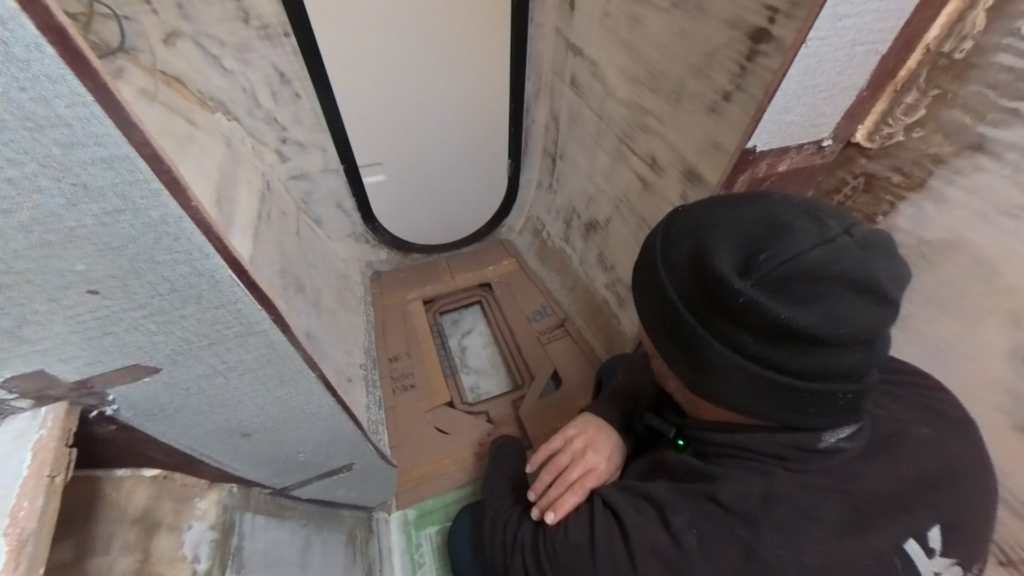
Every one of these decisions started as a rough cardboard mock-up before becoming a CAD model — not because cardboard is precise, but because it isn’t. Cardboard sags and settles in a way that mimics real material behaviour, giving an immediate physical sense of fall, fit, and scale that a screen never quite replicates. After two decades spent professionally modelling boats on a computer, the lesson learned the hard way is that nothing replaces physically mocking something up before committing it to a final design — the computer model refines what the cardboard already proved.
More on Floors and Hatch Design
Interested to see more on our approach to hatch design and build? Read Paikea’s Composite Hatches: The Full Story More on the story of creating and installing lightweight composite floors on our Paikea’s Refit page.
More on our floor rebuild in Paikea’s Floors: Replacing Timber with Structural Composite.