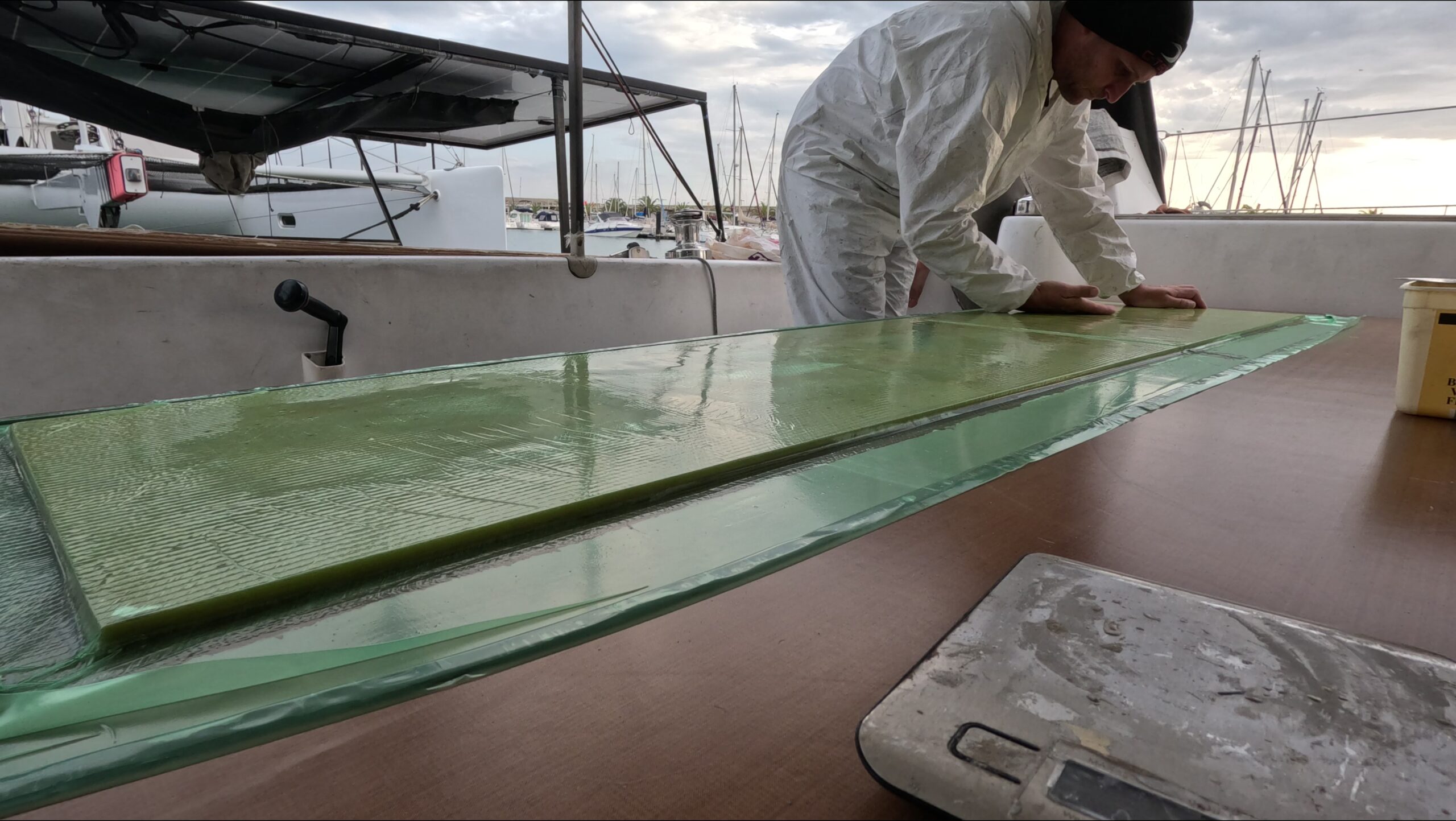
Working with Composites
Real boat repairs, real knowledge. This is the practical archive of composite work from our Catana 42 refit, Paikea. We’re peeling back the fiberglass to show you what goes into a proper boat refit—sharing the good, the bad, and the messy.
Our focus is on demystifying composite materials: the carbon fiber, fiberglass, and resins that make modern boats strong and light. Whether you’re a DIY builder, a fellow sailor, or just want to understand the structure beneath your feet, these project logs document our real-world methods.
Composite Projects on Paikea
A practical archive of composite applications from our refit. These posts cover everything from rudder construction to bulkhead reinforcement, providing a grounded reference for your own projects.
- Solving Boat Shower Drainage with Cardboard, CAD, 3D Scanning & 3D PrintingThe Hybrid Design Workflow: Building a Boat Shower Floor with Cardboard, CAD, and 3D Scanning: Walk through the hybrid design process for a custom boat shower floor. See how cardboard prototyping, CAD, 3D scanning, and… Read more: Solving Boat Shower Drainage with Cardboard, CAD, 3D Scanning & 3D Printing
- Hull Weight Reduction & Flush Hatch Installation: Paikea Refit UpdateKey Message: Significant weight reduction is not just about going faster; it’s about returning a performance multihull to its designed potential, which requires a systematic, professional approach to refitting. Author: Anna and Shayne Introduction This refit update… Read more: Hull Weight Reduction & Flush Hatch Installation: Paikea Refit Update
- Professional Hatch Installation: Solving Leaks with Precision EngineeringKey Message: This post documents two distinct professional upgrades on our Catana 42 refit: the precise installation of custom composite deck hatches and the full conversion of leaky portlights to watertight, outward-opening hatches. The first… Read more: Professional Hatch Installation: Solving Leaks with Precision Engineering
- Building Composite Hatches Using 3D Printed MoldsKey Message: Precise, Accessible Fabrication with 3D Printed ToolingBuilding custom composite hatches requires tooling that can accurately capture complex geometry. This project demonstrates a practical approach: using 3D printed molds for both the hatch lid… Read more: Building Composite Hatches Using 3D Printed Molds
- Engineering Custom Composite Hatches: A Systematic ApproachTopic: A detailed breakdown of the design and engineering process for creating custom composite deck hatches, covering problem analysis, material selection, structural integration, and the use of 3D printing for prototyping and manufacturing. Author: Shayne and Anna… Read more: Engineering Custom Composite Hatches: A Systematic Approach
- Building Lightweight Composite Shelves for Our CatamaranSolving the Boat Storage Puzzle: Strong, Custom & Lightweight Shelves One of the eternal challenges of living on a boat is creating functional storage without adding unnecessary weight. Every kilogram counts, and every millimeter of… Read more: Building Lightweight Composite Shelves for Our Catamaran
- Composites the Hard Way: Fixing a Vacuum Infusion ImplosionAuthor: Shayne and Anna Key Message: A dramatic vacuum infusion implosion taught us that in composite boat building, true expertise isn’t about avoiding failure—it’s about mastering the art of the recovery. By diagnosing the precise physics of… Read more: Composites the Hard Way: Fixing a Vacuum Infusion Implosion
- Laminating Stanchion Sockets & The Truth About Peel PlyKey Message: A successful composite lamination is defined by understanding the loads, mastering the process, and knowing the hidden details—like why you must always sand a peel ply surface before secondary bonding. Author: Shayne and Anna… Read more: Laminating Stanchion Sockets & The Truth About Peel Ply
- From Scrap Foam to Flying: Building a Custom Pump Foil BoardKey Message: Even with professional knowledge, hands-on projects are a process of problem-solving. The goal is a functional, lightweight part, and sometimes that means making—and fixing—mistakes along the way. Author: Anna & Olly Introduction This project… Read more: From Scrap Foam to Flying: Building a Custom Pump Foil Board
- Engineering Lighter, Smarter: Why We’re Replacing Paikea’s Wooden Doors with CompositesBeyond the Slam: Engineering Composite Doors for a Performance Catamaran Author: Shayne & Anna Key Message: The choice of material is never about what’s “best,” but what is most fit for purpose. For our performance refit,… Read more: Engineering Lighter, Smarter: Why We’re Replacing Paikea’s Wooden Doors with Composites
- Engineering a Lightweight Door: The Value of 350 GramsTopics: A detailed look at the design and fabrication of a structurally efficient composite door, highlighting the techniques for managing complex geometry and the performance philosophy that values incremental weight savings. Author: Shayne & Anna In the… Read more: Engineering a Lightweight Door: The Value of 350 Grams
- Re-Engineering a Structural Bulkhead | Cutting a Doorway Adjacent to a Carbon ChainplateAuthor: Shayne and Anna Key Message: Major structural changes require professional composite engineering expertise. This project demonstrates what is possible but should not be attempted without a deep understanding of load paths and advanced laminating techniques. Introduction… Read more: Re-Engineering a Structural Bulkhead | Cutting a Doorway Adjacent to a Carbon Chainplate
- Making Composite Stanchion Sockets: An Engineering Approach to Safety & AestheticsKey Message: A successful upgrade to a critical safety system requires understanding not just how to build it, but why you choose specific materials and processes. The goal is a solution that is stronger, cleaner, and fails in… Read more: Making Composite Stanchion Sockets: An Engineering Approach to Safety & Aesthetics
- Staunchion Sockets: A Masterclass in Material Selection and Failure ModesKey Message: Choosing materials isn’t about what’s “strongest,” but about how they handle loads and, just as importantly, how they fail. A pultruded carbon spiggot might seem high-tech, but its failure mode makes it a dangerously… Read more: Staunchion Sockets: A Masterclass in Material Selection and Failure Modes
- Hand Lamination vs. Vacuum Infusion: A Practical Weight & Quality ComparisonHand Lamination vs. Vacuum Infusion: The Real-World Trade-Offs Author: Shayne Key Message: The choice between hand lamination and vacuum infusion isn’t about which is “better,” but what you need from the finished part. For weight-critical applications… Read more: Hand Lamination vs. Vacuum Infusion: A Practical Weight & Quality Comparison
- Engineering a Crash Box: Protecting Paikea from a Daggerboard FailureEngineering a Crash Box: Proactive Safety for a Daggerboard Strike Author: Shayne Key Message: True safety in yacht design isn’t just about strong parts; it’s about planning for failure. A watertight crash box is a passive… Read more: Engineering a Crash Box: Protecting Paikea from a Daggerboard Failure
- Re-Engineering a Hull: Load Paths, Daggerboards, and a New Structural BulkheadAuthor: Shayne and Anna Key Message: The most important part of a structural refit is understanding and optimizing load paths. By relocating a bulkhead to align with the strongest part of the daggerboard foil, we significantly… Read more: Re-Engineering a Hull: Load Paths, Daggerboards, and a New Structural Bulkhead
- Refit Progress: Templating, Infusing, and Building a New Laminating TableKey Message: A major refit is a series of small, repetitive, and precise steps. By creating a family “assembly line” for templating and infusion, we’re efficiently producing lightweight, custom composite floors while constantly improving our workshop… Read more: Refit Progress: Templating, Infusing, and Building a New Laminating Table
- Mid-Refit Update: The Floor Replacement Hits HalfwayKey Message: Replacing an entire boat’s interior is a marathon, not a sprint. Hitting the halfway mark is a huge morale boost, proving the system works and the weight-saving benefits are real and tangible. Author: Anna… Read more: Mid-Refit Update: The Floor Replacement Hits Halfway
- Modifying Boat Bulkheads: The Engineering Behind Increasing HeadroomTopic Overview: This post details the process and engineering rationale behind cutting down a structural bulkhead to improve livability. We explain the load path disruption, the calculations for reinforcement, and the practical execution using unidirectional carbon… Read more: Modifying Boat Bulkheads: The Engineering Behind Increasing Headroom
- Salvaging a Failed Vacuum Infusion: How We Saved Our Boat FloorAuthor: Shayne and Anna Key Topic: A successful project isn’t defined by a perfect process, but by the ability to adapt and salvage the result when things go wrong. Our cabin floor infusion, threatened by cold… Read more: Salvaging a Failed Vacuum Infusion: How We Saved Our Boat Floor
- Bulkhead Reinforcement: Unidirectional Fibreglass and Edge CappingRestoring structural integrity and finishing a cut composite panel. Author: Shayne Key Message: Cutting into a cored panel necessitates a two-stage process to restore its structural integrity: first, reintroducing in-plane stiffness and strength along the cut edge… Read more: Bulkhead Reinforcement: Unidirectional Fibreglass and Edge Capping
- Weight, Performance, and Payload: The Logic Behind Our Catamaran RefitTopics: An engineering analysis of weight reduction in a catamaran refit, covering the strategic goals of increasing payload capacity and the critical considerations of balance, center of gravity, and structural integrity. Author: Shayne & Anna The systematic… Read more: Weight, Performance, and Payload: The Logic Behind Our Catamaran Refit
- Custom Cabin Floor: An Advanced Vinyl Ester InfusionTopic: A look at the meticulous process of vacuum infusing a custom cabin floor, highlighting the switch to a low-viscosity vinyl ester resin and the advanced “envelope bagging” technique that ensures a perfect, void-free laminate. Author: Shayne… Read more: Custom Cabin Floor: An Advanced Vinyl Ester Infusion
- The Engineering Behind a Structural Bulkhead Return FlangeAuthor: Shayne and Anna Topic Overview: This post breaks down a key composite engineering technique from our Paikea refit: the design and lamination of a structural bulkhead with an integral return flange. We’ll explain why this method… Read more: The Engineering Behind a Structural Bulkhead Return Flange
- Structural Cabinetry: The Engineering Behind Lightweight Boat FurnitureAuthor: Shayne and Anna Topic Overview: This post details the design and fabrication of non-structural cabinetry that serves a critical structural purpose. We’ll cover the philosophy of strategic stiffening, the vacuum bagging process, and a key technical… Read more: Structural Cabinetry: The Engineering Behind Lightweight Boat Furniture
- The Right Way to Laminate a Penetration in a Composite StructureAuthor: Shayne and Anna Topic Overview: This post details the professional method for creating a strong, watertight penetration in a fiberglass hull or bulkhead. We cover the laminate rule of thumb, the step-by-step laminating technique using a… Read more: The Right Way to Laminate a Penetration in a Composite Structure
- The Correct Way to Put a Hole in a Structural BulkheadTopic Overview: This post explains the structural engineering behind making penetrations in boat bulkheads. We’ll dissect why failures happen, using real-world examples, and detail a three-part reinforcement strategy to create a strong, reliable opening that maintains… Read more: The Correct Way to Put a Hole in a Structural Bulkhead
- Vacuum Bagging with Polyester Resin: A Practical Guide to Avoiding the PitfallsTopic Overview: This post details the specialized techniques required for successfully vacuum bagging components with polyester resin. We’ll cover fabric preparation, precise resin mixing, bagging strategies for complex shapes, and the crucial steps to prevent volatile… Read more: Vacuum Bagging with Polyester Resin: A Practical Guide to Avoiding the Pitfalls
- Resilience & Routine: Working Through Valencia’s Historic FloodsTopic Overview: This post contrasts the dramatic impact of the DANA storm that flooded Valencia with the relentless, detailed work of a boat refit. We cover the importance of adapting to extreme weather, showcase ongoing projects… Read more: Resilience & Routine: Working Through Valencia’s Historic Floods
- Composite Door Installation, Flow Coat Application, and Steering System AnalysisAuthor: Shayne and Anna Topic: This post details the ongoing refit of the starboard stateroom, focusing on the practical installation of a composite door and the application of flow coat as a substrate for insulation. It provides… Read more: Composite Door Installation, Flow Coat Application, and Steering System Analysis
- Project Flow: From America’s Cup to Mini Maxi Refits & GunboatsAuthor: Shayne and Anna Key Topic: In the natural flow of professional marine work, we’ve transitioned from an America’s Cup campaign to a mini maxi refit and Gunboat management, while continuously balancing client projects with life… Read more: Project Flow: From America’s Cup to Mini Maxi Refits & Gunboats
- Project Initiation: Structural Review and Weight Reduction Strategy for Catana 42 RefitAuthor: Anna and Shayne Key Topic: This blog post provides a technical breakdown of the initial stages of the Paikea refit, detailing the engineering rationale behind the full interior strip-out for weight optimization and the systematic approach… Read more: Project Initiation: Structural Review and Weight Reduction Strategy for Catana 42 Refit
- Managing Multiple Refit Projects: Chainplates, Windows, and RiggingKey Message: Coordinated Project ExecutionPreparing a boat for an ocean crossing often involves a final push to complete a list of outstanding projects. For us, this meant simultaneously executing three key tasks: installing the second… Read more: Managing Multiple Refit Projects: Chainplates, Windows, and Rigging
- Carbon vs. Fiberglass – Building for Performance and ReliabilityWhen it comes to building or upgrading a cruising boat, the question of materials is never simple. Should everything be carbon fiber? Is fiberglass “good enough”? Recently, we sat down with Shane in the engine… Read more: Carbon vs. Fiberglass – Building for Performance and Reliability
- Rudder Evolution: Shaping the Ultimate FoilWe lost our rudder over a year ago during our Atlantic Crossing from The Canary Islands to St Lucia in the Caribbean. The rudder made a rather sneaky exit and at the time there was… Read more: Rudder Evolution: Shaping the Ultimate Foil
- Engineering Paikea’s Rig: Adapting America’s Cup Technology for CruisingKey Message: The successful adaptation of an America’s Cup mast for cruising proves that high-performance engineering and practical, safe operation are not mutually exclusive. Every decision—from the rotating system and custom spanner to the choice of… Read more: Engineering Paikea’s Rig: Adapting America’s Cup Technology for Cruising
- The Engineering Behind Our Bulletproof Composite ChainplatesAuthor: Shayne and Anna Key Topic: Replacing our catamaran’s rotten, failing chainplates became an exercise in advanced composite engineering. By moving from a traditional bolted stainless steel strap to a fully integrated carbon fiber chainplate laminated… Read more: The Engineering Behind Our Bulletproof Composite Chainplates
- Engineering Superior Strength: How We Build Carbon Fiber ChainplatesKey Message Paragraph: When a key component requires replacement, the opportunity exists to build something better than the original. We showcase our professional composite expertise by designing and fabricating a set of custom carbon fiber… Read more: Engineering Superior Strength: How We Build Carbon Fiber Chainplates
- How to Bolt into Carbon Fibre: Threaded Inserts vs. HelicoilsKey Message: Mounting hardware to a carbon fibre structure requires a method that ensures both ultimate strength and long-term serviceability. For our Spectra watermaker installation, this meant bonding custom carbon plates to the bulkhead and using… Read more: How to Bolt into Carbon Fibre: Threaded Inserts vs. Helicoils
- Carbon Fiber vs. Aluminum Beam: A Catamaran Structural UpgradeTopic: We replaced our Catamaran 42’s original aluminum front beam with a custom carbon fiber beam and longeron. This wasn’t just a simple material swap; it was a complete structural redesign. In this deep dive,… Read more: Carbon Fiber vs. Aluminum Beam: A Catamaran Structural Upgrade
- Repairing and Sailing a Traditional Vela LatinaA unique opportunity for Shayne to join in a local Vela Latina yacht race in the Mar Menor, Spain. The Vela Latina is an elegant and ancient design. It appears in the 9th century of… Read more: Repairing and Sailing a Traditional Vela Latina
- From America’s Cup to Our Catamaran: Rescuing a Carbon LegendAuthor: Shayne and Anna Key Message: The centerpiece of our rig is a mast with a legendary past: Rig #12 from Team New Zealand’s 2000 America’s Cup campaign. Rescued from a Valencia scrapyard where it was destined to… Read more: From America’s Cup to Our Catamaran: Rescuing a Carbon Legend
- Designing a stowable anchoring system for our cruising catamaranIf you have been following us on YT you will have seen our upgrades so far. One of the most major structural modifications has been replacing the front beam arrangement with a carbon fibre longeron… Read more: Designing a stowable anchoring system for our cruising catamaran
- Inside Carbon Race Boats: The Engineering Secrets Production Builders Should UseAuthor: Shayne and Anna Key Topic: This exclusive look inside high-performance carbon race boats reveals that their true advantage isn’t just speed—it’s smarter engineering. By moving beyond traditional plywood and hidden liners to exposed, carefully engineered… Read more: Inside Carbon Race Boats: The Engineering Secrets Production Builders Should Use
- Carbon Fiber Anchor Roller & Stealth Nav Lights – Finishing Paikea’s Front EndKey Message: With the major structural work complete, we’re adding the final functional details to Paikea’s new carbon front end. This post covers the fabrication of a custom carbon fiber anchor roller, the installation of stealth navigation lights hidden within our… Read more: Carbon Fiber Anchor Roller & Stealth Nav Lights – Finishing Paikea’s Front End
- Wet Laminate vs. Prepreg: Choosing the Right Carbon Fibre MethodTOPIC: This post provides a clear comparison between wet laminate and prepreg composite methods. It explains the critical differences in resin systems, curing requirements, working time, and material handling, offering practical insights for boat builders… Read more: Wet Laminate vs. Prepreg: Choosing the Right Carbon Fibre Method
- Why Peel Ply is a Critical Step in Composite LaminationWhy Peel Ply is Non-Negotiable in Composite Construction Author: Shayne and Anna Key Topic: Peel ply is a fundamental processing aid in professional composite work, not an optional extra. This sacrificial layer, removed after cure,… Read more: Why Peel Ply is a Critical Step in Composite Lamination
- The Pre-Splash Push: Integrating Engine Work, Composite Rudder Mods, and Custom FairingsKey Topic: Facing a firm launch deadline, we executed a coordinated final push on our catamaran’s critical systems. This involved servicing the saildrives, preparing new rudders for future winglets by installing a carbon rod backbone,… Read more: The Pre-Splash Push: Integrating Engine Work, Composite Rudder Mods, and Custom Fairings
- Beyond Flat Panels: Vacuum Bagging a Complex Carbon Fiber Beam-to-Hull JointTopic: Successfully vacuum bagging a structural joint is the true test of composite skill. This guide details the advanced techniques for consolidating a carbon fiber laminate on a complex, multi-dimensional beam-to-hull connection. We break down… Read more: Beyond Flat Panels: Vacuum Bagging a Complex Carbon Fiber Beam-to-Hull Joint
- Installing the Carbon Fibre Martingale: Precision Fitting & Engineering NuancesAuthor: Shayne & Anna TOPICS:This post details the final installation of a critical structural component on our Catana 42. It covers the transition from 3D CAD model to physical fitting, the use of specialist adhesives for… Read more: Installing the Carbon Fibre Martingale: Precision Fitting & Engineering Nuances
- Building Rudders Designed for Wings: An America’s Cup Inspired ProjectLeveraging professional-grade components and techniques to fabricate high-performance rudders on a cruiser’s budget. Key Message: True innovation in a refit often comes from creatively repurposing existing high-performance technology and combining it with meticulous, professional fabrication techniques.… Read more: Building Rudders Designed for Wings: An America’s Cup Inspired Project
- Major Hull Surgery: Transom Modifications, Fairing, and Sourcing an America’s Cup RudderExecuting multiple complex hull projects with a focus on structural integrity and performance gains. Author: Shayne & Anna Key Message: A systematic, professional approach allows multiple major refit projects to be run in parallel, turning a daunting… Read more: Major Hull Surgery: Transom Modifications, Fairing, and Sourcing an America’s Cup Rudder
- Engineering a Carbon Fiber Front Beam & Longeron from America’s Cup MastsKey Message: By repurposing high-modulus carbon fiber from America’s Cup masts, we engineered a custom front-end system that is lighter, stronger, and far more functional than the original, unlocking new sail options and improving overall performance.… Read more: Engineering a Carbon Fiber Front Beam & Longeron from America’s Cup Masts
- Hull Surgery: Uncovering the Truth Behind a Major Rudder ImpactKey Message: A proper repair requires understanding the original failure. By grinding back a poor previous fix, we uncovered the full story of a major grounding and executed a permanent, structural solution that also informs our… Read more: Hull Surgery: Uncovering the Truth Behind a Major Rudder Impact
- Engineering a Flush Fit: Recessing Skin Fittings for Less Drag & Better FlowKey Message: On a performance vessel, every protrusion below the waterline creates drag and turbulence. By recessing standard dome skin fittings flush with the hull, we significantly reduce hydrodynamic resistance and, critically, provide cleaner water flow… Read more: Engineering a Flush Fit: Recessing Skin Fittings for Less Drag & Better Flow
Technical Articles & References
For downloadable technical papers, engineering standards, CAD software references, and rig tuning specifications, visit the Composite Engineering Tools.
The composites supplier for most of our interior upgrades is Easy Composites. For the complete project log of Paikea’s transformation—including interior upgrades, structural modifications, and systems—visit Paikea’s Refit Log
Ready to Go Further?
Our Members’ Hub unlocks access to detailed video tutorials, downloadable files (like 3D print files for our Composite Stanchion Socket Drain), and direct access to our community forum to share ideas with like-minded sailors and composite enthusiasts.