
Helping Out on a Vela Latina
Some jobs start with “can you come help me for an hour” and turn into a full lamination masterclass.
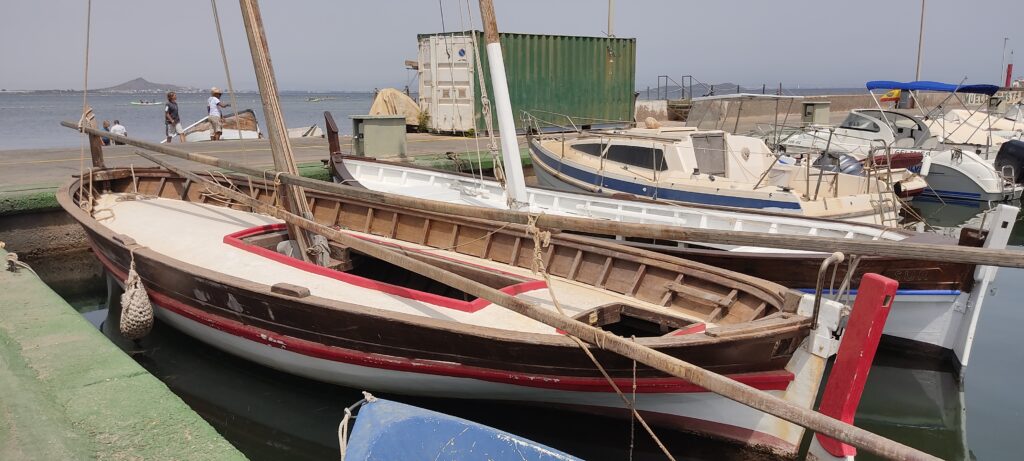
Our friend Miguel’s Vela Latina — a traditional lateen-rigged wooden boat — had sunk three times. Not from any one dramatic failure, but from fiberglassing that was never quite good enough to begin with. Small holes scattered through the laminate, invisible until you got close, each one a slow leak waiting to happen. Between us, we set out to actually seal the hull properly so it would stop happening a fourth time.
Working with what you’ve actually got, not what you’d choose
This wasn’t a controlled shop environment with the right materials on hand. It was old, splined timber — copper nail holes, glue gaps where the splines hadn’t seated deep enough, cracks, hard corners everywhere a laminate has to transition cleanly. No masking tape to protect the remaining paintwork. No consolidating roller. Chop strand mat instead of the multi-axial fabrics we’d normally reach for, and polyester resin on timber, which isn’t usually the first choice — cure on timber with polyester tends to be incomplete compared to what you’d get on a proper substrate. None of it was ideal. All of it was what was actually available, and the job still needed doing.
The fix for the rough, lumpy substrate was the same trick that works everywhere else: mix resin with microspheres to a honey-like consistency and backfill every hole, crack, and hard edge before laminating over the top. It’s the difference between fighting a laminate over lumps and bridges the whole way through, and giving it a smooth, faired surface that actually wants to bond.
Chop strand isn’t multi-axial, and that changes everything
Worth understanding if you’re using chop strand mat: it behaves completely differently to the woven and stitched fabrics used in structural composite work. Chop strand runs 60 to 70 percent resin to 30 to 40 percent fibre — nearly the reverse of a multi-axial layup, where the fibre does the structural work and the resin is mainly there to bind it together. That’s exactly why chop strand ends up heavier and less strong for the same thickness — it’s mostly resin holding a modest amount of reinforcing fibre in place, not fibre carrying the load with resin as a supporting act.
Technique differs too. Tearing the edge of a piece of chop strand rather than cutting it clean gives you a soft, furry edge that blends into the next section far better than a hard-cut edge would — a small detail, but it’s the kind of thing that separates a rushed patch job from one that actually holds. And a mohair roller, rather than foam or a thick-nap roller, handles polyester resin better and does a genuinely better job bursting air bubbles out of the laminate rather than just moving resin around and creating new ones.
Race against the clock, sailed the same day
Materials ran out mid-job — Miguel’s blue antifoul ran dry partway through, finished off with whatever grey was on hand. Laminated in the morning, painted at lunchtime, and out sailing that same afternoon. Not the recommended cure schedule by any stretch, but it got the boat back on the water, and sometimes that’s exactly what the moment calls for.
In the Library
To learn more about how to work with fiberglass, carbon or understand how infusion works, visit our Working with Composites page.