
The Truth About Self-Tacking Jibs: Design & Compromises
Ten different ways to build a self-tacking jib system, and every single one of them is a compromise. The question isn’t which system is best — it’s which compromises you’re willing to live with.
This particular Gunboat 66 runs a track-and-car arrangement worth breaking down properly, because it illustrates almost every trade-off that shows up across the full range of self-tacking systems — from race dinghies through to the biggest performance multihulls.
Curved track versus straight track
The single biggest design decision in any self-tacking system is whether the track curves or runs straight. A curved track keeps the jib sheeting angle roughly consistent as the car travels from centreline out to its widest point — critical, because that sheeting angle controls how flat or full the sail sits, and how much twist runs through the leech.
A straight track is cheaper, easier to source, and easier to install. It’s also structurally wrong for the job. As the car moves outboard on a straight track, the sheeting angle flattens progressively — exactly backwards from what’s actually wanted. Reaching and running downwind call for a fuller sail, not a flatter one. A straight track gives you the opposite of what each point of sail actually needs, which is why boats stuck with straight tracks end up compensating constantly with barber haulers and tweakers just to claw back the shape a curved track would have delivered automatically.
Even the type of curve matters. Some tracks run a constant curve throughout. Others flatten in the middle and increase curvature toward the ends — a detail carried over from dinghy racing, where flattening the middle eases sheet tension automatically as the car passes through centre on a tack, smoothing out the transition rather than snapping the sheet in stepwise.

SHORT: Jib Track Orientation: Why Angle Matters — Curvature isn’t only about sheeting angle. A flat, uncurved track also creates uneven load on the jib car’s bearings as it travels — a wear point most sailors never think about until the car starts binding.
Sheeting angle isn’t the only thing the track and car geometry controls. Where the jib sheet actually attaches on the clew matters just as much — and that’s a separate adjustment from the track itself.
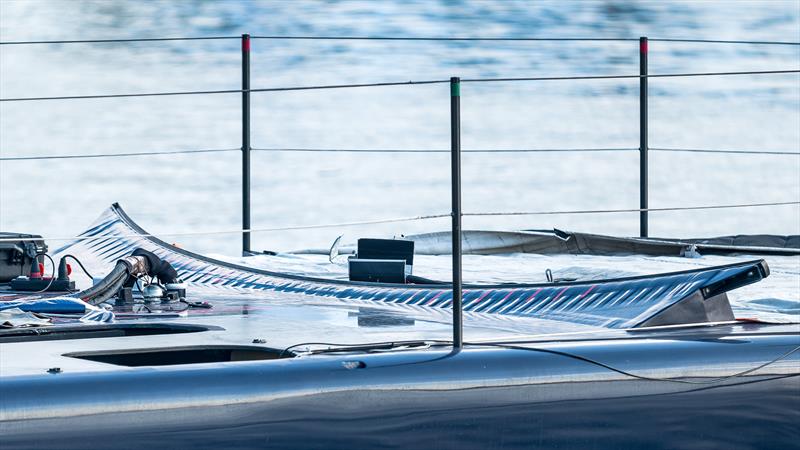

SHORT: The Block, The Clue Board, and the Jib’s Center of Effort — The clew board’s multiple hole positions exist so the jib sheet’s lead angle can be tuned to run through the sail’s actual center of effort. Move it to the wrong hole and the sheet ends up pulling the foot flat or letting the leech twist open, regardless of how good the track curve is doing its job elsewhere.The clew board’s multiple hole positions exist so the jib sheet’s lead angle can be tuned to run through the sail’s actual center of effort. Move it to the wrong hole and the sheet ends up pulling the foot flat or letting the leech twist open, regardless of how good the track curve is doing its job elsewhere.
The outhaul problem, and why it exists
On this boat, letting the car go doesn’t send it outboard under wind pressure the way the theory suggests it should — it creeps back inboard instead, and does it hard enough that hauling it back out by hand takes real, sustained load. That’s not a fault. It’s a direct consequence of where the jib sheet exits the boat.
On high-performance dinghies, AC-class boats, and skiffs, the jib sheet routes down and under the deck, staying close to the sail’s natural rotation point up at the tack. That geometry means the sail’s own moment pulls the car outboard easily. On this boat, the sheet instead runs aft to a point on the centreline, behind the clew of the sail rather than ahead of it — a deliberate choice that keeps another rope off the trampoline and out of the way underfoot, at the direct cost of that same aft sheeting angle actively working to haul the car back inboard under load. Clean deck, more force needed at the winch. That’s the trade being made.
Why the jib sheet gets too short mid-tack
There’s a second, subtler problem tied to where the sheet exits — this time out of the front of the mast rather than the linger-on further forward. As the car travels outboard on the curved track, the sail simultaneously rotates around the forestay and the clew lifts slightly higher off the deck. Combined, that means the jib sheet effectively runs out of length exactly when the car needs to keep moving outboard. The result: in light air, pulling the jib sheet on can actually drag the car back inboard, because there simply isn’t enough sheet length to let it sit where it should. In a genuinely full self-tacking system — the kind found on AC boats and top-tier skiffs — the track curves not just fore-and-aft, but up and down as well, keeping the car’s effective distance from the sheet exit constant through the whole range of motion. That upward curvature is expensive and complex to build, so it’s usually the first thing sacrificed as a system moves from full race spec toward something practical for a cruising or delivery boat.
Why this boat carries so many cars
The multiple parallel cars on each side aren’t excess — they exist specifically to run a staysail and a J1 simultaneously without re-rigging the whole sheeting system between them. Offshore, a boat might hold a single tack for a full day, sometimes a week. Being able to swap between a self-tacking staysail and a sheeted J1, or run both at once during a sail change, without ever going bare-headed, is worth the extra hardware. A similar problem on a different Gunboat got solved differently — a custom single-pin stopper car with a built-in friction ring, giving up some of this system’s fine trim adjustability in exchange for more usable scope along the track.
The system to avoid entirely
Worth naming directly: a mainsheet-style arrangement, where the jib sheet runs through a block partway along, then back up to the sail, then back down again, is not recommended for a serious performance setup unless there’s genuinely no other option. That configuration stacks two separate sources of friction — the car’s own bearings, plus every block the sheet has to run through — against the sail’s ability to self-tack cleanly. A well-designed system has only one source of friction to overcome: the car itself. Every extra pulley in the chain is one more thing fighting against the sail doing its job automatically.
The real lesson
None of this is really about right and wrong hardware. It’s about understanding exactly what each design choice costs you before you commit to it — a clean deck versus outhaul load, ease of installation versus correct sheeting geometry, adjustability versus friction. A self-tacking jib looks simple from the cockpit. Getting one to behave the way it’s supposed to is a genuinely deep design problem, and every boat carrying one has made a specific, deliberate set of trade-offs to get there — whether the owner realizes it or not.
In the Library
Paikea’s own jib setup takes a different approach entirely — no traveller, so trim relies on different tools altogether. That contrast is covered in How to Trim the Jib Upwind on a Catamaran. For more on catamaran performance and rig setup, the Performance Sailing Hub is the place to start.