Paikea’s Rudders: The Full Story
Most sailors never think about their rudders until something goes wrong. On Paikea, a lot went wrong — and working through it, across four years and three continents, gave us more real-world data on rudder design than we could have planned for.
This page documents the full story in sequence: buying a boat with a hidden grounding history, losing a rudder 800 miles from land in the middle of the Atlantic, building a replacement by hand at anchor in the Caribbean, and working steadily toward a proper set of rudders designed from scratch by Shayne. Every video, in order, with enough context to make sense of each decision.
The Beginning: A Boat With Secrets
When we bought Paikea in 2018, she had one proper rudder and one temporary blade standing in for the other. The previous owner had a vague story about how that happened. When we started work on the transoms, the actual story became clear: the boat had run aground at some point, lost the original starboard rudder, and been patched up with whatever was available. There was damage around the rudder apertures on both hulls.
We replaced both blades using the AC moulds and inspected both stocks. They both appeared to be solid stainless — a reasonable assumption given the temporary starboard stock had been solid. We had no reason to suspect otherwise.
The First Fix: America’s Cup Moulds (2021)
During the Valencia refit in 2020–21, we had the chance to do something about the rudders. We sourced a pair of actual 2007 America’s Cup rudder blades and took splashes directly off them to make our moulds — a fast, practical way to get a known high-performance foil geometry onto the boat quickly.
It was always a stopgap. Shayne had his own ideas about what the right rudders for Paikea should look like, and the AC profile wasn’t it. But the AC moulds were available, the geometry was solid, and we needed to get sailing. The plan was always to build the right rudders later.
Because Paikea was sitting on a low cradle with insufficient clearance to pull the stocks, we couldn’t replace them either. Both new blades went onto the existing stocks. What we didn’t know was that the port stock — the original — was hollow. From the outside it was indistinguishable from the solid one.
Transom Extension, Saildrive Housing, and an America’s Cup Rudders The full transom work, hull repairs, and the first composite rudder coming together.
Rudder Upgrades — Making Moulds from 2007 America’s Cup Rudders Where the AC rudder moulds came from and how we used them.
The Atlantic: What We Didn’t Know About the Port Rudder
In August 2022, crossing from the Canary Islands to St Lucia, the port rudder failed. It wasn’t dramatic at first — no obvious bang, just Paikea starting to feel unbalanced and the autopilot working harder than it should to hold a straight course. Anyone who has sailed a catamaran offshore knows there are plenty of unexplained bangs along the way. This one didn’t announce itself.
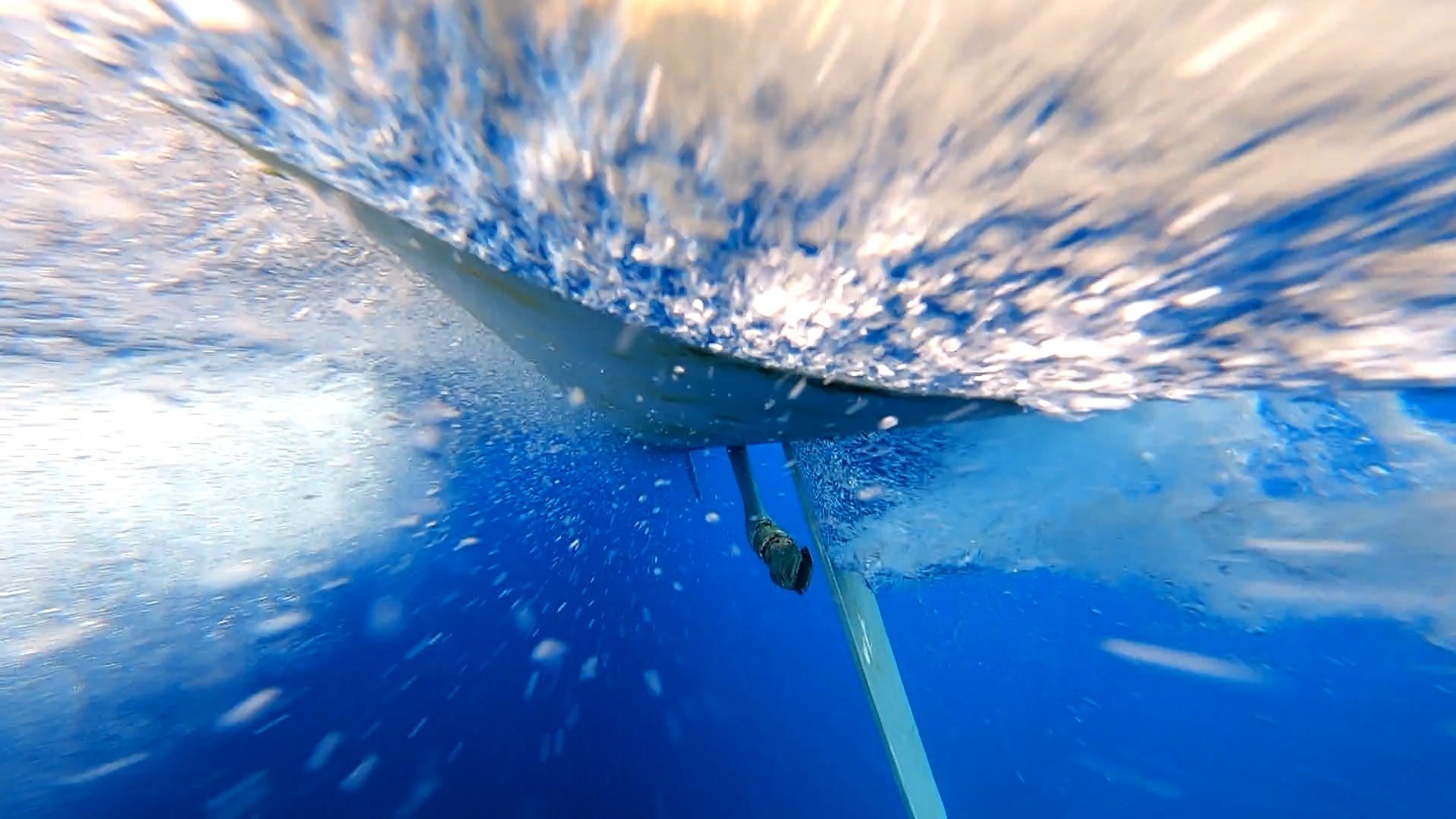
We slowed down and put a GoPro underwater. Our port rudder was not there! The port rudder stock had snapped off flush with the hull. We were 800 miles from land with one working rudder.
After some time working out the best sail configuration to balance the boat and maintain enough speed to steer effectively, we settled back into crossing the Atlantic.
Losing a Rudder 800nm from Land What happened, what the conditions were, and how we kept sailing.
Crossing the Atlantic on a Cat with Only One Rudder Sail trim and configuration for downwind sailing after the failure.
We Lost a Rudder in the Middle of the Atlantic The full debrief. The complete 18-day crossing, the failure, the seamanship, the lessons.
Sailing a Catamaran with Only One Rudder Boat handling in a compromised state.
The Aftermath: Antigua and the Hull Inspection
Once in St Lucia, the first job was to get underwater and understand what the failure had done to the hull. The second was to find another rudder — any rudder.
Did Losing a Rudder Damage Our Hulls? Hull inspection, what we found, and what it told us about the original failure.
Rudder Hunt — Sailing a One-Rudder Catamaran to Scavenge Hurricane Wrecks The scavenging mission through Antigua. We didn’t find what we needed — which pushed us toward building our own.
The Caribbean Build: Composite Work at Anchor
We couldn’t wait. Shayne had been offered a position as rigger for the French America’s Cup team, which meant we needed to cross back to Barcelona on a deadline. We needed a working rudder.
Shayne designed a new carbon rudder stock and had it built by C-Tech in New Zealand, shipped to us via Janes Yacht Services in Antigua. We sourced the foam for the blade from Wind in Martinique. The epoxy and fibreglass we already had on board. The rudder blade was hand-shaped by Shayne on the boat, at anchor — laminated, faired, painted, and installed in the water. It is not an easy way to do quality composite work.
We only built one. The starboard blade from the Valencia build was still sound. We got Paikea sailing again and headed back across the Atlantic.
Paikea’s New Rudder Design How rudders work and the thinking behind the new design — structure, feel, and performance.
Making a Composite Rudder — Part One The full build story: sourcing materials across the Caribbean, shaping, laminating.
Making a Composite Rudder — Part Two Completion, finishing, and installation — and the compromises we had to work around.
Back in Barcelona: Refit and the Next Set of Rudders
Back with time to do things properly, the refit began in earnest. The existing rudders — one AC-profile blade, one Caribbean-built blade, mismatched stocks — were always temporary. The plan was always to build the right ones.
Paikea Refit Begins — Interior Strip-Out, Hull Assessment, and Rudder Analysis Where the refit starts, and a proper look at what the existing rudders tell us about what needs to change.
3D Printed Rudder Winglets for Paikea With the Bambu Lab X1 Carbon 3D printer on board, a project that had been sitting in Shayne’s design files finally became practical. Rudder winglets act as a fence at the blade tip, stopping high-pressure water from escaping to the low-pressure side and bleeding off energy as a tip vortex. The effect is the same as making the rudder longer — without adding draft. The printed parts are the cores; Shayne laminates e-glass over them to make them structural, exactly as he built the rudder blades. They’re designed to be fully removable. The design file is available to members to download and print themselves.
Where Things Stand
We’re currently in Valencia, deep in the interior refit, with the mismatched rudders still on the boat. The new rudder design — Shayne’s own foil profile, designed from scratch, with proper stocks — is done. The build is next, once the interior work is far enough along.
We’ll document the full design and build when it happens.
Behind the Scenes: Members Content
The rudder videos tell the build story. In the members library you’ll find the technical layer — underwater footage of rudder ventilation in action, the engineering diagnosis behind the failure, and the design principles behind Shayne’s second generation rudder design.
Join here → Already a member? Members rudder page →