
Making a Composite Rudder Part Two: Laminating, Fairing and Getting It on the Boat
There was a deadline on this one. Shayne had accepted a job as rigger for the French America’s Cup team and we needed to get to Barcelona. Five days to finish two rudder blades, get them installed, and be ready to cross the Atlantic.
No pressure.
Two Islands, One Rudder
We were anchored on the French side of St Martin, which gave us a calm anchorage and not much else in the way of facilities. Everything that required tools, machines, or infrastructure meant commuting across to the Dutch side — which is exactly what we did, every day, for the duration of the build.
The fibreglass lamination had already been done in Antigua, where Shayne had access to a vacuum pump. The laminate went on properly — vacuum bagged, consolidated correctly. Not glamorous conditions, but the result was the same as you’d get in a professional facility. Shayne’s observation that he wasn’t getting paid for it doesn’t change what it is.
By the time we reached St Martin, the blades were laminated and the next jobs were fairing, profile checking, and getting the bearing sorted.
Getting the Bearing Right
The rudder bearing from the original rudder needed its internal diameter opened up to fit the new carbon stock. We had that machined on the Dutch side by FKG — a machine shop in Sint Maarten who did exactly what was needed, quickly, and without fuss. If you’re in St Martin and you need precision machining done on a boat project, they’re the people to call.
Fairing to Profile
This is where the work gets precise. Shayne had cut templates from plywood — normally he’d laser cut these in steel for accuracy, but the laser cutter on board wasn’t operational, so hand-cut plywood it was. The templates represent the finished foil profile, and the process is straightforward in principle: hold the template against the blade, see where it touches and where it gaps, and sand or fill accordingly.
In practice it’s more nuanced. At the trailing edge, Shayne had put too much fairing compound in and there wasn’t enough hollow to match the profile — so material had to come back off to get the shape right. At the top of the stock, where the tiller arm attaches, sections of carbon had been removed to create the square drive interface. The tiller arm itself still needed to be made.
The profile Shayne is working to is his own — not a standard catalogue foil section. The templates are the only reference for what that profile should look like at any given chord station, which makes them non-negotiable. If the template doesn’t sit where it should, the blade isn’t right.
Installation: Shayne, the New Rudder, and Barry
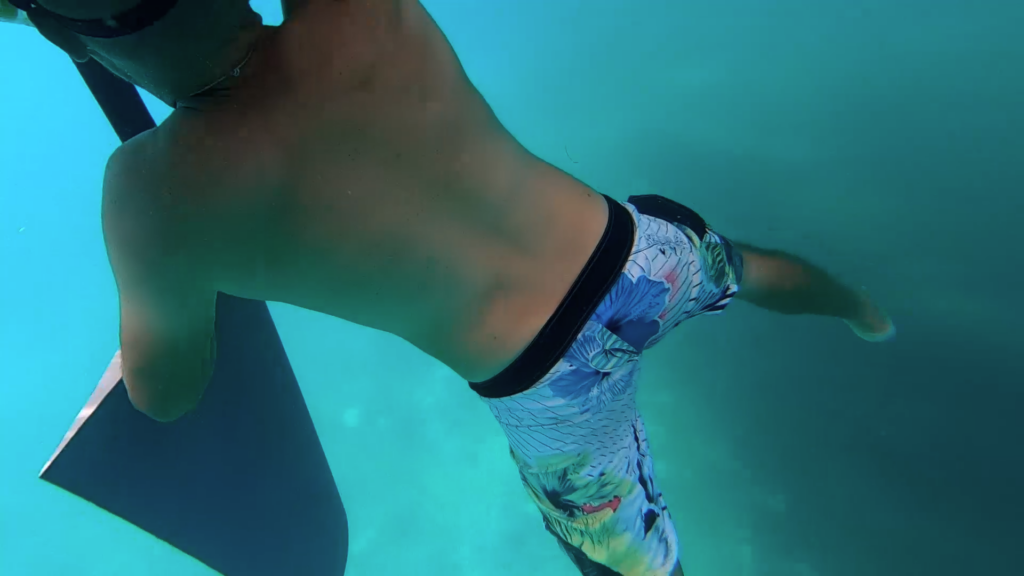
With the blade faired, painted, and bearing fitted, it was time to get it on the boat. Installation meant going underwater — the rudder is fitted from below, fed up into the stock tube through the hull.
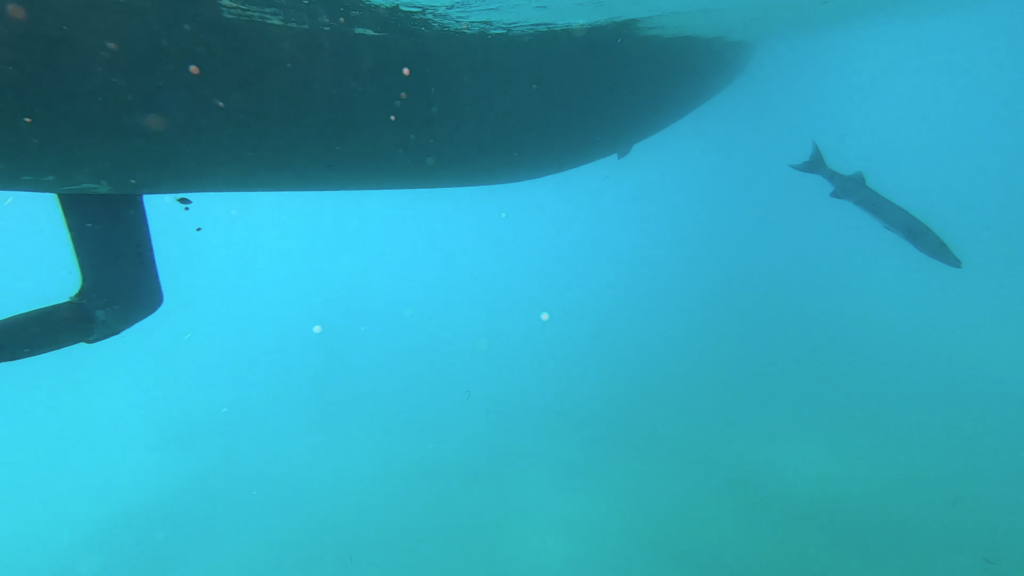
Shayne went in. Barry the barracuda, a regular presence in the anchorage, came along to supervise.
A buoyant rudder going into the water wants to go up, not down, which makes the initial handling interesting. Once it’s located and the pintles are engaged it goes smoothly, but getting it there requires some coordination between the person underwater and whoever is managing things from on deck. It went in. Barry approved.
What We Had at the End of It
Two rudder blades. Shayne’s own foil profile, carbon stocks from C-Tech, fibreglass skins laminated under vacuum, faired to template, bearing sorted by FKG in Sint Maarten, installed at anchor on the French side of St Martin.
Built in the Caribbean, without a shed, without a bench, against a deadline imposed by an America’s Cup programme. The rudder that went on the port side that day is still on Paikea.
It’s not the rudder Shayne would have built given unlimited time and a proper facility — the members hub has the honest version of that assessment, alongside the design thinking behind what comes next. But it works. And it got us to Barcelona.
What Comes Next
These Caribbean-built rudders are the current generation. The next generation — Shayne’s second design, built with full yard access and none of the constraints that shaped this build — is in progress. The design is done. When the interior refit reaches the right stage, the rudder build starts, and we’ll document it in full.
The complete rudder story — every version, every decision, from the original Catana blades to where we are now — is on our free cornerstone page: Paikea’s Rudders: The Full Story
The engineering detail behind the foil design, the ventilation analysis, and the build documentation that doesn’t go in a public video is in the Youngbarnacles members hub.