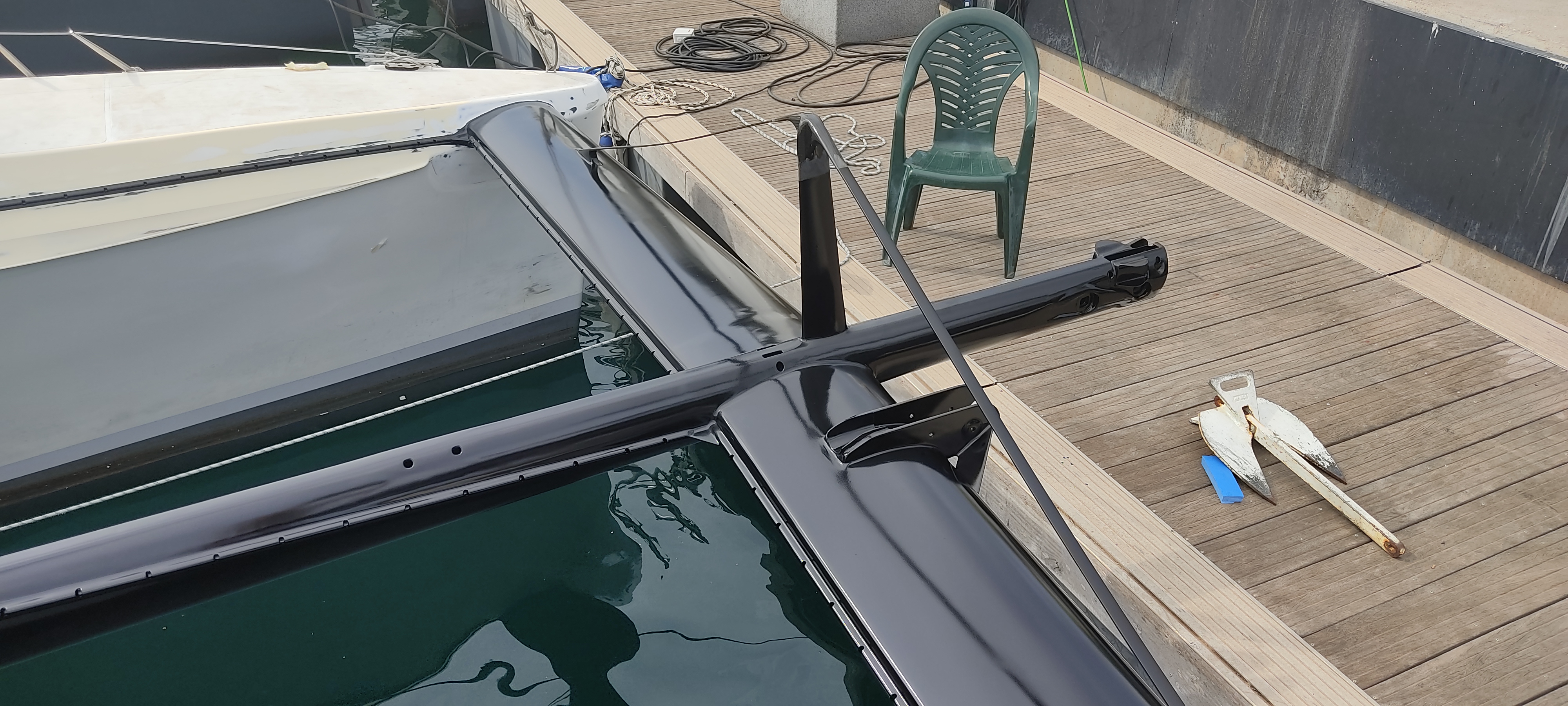
Paikea’s Carbon Front End Rebuild
The original aluminium front beam on Paikea worked. It had done 45,000 miles. But it was a collection of mechanical connections — pins, bolts, flanges — transferring load through a series of concentrated points into a hull that wasn’t designed to receive it that way. The walkway that handled the aft forestay load wasn’t a structural component. The martingale was 12mm stainless steel wire at five kilos. There was no bowsprit, no inner forestay, and no way to fly the asymmetric sails that would transform how the boat performs offshore.
The replacement is built entirely from recycled America’s Cup mast sections — material that was heading for landfill until our friend Ewen decided fence posts were beneath it. The front beam, longeron, seagull striker, and bow pole are all cut from the same batch of high-modulus carbon that had been through a Cup campaign. The martingale is a custom press-moulded carbon strap at just over one kilo. The trampoline is Dynex SK78 — the same material as high-performance halyards. The anchor system is built from salvaged titanium pins, HDPE pipe, and a chain sock Anna made from recycled hydrant sail cloth and an old sail bag.
The result is a front end that is structurally superior to the original in every way, gives Paikea a centreline platform for code zero and spinnaker sailing, provides an inner forestay for heavy weather, and weighs a fraction of what it replaced.
Shayne designed and built everything. The full series is documented below.
The Build Series
Building a Carbon Front Beam from America’s Cup Mast Sections
The first cuts into the mast sections, the coving mix Shayne makes himself from milled fibre, microspheres, and cabosil, and the beam going in — then sliding five millimetres overnight.
Catamaran Front Beam Load Paths: Why We Replaced Aluminium with Carbon
The engineering case for the new system — how forestay load resolves into vertical and aft components, why the original pinned connections were adequate but compromised, and how a bonded carbon beam changes the structural logic of the whole bow.
Building a Carbon Fibre Seagull Striker and Martingale
Why adding the seagull striker gives a stiffer lighter beam for less material than reinforcing the junction alone, and how Shayne press-moulded a 20-layer unidirectional carbon strap to replace five kilos of stainless wire.
Installing the Carbon Fibre Martingale
Drilling through a carbon beam built from America’s Cup mast sections, CAD-modelled slot positions, rubber-toughened epoxy secondary bonding, and the load path that goes straight into the hull.
Vacuum Bagging Complex Geometry: Joining a Carbon Beam to a Hull
The complete vacuum bagging process for the beam-to-hull joint — consumable stack, peel ply, breather felt, frog’s tongue, pleating technique for complex geometry, and why getting heat on it fast matters.
Removing the Vacuum Bag: What Good Consolidation Actually Looks Like
The bag comes off — saturated breather, clean laminate, fibres pressed into every corner. What good vacuum bagging actually looks like, and an honest note on composite waste.
The Carbon Longeron: How a Recycled America’s Cup Mast Changed Everything
The longeron replaced the walkway and transformed what Paikea can do — centreline spinnaker launch, inner forestay, no whisker stays, bigger trampolines, and a cleaner faster bow.
Carbon Fibre Bow Pole: Finishing the America’s Cup Front End
Fitting out the bow pole — galvanic corrosion between carbon and metal, Tef-Gel, Duralac, and the forestay fitting that required some secret techniques for potting screws.
Forestay Attachment and Wet Preg: Engineering the Pin Into a Carbon Longeron
A custom transverse pin forestay attachment modelled in Solid Edge before anything was cut, and the wet preg technique — professional resin control without a prepreg facility.
How to Install a Dyneema Trampoline on a Catamaran
Why separate lashings beat continuous lacing, how to get professional tension into Dynex SK78 netting, and a two-year update from the Caribbean.
Carbon Anchor Roller, Nav Lights, and the Final Details
Trampoline tracks raised and laminated in, nav lights positioned inside the bow pole fairing to protect them from tack lines, and Jotamastic primer over everything before paint.
Designing a Stowable Anchor System for a Carbon Front Beam
HDPE chain guides, a titanium pin from the mast, a chain sock made from recycled sail cloth, and a fully removable system that takes the anchor off the bow for longer passages.
Sea Trials With Our New Mainsail: Proof-Loading the Front End
Testing the rebuilt front beam and longeron under real sail loads for the first time — a new headcar gaff lock, sidestay tensioning in building breeze, and a small webbing fix traced back to a midnight repair job before an earlier trip to France.
Paikea’s First Sea Trial: Carbon Front Beam, New Rudders, and a Midnight Sewing Job
A mainsail head repair that ran until four in the morning, then out into 16 knots of chop to test everything. The beam was solid. The rudders transformed how the boat steers. A daylight passage that used to take six hours got done comfortably faster with everything up.
Behind the Scenes: Members Content
The build series covers the full story from first cuts to sea trial. In the members’ technical library you’ll find the behind the scenes footage and engineering detail that didn’t make it into the public videos — composite work, material decisions, and the technical forum where members are discussing their own builds.