
Paikea’s First Sea Trial: Carbon Front Beam, New Rudders, and a Midnight Sewing Job
The sea trial almost didn’t happen on schedule. When we’d left for France earlier in the build — when Shayne was stepping the Gunboat 68 rig — Anna had set the mainsail head webbing in an approximate position, the intention being to fine-tune it properly on return. What we discovered back in Valencia was that the webbing was too low, which had pushed the cunningham loops too high and thrown the whole sail geometry off. Before we could sail properly, the webbing had to move.
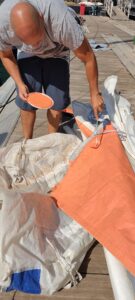
That job started in the afternoon and finished at four in the morning. The walking foot sewing machine had other ideas — two rows of stitching and it kept breaking, through the afternoon and into the night. By two in the morning the webbing was moved and repainted, a little hand sewing left to do on the leech line, and everyone was exhausted. The sail went back together. We went to bed.
The sea trial was the next afternoon.
The conditions were not gentle — rough, messy, 16 knots with an unpleasant chop. As a test of the new front end that was actually better than a perfect day. The beam was solid. No flex, no movement, nothing to worry about. The forestay geometry was right. The inner forestay arrangement worked as designed.
The rudders were the other big result. The boat steered better, felt more balanced, and sailed faster. A daylight passage that would previously have taken six hours was done comfortably in noticeably less, fully pressed, reaching in good breeze with everything up. Downwind the apparent wind was dragging forward thirty degrees — a good sign that the boat is moving quickly enough through the water to shift its own wind angle significantly. The centreboard trim needed watching — boards down downwind will slow you — but that’s crew work, not boat work.
The new front end gave Paikea her code zero and spinnaker capability for the first time. The rig is stiffer. The sail plan is larger and better. The boat is measurably faster. That’s what six months in the boatyard was for.
In This Series
This post is part of the Front End Build Series. Load paths, vacuum bagging, forestay fittings, seagull striker, martingale, trampoline installation and sea trials are all documented in the series Paikea’s Carbon Front End Rebuild.
The entire playlist is featured below:
- Building a Carbon Front Beam from America’s Cup Mast Sections
- Catamaran Front Beam Load Paths: Why We Replaced Aluminium with Carbon
- Building a Carbon Fibre Seagull Striker and Martingale
- Installing the Carbon Fibre Martingale
- Vacuum Bagging Complex Geometry: Joining a Carbon Beam to a Hull
- Removing the Vacuum Bag: What Good Consolidation Actually Looks Like
- The Carbon Longeron: How a Recycled America’s Cup Mast Changed Everything
- Carbon Fibre Bow Pole: Finishing the America’s Cup Front End
- Forestay Attachment and Wet Preg: Engineering the Pin Into a Carbon Longeron
- How to Install a Dyneema Trampoline on a Catamaran
- Carbon Anchor Roller, Nav Lights, and the Final Details
- Designing a Stowable Anchor System for a Carbon Front Beam
- Sea Trials With Our New Mainsail: Proof-Loading the Front End
- Paikea’s First Sea Trial: Carbon Front Beam, New Rudders, and a Midnight Sewing Job
Additional behind the scenes photos of the build showing more detail in the members’ technical library Join here.