Author: Shayne and Anna
Introduction
If you’ve ever spent a long day on the water tacking up a tight channel, you know the appeal of a self-tacking jib. The promise is simple: ease, simplicity, and the ability to short-hand the boat without a grinders’ pit crew on the rail. But as with anything in sailing, there are ten ways to skin a cat. In a recent deep-dive on board a stunning Gunboat 66, we explored the nuances, the clever engineering, and the inevitable compromises that come with different self-tacking jib systems.
While the conditions were “glamorous” with a light 15-knot breeze, the setup on this particular vessel offered the perfect classroom to discuss why your jib track isn’t just a piece of metal bolted to the deck.
The Anatomy of the System
The boat we were on features a rig that allows for a jib and a staysail. On this lighter-wind day, the staysail was parked, leaving us with a clear view of the primary jib’s control systems.
Looking forward, you’ll notice a few key components:
- The Track: It’s not straight.
- The Cars: There are multiple cars on the track to accommodate different sail plans.
- The Sheet Lead: The jib sheet exits the mast high up, rather than leading to the bow.
- The Controls: A centering line pulls the car inboard, and “outforce” lines pull it outboard.
The Curvature Conundrum: Fore and Aft
The first major point of discussion is the curve of the track. If you look at the deck, you’ll see the non-skid line is relatively straight. But the actual track bows forward in the middle.
Why the curve?
When you are sailing upwind, the jib car sits relatively close to the centerline. When you bear away for a reach, you want the car to slide outboard. However, if you have a straight track, moving the car outboard also moves it aft.
This changes the sheeting angle entirely. It flattens the bottom of the sail and allows the leech to twist open—exactly the opposite of what you want when reaching. You generally want a fuller sail shape off the wind.
A curved track solves this by keeping the sheeting angle consistent relative to the clew as the car moves outboard. This maintains proper sail shape and twist through the entire range of travel.
The Vertical Challenge: Up and Down
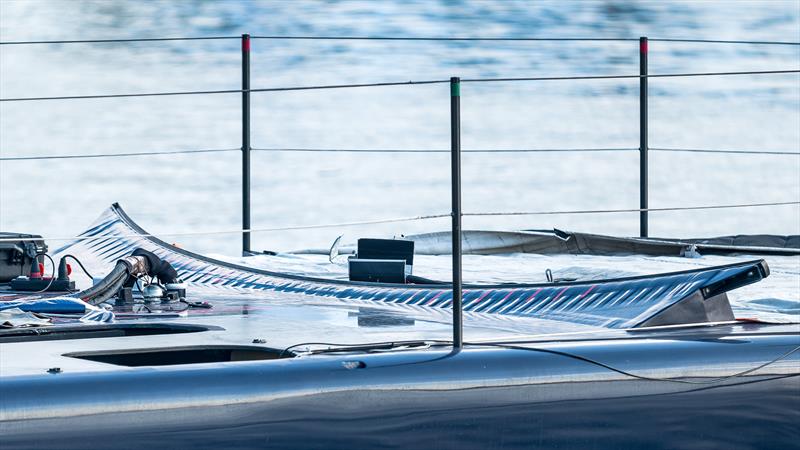
While the fore-and-aft curve solves one problem, it doesn’t solve another: height.
On a high-performance boat (like an AC75 or an 18-foot skiff), the jib sheet doesn’t just run horizontally back to a car. It leads down to the deck near the tack, pulling the clew down as well as back. This keeps the leech tight and the sail profile correct.
On this Gunboat setup, because the sheet exits the mast (which is actually quite far aft on modern hulls) and runs directly to the car, a different issue arises.
As the car moves outboard, the distance between the mast exit point and the car decreases. Essentially, the sheet becomes “too short.” This pulls the car back inboard, fighting against the wind pressure trying to push it out. This is why the “outforce” lines are necessary—to physically drag the car outboard against the sheet’s pull.
The Solution: The 3D Curve
To make a jib truly and effortlessly “self-tacking” across all points of sail, you need a track that curves in two planes:
- Horizontally: To maintain the sheeting angle (fore and aft curve).
- Vertically: To account for the changing height of the clew and the fixed lead point, ensuring the sheet tension remains constant without needing human input.
On boats like the Gunboat, the designers made a conscious compromise. They kept the horizontal curve (critical for sail shape) but omitted the vertical curve. This means that when you want to move the car outboard for a reach, you must manually ease the jib sheet to allow the car to travel. It’s not a “set and forget” system, but it keeps the deck layout clean and avoids running sheets and hardware across the trampoline.
The Multi-Car Setup
You might also notice there are multiple cars on the track. This isn’t just redundancy; it’s versatility.
When the staysail is flown, the jib (J1) is often sheeted independently to the primary winches via these outboard cars. This allows the crew to make sail changes without a “bareheaded” maneuver—hoisting one sail while the other is still drawing. It’s a setup borrowed from the Gunboat 68s, refined here to allow for easy offshore sail changes.
The System to Avoid
There is one configuration we generally advise against: the “mainsheet-style” system where the sheet attaches to the car, runs to the clew, and back to the car again.
While this works, it introduces double the friction. You have to overcome the friction of the cars on the track plus the friction of the sheet running through the blocks. In a self-tacking system, friction is the enemy. It prevents the sail from moving across smoothly in light air and can lead to poor sail shape.
Conclusion
A self-tacking jib is a beautiful thing, but it’s rarely as simple as it looks. Whether it’s a curved track, a vertical lead, or a multi-car setup, every design choice is a trade-off between performance, simplicity, and deck layout.
If you’re designing a system for a new boat or troubleshooting an existing one, remember: prioritize the horizontal curve for sheeting angle, minimize friction at all costs, and understand the “use case” of your vessel. Are you racing around the cans, or are you crossing oceans?
Understanding these compromises is the difference between a system that merely exists and one that truly performs.
Large Performance Multihull Sailing
Enjoyed this video? Make sure you check out more of our Performance Multihull Sailing in these posts below.
- Apparent Wind vs. True Wind: The Biggest Misconception in Sailing
 Authors: Shayne and Anna Introduction You’re sailing downwind on a beautiful performance catamaran. You glance at the instruments. One display says you’re going upwind at 150 degrees. Another says you’re going downwind. Which one is right? The answer is both. And that confusion is the biggest misconception in sailing. In this guide—filmed onboard the Gunboat… Read more: Apparent Wind vs. True Wind: The Biggest Misconception in Sailing
 - The Art and Science of the Self-Tacking Jib: Why It’s More Complicated Than You ThinkAuthor: Shayne and Anna Introduction If you’ve ever spent a long day on the water tacking up a tight channel, you know the appeal of a self-tacking jib. The promise is simple: ease, simplicity, and the ability to short-hand the boat without a grinders’ pit crew on the rail. But as with anything in sailing,… Read more: The Art and Science of the Self-Tacking Jib: Why It’s More Complicated Than You Think
- A Privileged View: Showcasing the Iconic Gunboat 66 “Outnumbered”Author: Shayne & Anna As liveaboard sailors and marine professionals, we’re constantly surrounded by beautiful boats. But every so often, we encounter a vessel that is truly special—an icon that stops you in your tracks. The Gunboat 6602, “Outnumbered,” is one of those boats. We’ve been entrusted with a unique task: caring for this legendary performance… Read more: A Privileged View: Showcasing the Iconic Gunboat 66 “Outnumbered”
- Atlantic Emergency: Managing a Rudder Failure on a Gunboat 68TOPIC:This post details a serious offshore emergency aboard a Gunboat 68, where a collision with an unknown object destroyed a rudder. It covers the immediate response, damage control, and the challenging sail to the Azores, showcasing professional-grade seamanship and problem-solving. Author: Shayne The second leg of our Gunboat 68 transatlantic delivery from Antigua to France presented… Read more: Atlantic Emergency: Managing a Rudder Failure on a Gunboat 68
- The Art of Light-Air Passagemaking: Sailing a Gunboat 68 Across the AtlanticTOPIC:This post analyzes a transatlantic delivery on a Gunboat 68, focusing on the techniques and technologies that enable high average speeds in light conditions. It covers the relationship between speed and comfort, advanced sail aerodynamics, and practical rules for optimizing mast rotation. Author: Shayne What defines a true performance cruiser? It’s not just top speed in… Read more: The Art of Light-Air Passagemaking: Sailing a Gunboat 68 Across the Atlantic