
Transatlantic on a Gunboat 68: Light Air, Big Miles
Day three, maybe four, of a Gunboat 68 delivery from the west side of the Atlantic back to Europe — and the wind’s done almost nothing since departure. Eleven knots has been the ceiling. For most boats, that’s a day for the engine and a long wait for better breeze. For this one, it’s a genuine demonstration of what a performance multihull is actually for.
200-mile days in under 11 knots
The engine came on overnight when wind dropped below 4 knots — below that, boat speed becomes hard to manage under sail alone. But everywhere between 4 and 10 knots of true wind, the boat’s been sailing, and sailing well: 180 to 210 nautical miles a day, close to wind speed for most of it. That’s the number worth sitting with. A lot of sailors assume a fast boat needs real breeze to be worth having. The opposite case is the more interesting one — a boat capable of covering serious distance in conditions most cruising boats would motor straight through.
The reason it works comes down to sea state. Sailing fast in light air keeps the boat moving close to the true wind speed, which means the apparent wind stays forward and strong even when the true wind is barely there. The practical result on deck is a flat, calm sea state — none of the slop and wallowing that shows up on a slower boat becalmed in the same conditions. Fast in heavy air is a battle. Fast in light air, on a boat built for it, is close to the easiest sailing there is.
Reading the J0 for shape
With breeze filling back in through the morning — 6 knots, then 10 — the J0 (known as a screecher in some parts of the world) went up: a fractional-hoist sail set just above the jib, tacked to the end of the bowsprit. This particular sail has glow-strips sewn into the panels, which makes the aerofoil shape genuinely visible rather than theoretical — the same shape as an aircraft wing, curling the airflow around a knuckle near the luff before flattening out through a long, low-pressure curve toward the leech. That shape is what a trimmer means by talking about a sail being “full” or “flat,” and what “twist” refers to when the aerofoil angle changes higher up the sail compared to lower down.
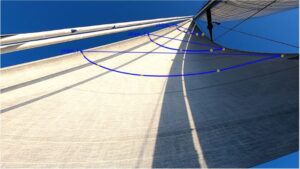
Sail shape on the J0 is indicated with blue lines. Shayne uses sail design software to analyse sail shape and forestay sag.
This Doyle sail has glow in the dark stripes at these points to allow the crew to trim the sail correctly at night.
This particular sail is built with Doyle’s structured luff, a cableless design intended to carry load through the sail itself and hold the luff stable with minimal sag — the vertical curve of the luff from head to tack. Compared to other sails on the boat, including the Code Zero, it holds that shape convincingly, and the result on the water is the sail doing exactly what it’s meant to: 10 knots of boat speed in 8 knots of wind, on a fully loaded cruising catamaran.
Trimming mast rotation
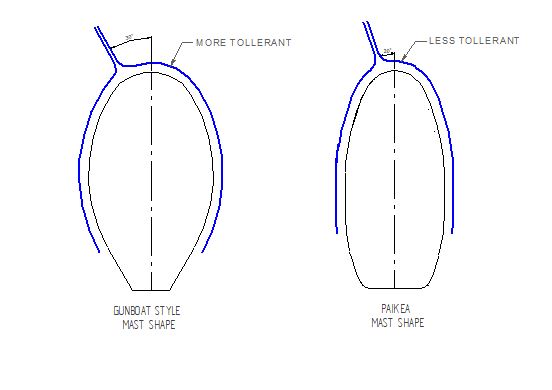
The rule of thumb for mast rotation is simpler than it looks: rotate the mast until it’s facing directly into the apparent wind angle, not the true wind angle. At 34 degrees of apparent wind, the mast gets rotated to roughly the same figure — the wind indicator at the masthead pointing straight up the mast’s centerline is the visual check. Under-rotating leaves the mast fighting the airflow; over-rotating creates a separation bubble on the windward side that costs power without any benefit. Neither extreme helps.
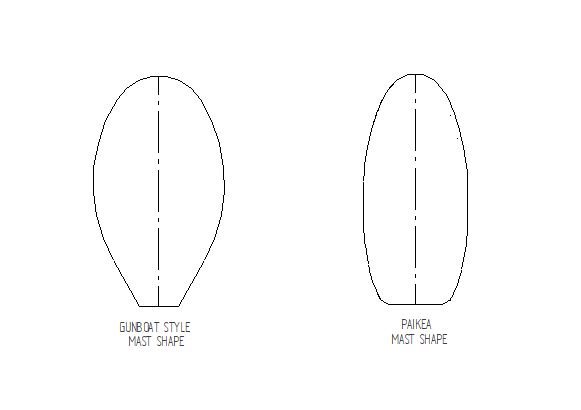
Mast Section Tolerance: Gunboat vs. Paikea
The Gunboat’s rig is designed for powerful, reliable cruising. Its mast section is substantially more rounded than the fine-tuned, elliptical section we have on Paikea.
“For a performance cruiser, the Gunboat’s section is the perfect shape as it is quite tolerant,” Shayne explains. “Paikea’s rig, on the other hand, is a much finer section inherited from an America’s Cup campaign. It is incredibly efficient but demands vigilance with rotation trim. The difference highlights how design priorities—bulletproof cruising versus top-end racing—dictate the systems we use.”
Different rig sections tolerate this differently. A large round mast section is forgiving of small rotation errors — sail past the ideal angle by a few degrees and the loss is minimal. A narrower, more aerofoil-shaped rig — the kind salvaged from an America’s Cup programme, for instance — is far more sensitive to exact rotation, which changes how closely it needs to be trimmed to stay efficient.
In This Series
In This Series
This wraps a four-part delivery — from a light-air start through a mid-ocean rudder loss to the final leg into the Mediterranean. See the full delivery on How We Sail the World’s Fastest Cruising Multihulls, or read the series in order:
- Part 1: Light Air, Big Miles
- Part 2: Losing a Rudder Mid-Ocean
- Part 3: From the Azores to Toulon
- Debrief: Rudders, Boards, and Cockpit Systems
For more on Paikea’s own America’s Cup-derived mast section and why it demands that vigilance with rotation trim, see Paikea’s Mast.
Members deep dive
In the Members Library, the full systems breakdown for this Gunboat 68 — including the clutch arrays and deck padeye layout — goes deeper into the hardware discussed here.
Shayne,
Really enjoyed the video and the sail and mast trimming tips. In fact we always enjoy all your videos. I have a somewhat unrelated question. I am wondering if you know the blue color on this Gunboat 68. We are looking for a blue for our new cat and this would be great.
Cheers,
Joe
Hi Joe! thanks for the great feedback. Awesome to hear you are enjoying the videos and that you get some real value out of our content. I think the paint was a custom job but next time I see the guys I’ll see if I can get the colour code for you.