
Transatlantic on a Gunboat 68: Losing a Rudder Mid-Ocean
A cockpit detail worth knowing before the rest of this story: the winches carry slave rings at their base, a small fitting that lets a line get redirected to a free winch without ever touching one that’s already tied up with another job — a furling line locked off, say, while something else needs handling right now. It’s simple hardware, and it buys real flexibility in a cockpit where every winch already has a job to do. (The full breakdown of the clutch and padeye systems on this boat lives in the Members Library, linked below.)
The passage settles in
Wind filled to the mid-teens and the boat started moving with real pace — rooster tails off the transoms, the kind of speed that makes the ocean feel smaller. The trade-off at that pace is comfort: waves start meeting the wind, the ride gets bouncier, and sleeping up in the bow means accepting some bang and crash as the hulls work through it. That’s the deal with covering ground quickly offshore — speed and comfort don’t rise together forever.
A grinding halt
Then, without warning, the boat came to a sudden, hard stop. The impact destroyed the starboard rudder and rudder box entirely, along with the surrounding hardware. What followed was a couple of hours’ work to remove the damaged blade from the box — awkward, deliberate work, a thousand miles from the nearest point of land, with no shortcuts available out there.
With the blade out, the boat was sailing again — on one rudder, a scenario familiar from an earlier Atlantic crossing on a different boat that faced the same problem. The response was the same: second reef, big jib, and a steady, conservative pace toward the Azores, watching the remaining rudder carry a job it wasn’t built to do alone.
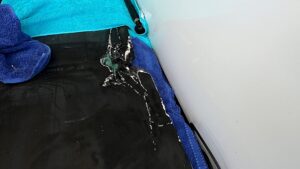
The incident occurred approximately 1,000 nautical miles from the Azores. While sailing at 12 knots, the Gunboat 68 hit an unknown object in the water with tremendous force. The result was immediate and severe: the starboard rudder and its surrounding rudder box were “completely destroyed.”
Left picture: rudder damage
North Atlantic weather
The Caribbean’s warmth gave way to grey, wet North Atlantic conditions within days — sails reduced early, in anticipation of what was coming rather than reacting to it after the fact. Wind built quickly overnight to 27–29 knots, and one gust pushed the boat to 22 knots surfing down a wave — comfortably past the self-imposed 12-knot limit set specifically because a boat running on one rudder has less margin for error at speed. From there it was mast-and-jib only, holding 9–10 knots through building seas that reached two to two and a half metres — big enough to make the ride properly uncomfortable, cold, and wet, with a heater on inside the only real relief.
By day ten, only 250 miles remained to the Azores. Sail plan shifted repeatedly through that stretch — J2, then J2 plus a small handkerchief-sized reduction — chasing a self-imposed speed band of 10 to 12 knots that occasionally crept to 16 as the breeze swung up and down. One stretch running at 21–22 knots at two in the morning, still on one rudder, was a clear reminder of exactly where the margin was and wasn’t.
Closing distance on the islands, the boat spent ten minutes reeling in and passing a heavier boat under a similar sail plan — both making similar average speed through the water, but the lighter boat consistently catching waves and surfing to 14–16 knots where the heavier boat held steady at 8–9. Same wind, same rough sail area, different result — a clean demonstration of what weight actually costs a boat’s ability to convert breeze into speed.
Landfall came after dark, into a harbour already crowded with other boats sheltering from the same weather. With the boat finally tied up, the real work started: repairing a rudder and rudder box in a boatyard far from home, with wind still gusting hard enough to lift spray off the water into visible cloud.
In This Series
This wraps a four-part delivery — from a light-air start through a mid-ocean rudder loss to the final leg into the Mediterranean. See the full delivery on How We Sail the World’s Fastest Cruising Multihulls, or read the series in order:
- Part 1: Light Air, Big Miles
- Part 2: Losing a Rudder Mid-Ocean
- Part 3: From the Azores to Toulon
- Debrief: Rudders, Boards, and Cockpit Systems
Members deep dive
In the Members Library, the full systems breakdown for this Gunboat 68 — including the clutch arrays and deck padeye layout — goes deeper into the hardware discussed here.
“