Author: Shayne & Anna
Topic: Follow the transformation of our forward port cabin, where we replace heavy original parts with lightweight composite structures while maintaining and improving the critical structural integrity of the hull.
The refit of Paikea’s forward port hull represents a perfect convergence of our goals: significant weight reduction without compromising—and often enhancing—structural strength. In this phase, we transformed what was once a bathroom into part of Harry’s cabin, installing a new infused floor that weighs 50% less than the original and rebuilding the structural bunk system from composite materials.
The result is immediately visible: “The bows on Paikea are definitely sitting higher in the water right now.” This isn’t just an aesthetic change; it’s a direct performance improvement that affects sailing characteristics and fuel efficiency.
The Process: Lightweight Floors & Structural Bunks
The project involved a multi-step process of removal and precision replacement:
- Removing Outdated Structures: We took out the old timber bunk and the original heavy composite floor.
- Installing the New Infused Floor: The cabin floor, infused with vinyl ester resin in a previous session, was fitted. This part alone halved the weight in this section.
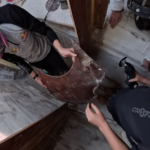
- Rebuilding the Bunk: The old timber bunk was replaced with a new, lighter composite bunk base, which was installed in two sections to allow for access and manageable fabrication.
The Engineering: Why a Bunk Bed is Structural
A common misconception is that interior furniture is non-structural. On a performance catamaran, this is far from the truth. Elements like bunk beds play a critical role in hull integrity.
“The bunk is structural because you can see from the forward bulkhead to this bulkhead here, that’s what we call a massive panel span,” Shayne explains. “There’s a massive span of panel with no supporting structure… that panel will flex in and out without any support.”
The bunk acts as a structural member that cuts this large, unsupported panel in half vertically. By drastically reducing the panel span, it prevents the hull side from flexing under the immense loads generated by waves and rig tension.
The Detail: Bulkhead Modification & Reinforcement
To create a more comfortable and spacious cabin, we modified a partial bulkhead under the bunk. Any modification to a structural element requires careful analysis and reinforcement.
After cutting the bulkhead, the team had to add unidirectional carbon fiber tape to restore and enhance the strength of the surrounding structure. “I actually need to put uni inside here because this flange here is now a little bit smaller… I’ve got to put uni through here to turn it into a beam,” Shayne notes, highlighting the constant engineering assessment that happens during the refit.
The Payoff: Performance Through Weight Savings
Every kilogram removed from the ends of a catamaran has a disproportionate effect on performance. Reducing weight in the forward hulls makes the boat more responsive, reduces pitching, and improves overall handling. The fact that this was achieved while simultaneously improving the structure is the hallmark of a professional-grade refit.
Follow the Floor Refit:
- Solving Boat Shower Drainage with Cardboard, CAD, 3D Scanning & 3D Printing
 The Hybrid Design Workflow: Building a Boat Shower Floor with Cardboard, CAD, and 3D Scanning: Walk through the hybrid design process for a custom boat shower floor. See how cardboard prototyping, CAD, 3D scanning, and 3D printing combine to solve complex drainage and access problems in a marine refit. Author: Shayne and Anna Introduction Designing… Read more: Solving Boat Shower Drainage with Cardboard, CAD, 3D Scanning & 3D Printing
 - The Boat Shower Floor Blueprint: Drainage, Hatches & Avoiding Bilge FloodsWhen your floor needs to drain, provide access, and never flood the bilge. A deep dive into the logic behind our custom shower hatch. Key Topic: Join Shayne & Anna in the bilges for a marine design deep-dive. We’re solving the boat shower’s trickiest puzzle: creating a floor that drains properly, includes mandatory access hatches,… Read more: The Boat Shower Floor Blueprint: Drainage, Hatches & Avoiding Bilge Floods
- Diagnosing and Repairing Hull Delamination and Core Damage.The Problem: From Floor Installation to Structural Repair Author: Shayne and Anna During the installation of new cabin soles in our Catana 42 refit, a routine task uncovered a significant structural issue. The discovery process is a textbook example of why systematic disassembly is critical. Initial Indicators: The Technical Failure:In a cored composite structure (like… Read more: Diagnosing and Repairing Hull Delamination and Core Damage.
- Re-Engineering a Hull: Load Paths, Daggerboards, and a New Structural BulkheadAuthor: Shayne and Anna Key Message: The most important part of a structural refit is understanding and optimizing load paths. By relocating a bulkhead to align with the strongest part of the daggerboard foil, we significantly increase Paikea’s structural integrity and sailing performance. Introduction: Identifying a Structural Flaw During Paikea’s refit, we noticed a discrepancy. On… Read more: Re-Engineering a Hull: Load Paths, Daggerboards, and a New Structural Bulkhead
- Refit Progress: Templating, Infusing, and Building a New Laminating TableKey Message: A major refit is a series of small, repetitive, and precise steps. By creating a family “assembly line” for templating and infusion, we’re efficiently producing lightweight, custom composite floors while constantly improving our workshop tools. Author: Anna & Shayne Introduction: The Flooring Assembly Line The transformation of Paikea’s interior continues, one floor panel at… Read more: Refit Progress: Templating, Infusing, and Building a New Laminating Table