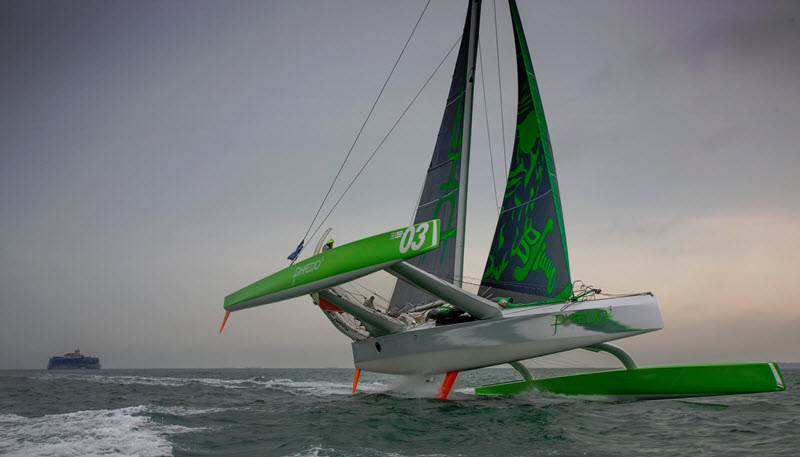
What makes a Performance Boat?
Defining what is a Performance Boat
Author: Shayne
The term “performance” is being thrown around way too much these days. It’s being used without the consideration of what the actual term “performance” means in relation to sailing. In order to understand what is a performance boat, we must first agree on what is meant by the term performance. Whether it’s high performance oreven low performance we need to know the parameters or boundaries that can help us define the term and start to understand what is truly a performance boat. One thing that is clear however, is every one refers to the “performance” of a boat in terms of its speed.
So let’s look at some boatsthat have already been categorised and accepted in general. These are categories that define what a boat is and not what it can do. These are as listed below:
- Race Boat
- Cruiser/ Racer
- Cruising Boat
- Charter Boat
- Monohull
- Multihull
- Power Boat
- Sailing Boat
With the categories above they are generally defined by the way they are made and the stuff they have or don’t have onboard. What they don’t define is how they perform. Just because a boat is made to be a race boat doesn’t mean it will perform or be classified as a performance boat. This is very much the case with boats that were designed and built to the old IOR race rule. It also goes to say that just because a boat was designed and built to be a cruising boat doesn’t mean it won’t have good performance. There are cruising boats that out perform many racing boats!
There is also another issue with trying to use the above categories to define the performance of a boat. There are boats, such as a Gunboat, that is used as a cruising boat, a racing boat and also used in charter. So to say a charter boat will not perform is incorrect.
There is also a false idea that if a boat has certain items, it will be a performance boat. A classic example is because a catamaran has daggerboards it will be a performance boat particularly up wind. This is most certainly not the case. The other example is if a boat is built completely of carbon fibre that it instantly makes it a performance boat. Both these assumptions have been proven in many cases to be untrue resulting in expensive and underperforming vessels.
The question for most people is, how do we categorise a boat accurately to know how it performs? This is actually quite easy. We look at its efficiency in its simplest and easiest form to measure, speed. We look at the wind speed as the energy put in and the energy harnessed and converted to boat speed as the output. So it is as simple as what is the boat speed in relation to the TRUE wind speed. This is expressed as a percentage and can be known as the boats efficiency. An example of this would be if we are sailing along at 8 knots and the wind speed is 16kts, we are sailing at 50% of wind speed. It is very important to note everything is in relation to TRUE WIND SPEED and speed through the water (see true wind vs apparent wind). It is also very important that your instruments are well calibrated to get this data (see calibrating your instruments).
Once this method is applied, it gets very easy to categorise a boat’s performance. We can then also see how a boat’s performance can be improved. It is very important to also understand that the performance of a boat can be very easily changed. This is especially true for multihulls as their performance is so very heavily dictated by weight (see weight article). Just by adding a bunch of weight to a catamaran can take it from a high performance category boat to a low performance category boat. This is also true for removing a heap of weight from a catamaran, it can go from low performance to high performance.
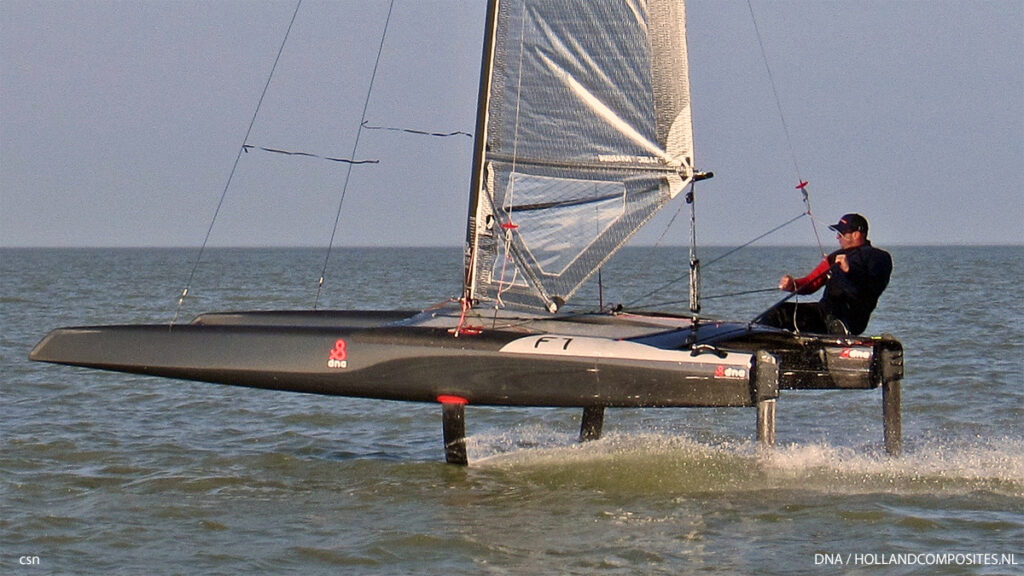
Let’s categorise this performance so we can see where boats sit within these categories. Based on a boat’s speed in relation to true wind speed, it is now easy to say a boat is either high performance or low performance, but we want to put a third definition in the middle. This middle definition sounds a bit silly as middle, average or half performance so we refer to it just as a performance boat. So now we have three categories:
- Low Performance
- High Performance
- Performance
The scale used to be easy to define as 0% to 100% but now we have high performance boats that actually go to more than 100% of wind speed! The scale shows also that there is no clear defined line that a boat is or isn’t something but it sits some where in the scale. What we will do is divide the scale up to help categorise if a boat is High Performance, Performance or a Low Performance Boat.
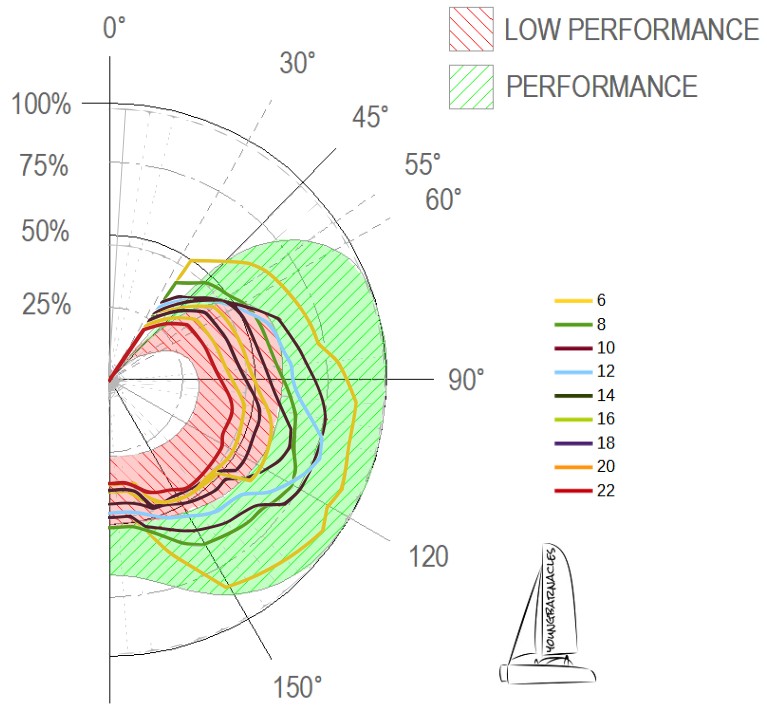
Now here is the really fun part of a sailing boat, the efficiency number is not the same for different points of sail. Sailing up wind is much slower in relation to wind speed compared to sailing down wind. Due to this, we need to change our simple graph and turn it into a polar, one that also takes into account the different points of sail. Our categories also now need to account for the speed differences between upwind and down wind sailing.
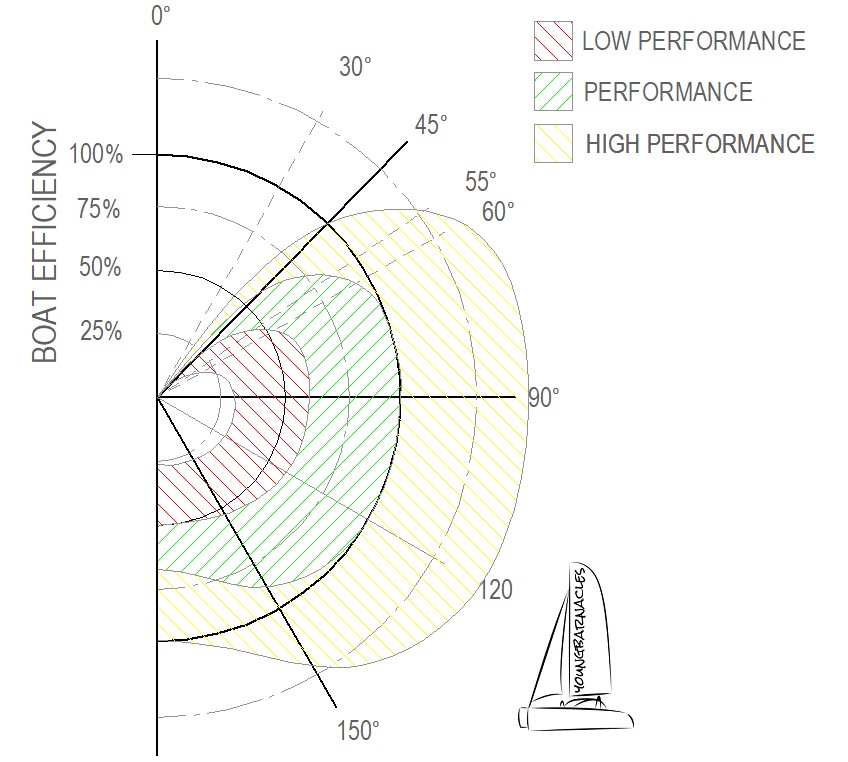
Now that we have a graph showing the definitions of where a boat might fit into a category how will it look? A boat may not actually sit right in a category as it may be designed to be, lets say a down wind flyer with certain goals in mind and not actually be any good at sailing up wind. A boat may also be tailored to a region where it is always windy so it efficiency at lower speeds will be not as good as it higher wind ones. These are exceptions however, and not what we would generally look for in a boat. What we want to look for is in wind speeds from 8 to 16kts a boat that will perform well across the board. Why 8 to 16kts you ask? This is the wind that provides the most stable sailing conditions and the wave state is still small and comfortable.
Let’s look at the sailing upwind component as this is a critical factor. Why is this critical? Sailing upwind is a safety aspect for the ability for a boat to sail off a lee shore or making sure that it doesn’t get blown onto or into something dangerous. For us in a racing boat, getting to the top mark first means you want to be as efficient as possible upwind. For a cruising boat you also want to be as efficient as possible upwind because you want to minimize your sailing passage times as much as possible. You also want to be able to broaden your range of cruising and in some cases that means you need to sail upwind.
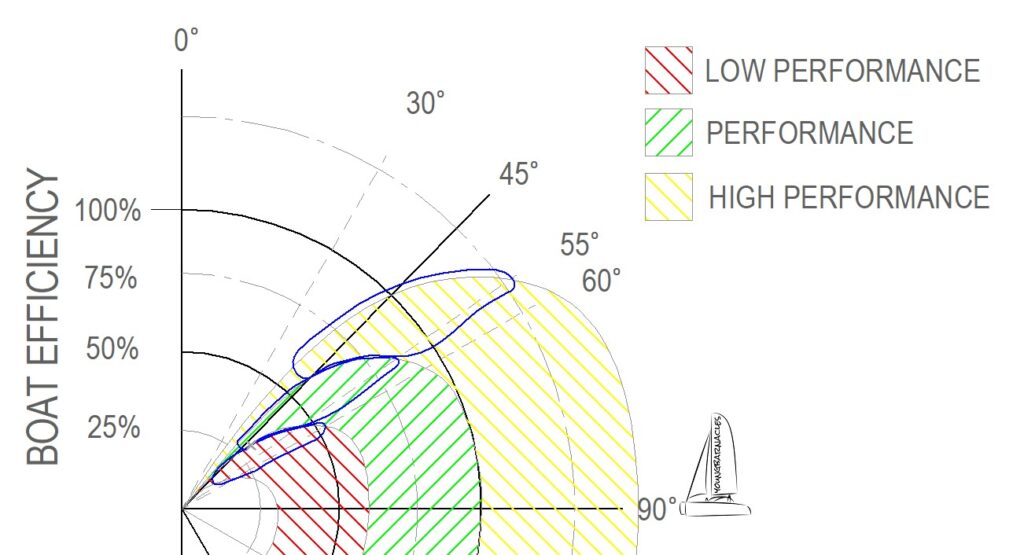
The true wind angle zone for upwind is 40 degrees true to 55 degrees true, again I’ll emphasize this is true wind angle not apparent wind angle. So why is 55 degrees the defined limit for upwind sailing and not 60 degrees? Going upwind means we make more ground going straight into the wind than we then we would if we were going 90 degrees to the wind. Sailing at 45 degrees true wind means the speed we make going forward straight up into the wind is equal to the speed that we go 90 degrees to the wind. If we sail at 55 degrees to the true wind we go sideways 50% more than we up into the wind, and this is a good boundary for making the definition of what is upwind. It should be noted that at 63 degrees we will sail 2 times faster 90 degrees to the wind than we will going up into the wind, so this would be 100% increase in speed sideways.
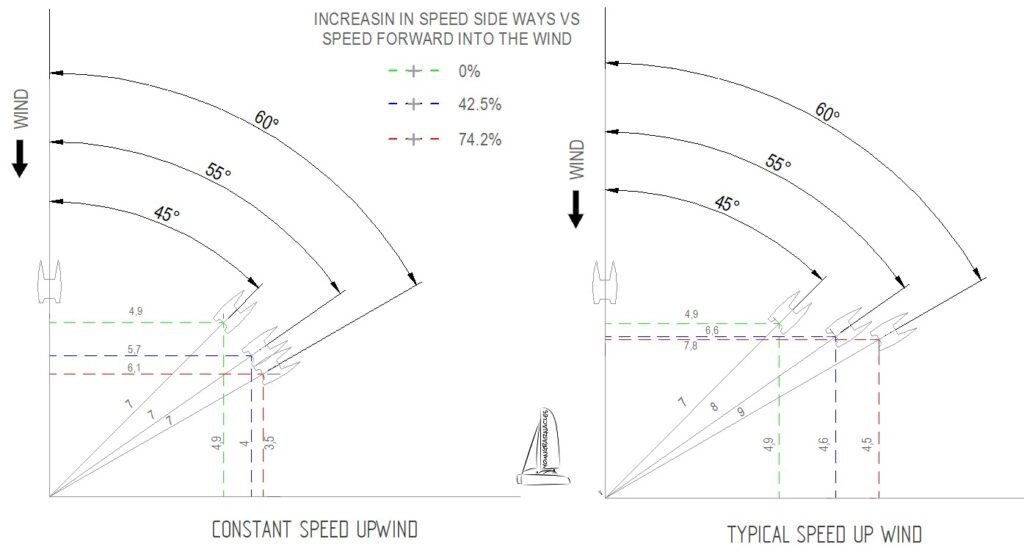
Upwind typical boat speeds is defined as a percentage of wind speed for a low performance boat 10 to 40% of wind speed is normal, for a performance boat 40 to 55% of true wind speed, a high performance boat it is 55% or more. It is also important to note the angle sailed up wind with the speed.
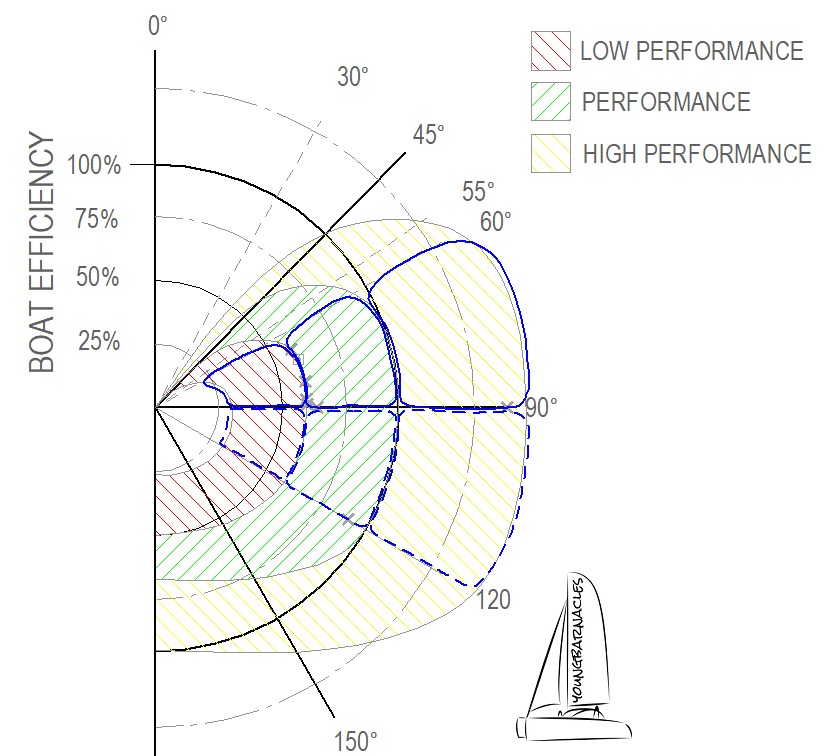
Reaching is where multihulls really start to excel with their speeds. The angle range is quite large and is broken into two sub categories tight reaching and broad reaching. The angle range that is 60 degrees to 120 degrees is classed as reaching. True wind tight reaching is 60 to 90 degrees at broad reaching is 90 to 120 degrees True wind angle. It is typically defined as not up wind but not using spinnakers. So what about the five degrees between 55 and 60 degrees, this is a funny area defined as cracked sheets upwind or in the footing upwind range It is sort of a buffer zone on some boats to gain a bit of speed going up wind especially in rough choppy conditions.
Reaching speeds for low performance boats is 50 to 60% performance boats its 60 to 100% and high performance boats its 80 to 200% . Foiling race boats are now touching 300% wind speed!
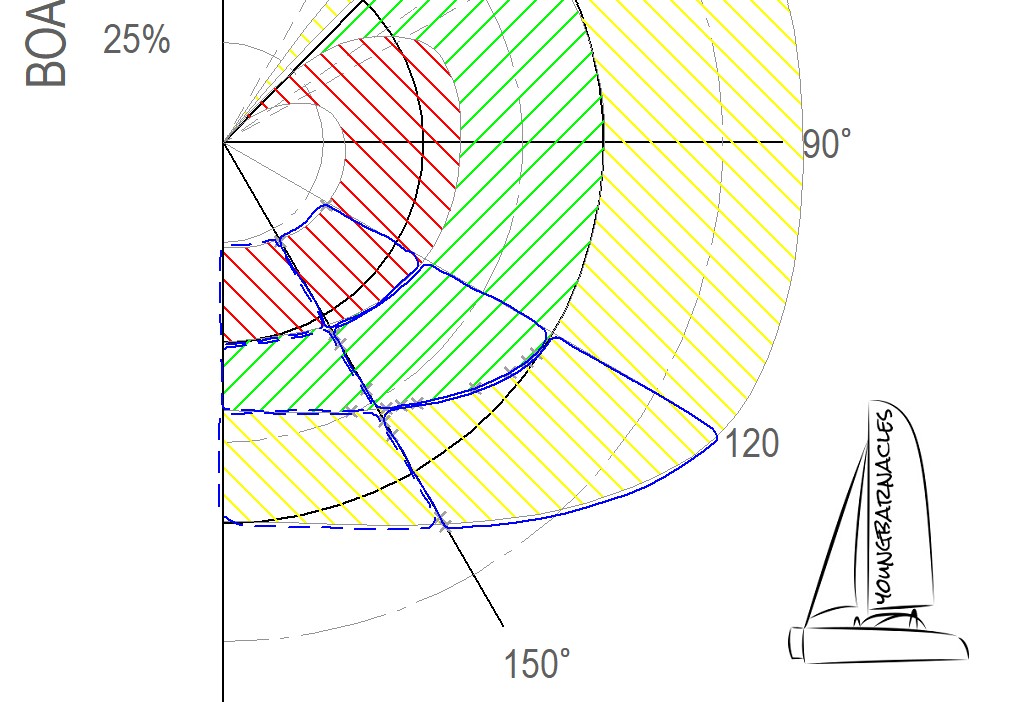
Downwind sailing is the part everyone likes. The angles are 120 to 180 degrees true, with the range from 120 to 150 the most popular angle as apparent wind sailing is still fast and a very effective in this range. Angles from 150 to 180 degrees tend to be a less efficient area for boat speed but can be quite good for VMG running downwind. Speeds downwind Low Performance Boats 40- 50% Performance Boats 50 to 80% High Performance Boats 70 to 100% .
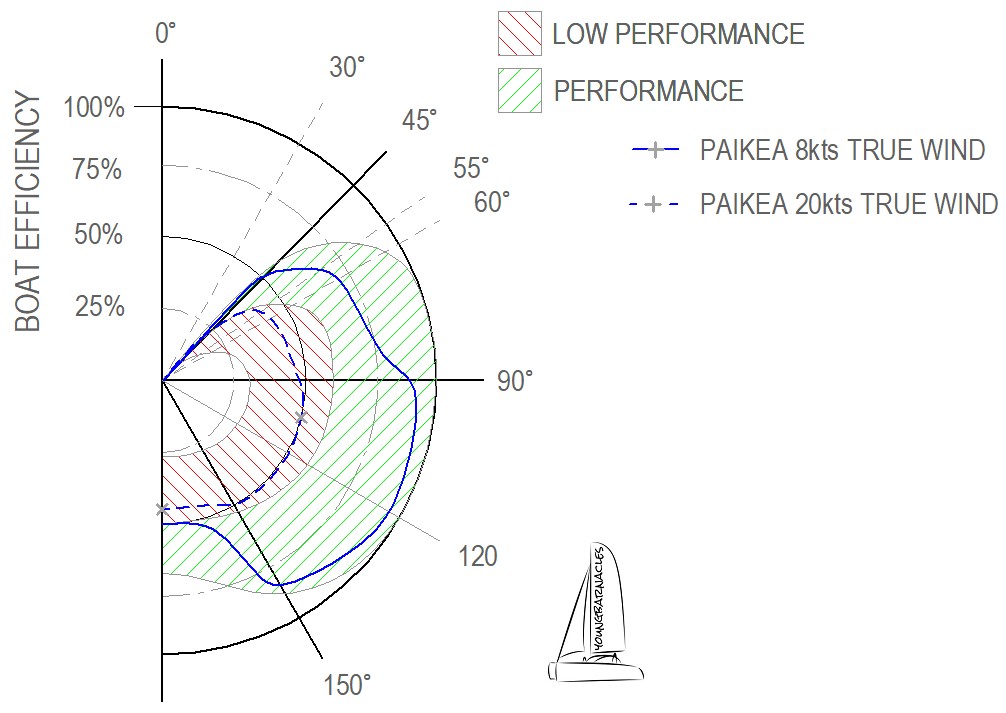
Where do I sit on the curve? This is now the really interesting and important part to look at. We are going to use Paikea as the sample boat because we have a lot of data on it. It is also a very interesting case to highlight what the boat has been optimised for and the intended sailing use. This data has been collected from more than 3000 miles of sailing in different areas of the world. What can be seen is that Paikea is very efficient in the 8 knot wind range but not as efficient in the 20 knot range. So is the boat a Low Performance or a Performance Boat since it sits in the two categories and not clearly in one category at one wind speed? Well a lot of data is left out for clarity
a racing boat We have we have the category of the cruiser racer And we have the category of a cruising boat Now this has been a definition of boats for a very long time and it clearly defines the use of the boat and it’s intended use We look at a race boat and it’s intended use is to go racing to get from Point A to point B as fast as possible and not all the occupant inside That is the primary function of a racing boat Then we look at a cruising boat a cruising boat is used to get from A to B and maybe a few places in between as well And it is designed to keep the occupant inside one alive but two comfortable as well because on a cruising boat you spend a lot more time actually living in the boat so let’s look at what is a cruiser racer or a racer cruiser Well it’s sort of a hybrid of the two Let’s take a racing boat and go and live on it for a little bite But that’s a racer cruiser But a racer cruiser is usually looked at as a weekend maybe a week away type boat generally coast or cruising but primarily racing as the goal Then there is the cruiser racer which is a cruising boat there you will actually try and race and enter in a race with which is perfectly fine but it has more of an emphasis on the cruising side of things So more creature comforts are kept in the boat .
on top of this there is actually a charter boat a charter boat primarily focused at taking people who generally don’t know much about sailing or boats and give them the experience of sale of sailing or going boating These boats have a very different approach to how they work compared to a good cruising boat or a good racing boat generally speaking a charter boat is focused on having a good time at anchor and enjoying the bay that your anchored at or the marina that you’re at .interestingly enough one boat can act can actually fill all three categories So I could have something like a gun boat and it can be used for racing So it’s classed as a racing boat It can be used for cruising So as classed as a cruising boat and it can be used for charter So as classed as a charter boat and it will actually fulfill all three of those categories reasonably well So could I define boat against another with these three categories certainly if performance is the word or what you’re looking to what you’re looking at .
so let’s look at the category of performance Now performance is a good one because that is dictating how a boat performs, how it gets from Point A to point B in relation to primarily speed. now this is good to be able to break this category down into a very simple element if we just look at speed and that’s the ability to get from Point A to point B And that’s what we refer to primarily as performance Things get a lot easier to define this means it doesn’t matter how comfortable or uncomfortable the boat is doesn’t matter whether it’s made of carbon fiber or wood if it has daggerboards or keel etc…. All of these variables get taken out, What we can start to focus on is actually the efficiency of the boat and we actually can start defining some terms and some boundaries that will define performance.
now let’s look at this efficiency thing a lot closer this is nice and easy to define as and energy input in which is our true wind speed because at the end of the day this is what propels our sailing boat forwards Versus the output which is our boat speed that is converting the input of wind energy into output of sailing forward boat speed so we look at the true wind as essentially our fuel This is the energy that is put into the boat It is then captured and harnessed by our sales our mast our rigging and our platform and then translated down throughout daggerboards and rudders and holes in the water and turned into forward motion And that forward motion is . our forward motion is measured in speed How far we get over a given time now if we look at how much energy is put in the wind speed versus amount of energy that’s extracted out boat speed we can get an efficiency now this clearly defines how we’re going with our boat because we can have ah race boat that is actually really low performance because it’s defined above that this race boat doesn’t have all the nice creature comforts of a sink and oven a toilet nor the rest was not a cruising boat But because it’s a racing boat it doesn’t mean it is efficient there are a lot of racing boats out there that were duds and not efficient So let’s look at what we would define as a good efficient boat. If we can sell our boat at win at wind speed so that means our true speed over the water is the same as the true wind speed that is blowing across the water Our is sailing at 100% efficiency now this is what you would define as a performance boat be because we are extracting what we are we are extracting out what we are putting in. There are now boats out there that can sail above 100% they’ve actually been able to do this for a little while. This is due to new modern materials and engineering and particularly in multi hulls, this sailing at more than wind speed is becoming more and more possible and more and more available particularly in the racing scene.
Now all performance will be referred to in relation to true wind Why would we use true wind as our reference The true wind is essentially the energy we have available to make our boat move Sort of like fuel We will reference our boat speed as a percentage of the wind speed what this ultimately gives us is our efficiency to move the boat What we will be looking at is the efficiency of boats at 5 to 25 knots of wind speed with a real focus on the 10 to 15 knot range. so why is this 10 to 15 knot range so important Well it’s quite simple This is this is the wind speed that is quite average around the world and it most importantly it is the wind speed just before the waves become uncomfortable .
so let’s look at the the chart or the graph for defining these boats and performance Now the chart is going to start at 00 basically You’re on a rock You ain’t moving anywhere Then we’re going to go all the way out to 100%. It is the area from zero to 100% of efficiency of wind speed that will primarily focus on with most of the boats that we sell Nowadays yes there are boats that sail above this 100% But we don’t play in this arena too much particularly with our cruising boats But it is of interest that we can get there.
in addition to this graph of being from zero to 100% of sailing efficiency there is also an added complexity of how you achieve this efficiency at different angles of sailing. We sell in different modes all the way from upwind where we try to go head straight up into the wind as close as possible to sailing dead downwind with the wind directly behind us. Let’s look at the sailing up wind component this this is critical for a but why is this critical This is actually a safety aspect for the ability of a boat to sale of Lee Shore or making sure that it doesn’t get blown onto or into something dangerous. For us in a racing boat getting to the top mark first means you want to be as efficient as possible upwind for a cruising boat you also want to be as efficient as possible upwind because you want to minimize your sailing passage time as much as possible You also want to be able to broaden your range of cruising and cases that means you need to sail up wind. The true wind angle zone for upwind is 40 degrees true to 55 degrees true again i’ll emphasize this is true wind angle not apparent wind angle . There is a huge difference in the two terms multihulls particularly performance ones will easily drag the apparent wind forward 40 to 50 degrees. What this is a boat sailing at 45 degrees apparent wind angle can be easily sailing at 90 degrees True wind angle, this is not sailing upwind. So why is 55 degrees upwind and not 60 degrees? First we need to account for some leeway Secondly going upwind means we make more ground going straight into the wind Then we then we would if we were going 90 degrees to the wind. Sailing at 45 degrees true wind means the speed we make going forward straight up into the wind Is equal to the speed that we go 90 degrees to the wind. If we sell at 60 degrees to the true wind we go sideways 50% more than we up into the wind And this is a good boundary for making the definition of what upwind. Wind boat speeds So this define is defined as a percentage of wind speed for a low performance boat 10 to 40% of wind speed is normal for a performance boat 40 to 55%. of true wind speed a high performance boat it is 55% or more.