Key Message: The pursuit of speed on a performance catamaran demands a direct trade-off with comfort, governed by inescapable physics. Driving a hull through waves at 12 knots transforms the motion below decks into a persistent, high-frequency “jiggle” that can make rest and routine tasks challenging, even on a well-built, luxury vessel. This isn’t a design flaw, but a fundamental reality of high-speed sailing—a crucial consideration for any sailor who must decide whether the exhilaration of fast passages is worth the physical cost of a lively, less forgiving motion at sea.
Author: Shayne and Anna
“I want a fast boat.” It’s a statement we hear often. But after decades of professional sailing on everything from America’s Cup boats to performance cruisers, we’ve learned to ask a follow-up question: Do you really?
The desire for speed is understandable, but it’s crucial to understand the inescapable physics and practical trade-offs that come with it. A recent 4 AM watch on an upwind delivery of a high-performance, luxury catamaran—a vessel that is exceptionally well-built and designed—serves as a perfect case study.
The conditions were not extreme: 12 knots of boat speed in 16-18 knots of wind with a moderate sea state. Yet, as the video shows, even in the supposedly more comfortable aft cabin, sleep was a luxury. The boat isn’t slamming or pounding; it’s the persistent, high-frequency “jiggling” that becomes exhausting. This is the reality of driving a displacement hull through waves at speed.
The Inescapable Physics of Speed
This isn’t a design flaw. It’s fundamental physics. As speed increases, the energy of every wave impact is magnified.
- At lower speeds, a hull has time to gently rise and fall over a wave.
- At higher speeds, the hull hits the next wave sooner and with more kinetic energy, resulting in a sharper, more abrupt motion.
The faster you go, the more you exchange the gentle, rolling motion of a passage-maker for the lively, energetic motion of a racer. This translates directly to the motion you feel trying to sleep, cook, or simply move around below decks.
Who is This For?
This isn’t to dissuade you from a performance catamaran, but to ensure you choose with eyes wide open.
- A performance-oriented sailor will accept—or even enjoy—this trade-off. The exhilaration of a fast passage and the ability to outrun weather systems is worth the physical cost.
- A comfort-focused cruiser might find this environment draining over the long term. For them, a heavier, slower displacement boat that cuts through waves rather than skipping over them might be a better fit for quality of life onboard.
The Takeaway: Define Your “Performance”
“Performance” doesn’t exist in a vacuum. It must be defined by your personal priorities. Is it pure speed? Is it the ability to make a comfortable, predictable passage with a well-rested crew? Or is it a balance of the two?
Understanding this core trade-off is the first step in selecting the right boat for your ambitions. There is no right or wrong answer, only the choice that best fits your tolerance for motion and your definition of a successful voyage.
Interested in More?
Watch our videos on sailing Large Performance Multihulls in the collection below.
- Apparent Wind vs. True Wind: The Biggest Misconception in Sailing
 Authors: Shayne and Anna Introduction You’re sailing downwind on a beautiful performance catamaran. You glance at the instruments. One display says you’re going upwind at 150 degrees. Another says you’re going downwind. Which one is right? The answer is both. And that confusion is the biggest misconception in sailing. In this guide—filmed onboard the Gunboat… Read more: Apparent Wind vs. True Wind: The Biggest Misconception in Sailing
 - The Art and Science of the Self-Tacking Jib: Why It’s More Complicated Than You ThinkAuthor: Shayne and Anna Introduction If you’ve ever spent a long day on the water tacking up a tight channel, you know the appeal of a self-tacking jib. The promise is simple: ease, simplicity, and the ability to short-hand the boat without a grinders’ pit crew on the rail. But as with anything in sailing,… Read more: The Art and Science of the Self-Tacking Jib: Why It’s More Complicated Than You Think
- A Privileged View: Showcasing the Iconic Gunboat 66 “Outnumbered”Author: Shayne & Anna As liveaboard sailors and marine professionals, we’re constantly surrounded by beautiful boats. But every so often, we encounter a vessel that is truly special—an icon that stops you in your tracks. The Gunboat 6602, “Outnumbered,” is one of those boats. We’ve been entrusted with a unique task: caring for this legendary performance… Read more: A Privileged View: Showcasing the Iconic Gunboat 66 “Outnumbered”
- Atlantic Emergency: Managing a Rudder Failure on a Gunboat 68TOPIC:This post details a serious offshore emergency aboard a Gunboat 68, where a collision with an unknown object destroyed a rudder. It covers the immediate response, damage control, and the challenging sail to the Azores, showcasing professional-grade seamanship and problem-solving. Author: Shayne The second leg of our Gunboat 68 transatlantic delivery from Antigua to France presented… Read more: Atlantic Emergency: Managing a Rudder Failure on a Gunboat 68
- The Art of Light-Air Passagemaking: Sailing a Gunboat 68 Across the AtlanticTOPIC:This post analyzes a transatlantic delivery on a Gunboat 68, focusing on the techniques and technologies that enable high average speeds in light conditions. It covers the relationship between speed and comfort, advanced sail aerodynamics, and practical rules for optimizing mast rotation. Author: Shayne What defines a true performance cruiser? It’s not just top speed in… Read more: The Art of Light-Air Passagemaking: Sailing a Gunboat 68 Across the Atlantic
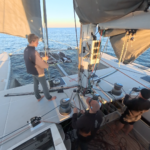



This glimpse is just one part of the story. In our Youngbarnacles Members Hub, our full video series on this Gunboat 68 covers everything from its deck layout and composite construction to its systems integration, giving you a complete understanding of what life on a high-performance multihull entails.
Become a Member today for access to this exclusive content and our detailed technical deep-dives.