Leveraging professional-grade components and techniques to fabricate high-performance rudders on a cruiser’s budget.
Author: Shayne & Anna
Introduction
Replacing Paikea’s non-original and failing rudders was a top priority. While designing from scratch was an option, a fortunate discovery offered a faster, more cost-effective path: a set of rudders from the 2007 America’s Cup. This post details the process of creating moulds from these elite foils and the unexpected discovery that will take their performance a step further.
The Master Plug: Sourcing Hydrodynamics from the Cup
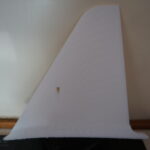
The foundation of a good composite part is a perfect mould, which itself requires a perfect “plug.” The 2007 America’s Cup rudder provided exactly that—a hydrodynamically refined foil shape developed with a level of R&D far beyond a typical cruiser’s budget. By selecting the optimal section of the AC rudder, we inherited world-class hydrodynamics for the cost of materials.
Mastering the Mould: Teflon Release and Professional Finishes
To create the female mould, we used a professional-grade Teflon release system. Unlike traditional waxes, this leaves a flawless, high-gloss surface finish on the mould without any transfer, eliminating the need for post-mould polishing. This technique, common in high-volume production, ensures each rudder we lay up will have a perfect outer skin straight out of the mould.
The Build: Foam Cores and Strategic Reinforcement
The rudders are built as a composite sandwich:
- Pre-Shaped Foam Core: The internal foam core was pre-cut and slitted to allow it to conform perfectly to the mould’s shape.
- Solid Glass Base: A solid fiberglass plate was integrated at the base of each rudder. This provides a robust, threaded insert point for the future attachment of the winglets, allowing for adjustment and replacement.
The Game-Changing Discovery: America’s Cup Bulb Winglets
While planning the winglets, a breakthrough occurred: we discovered the original winglets from the bulbs of the 2007 America’s Cup yachts. These components are designed for one purpose—to control tip vortices and reduce induced drag. This is exactly the function we need for our rudder tips. While they present a moulding challenge due to their complex, handed geometry, they represent a direct transfer of America’s Cup technology to our performance cruiser.
Parallel Projects: Custom Rigging and Hull Prep
Alongside the rudder work, we progressed on other fronts:
- Spectra Strops: We fabricated custom loops from high-strength Spectra to attach our existing wire sidestays to the new rotating mast, a critical detail for a safe and reliable rig.
- Hull Priming: The hulls were sanded, faired, and primed, a milestone that signifies the end of the major hull work and the beginning of the finish phase.
Conclusion
This phase of the project demonstrates the power of a resourceful, professional approach. By using an 2007 America’s Cup rudder as a starting point and incorporating genuine Cup winglets, we are achieving a level of performance and sophistication that would typically be cost-prohibitive, all through knowledge and skilled execution.
Want More?
This is just the beginning of our rudder journey. Check out the Paikea Refit on our Free Resources page to see the continuing evolution of Paikea’s rudders.
- Why Our Catamaran Now Has a 23kg 3D Printer | Performance Upgrades
 Author: Shayne and Anna Key Topic: Adding a 23kg 3D printer to our weight-conscious catamaran is a strategic trade-off: the tool’s onboard manufacturing capability enables us to create custom, performance-enhancing parts like rudder winglets and solve unique marine challenges, ultimately providing more value than the weight it adds. It seems counterintuitive: we’re working tirelessly to lighten our… Read more: Why Our Catamaran Now Has a 23kg 3D Printer | Performance Upgrades
 - Atlantic Emergency: Managing a Rudder Failure on a Gunboat 68TOPIC:This post details a serious offshore emergency aboard a Gunboat 68, where a collision with an unknown object destroyed a rudder. It covers the immediate response, damage control, and the challenging sail to the Azores, showcasing professional-grade seamanship and problem-solving. Author: Shayne The second leg of our Gunboat 68 transatlantic delivery from Antigua to France presented… Read more: Atlantic Emergency: Managing a Rudder Failure on a Gunboat 68
- How We Sailed Our Catamaran 800 Nautical Miles With One RudderAuthor: Shayne & Anna TOPICS:This post details the emergency procedures and sailing techniques we used to safely cross the Atlantic after losing a rudder. It covers strategic use of daggerboards, sail balance for steering control, and advanced weather routing to manage an offshore crisis. Losing a rudder 800 nautical miles from land presents a sobering reality… Read more: How We Sailed Our Catamaran 800 Nautical Miles With One Rudder
- Crisis at Sea: How We Managed Losing a Rudder 800nm From LandKey Message: This post details the immediate response to losing a rudder offshore, covering crisis leadership, technical diagnosis using onboard instrumentation, and the strategic decisions that ensured a safe passage to land. Author: Shayne & Anna The moment of truth in any offshore passage comes not when things are going well, but when they go wrong.… Read more: Crisis at Sea: How We Managed Losing a Rudder 800nm From Land
- The Pre-Splash Push: Integrating Engine Work, Composite Rudder Mods, and Custom FairingsKey Topic: Facing a firm launch deadline, we executed a coordinated final push on our catamaran’s critical systems. This involved servicing the saildrives, preparing new rudders for future winglets by installing a carbon rod backbone, and fabricating custom fairings to improve hull hydrodynamics. With a focus on engineering robust solutions—from reinforcing foils to managing a… Read more: The Pre-Splash Push: Integrating Engine Work, Composite Rudder Mods, and Custom Fairings
- Building Rudders Designed for Wings: An America’s Cup Inspired ProjectLeveraging professional-grade components and techniques to fabricate high-performance rudders on a cruiser’s budget. Key Message: True innovation in a refit often comes from creatively repurposing existing high-performance technology and combining it with meticulous, professional fabrication techniques. Author: Shayne & Anna Introduction Replacing Paikea’s non-original and failing rudders was a top priority. While designing from scratch was an… Read more: Building Rudders Designed for Wings: An America’s Cup Inspired Project
- Major Hull Surgery: Transom Modifications, Fairing, and Sourcing an America’s Cup Rudder
 Executing multiple complex hull projects with a focus on structural integrity and performance gains. Author: Shayne & Anna Key Message: A systematic, professional approach allows multiple major refit projects to be run in parallel, turning a daunting workload into a series of manageable, high-impact upgrades. Introduction Transforming a boat’s hull lines is one of the most ambitious… Read more: Major Hull Surgery: Transom Modifications, Fairing, and Sourcing an America’s Cup Rudder
 - Hull Surgery: Uncovering the Truth Behind a Major Rudder ImpactKey Message: A proper repair requires understanding the original failure. By grinding back a poor previous fix, we uncovered the full story of a major grounding and executed a permanent, structural solution that also informs our future rudder design. Author: Shayne & Anna Introduction: Uncovering a Hidden Failure During our refit, a small, suspicious repair above… Read more: Hull Surgery: Uncovering the Truth Behind a Major Rudder Impact

Want a deep dive into boatbuilding? Check out our Members Hub where we share more details on Paikea’s Upgrades and share resources you can use for your own project.