
Removing a Volvo Penta Sail Drive
Every seven years, that rubber boot needs to come out. Ours might have been original.
Paikea runs a Volvo Penta 2003 series engine through a saildrive — the same setup on plenty of production cats her age, and the same weak point too. The boot is the rubber gaiter that seals the saildrive leg where it passes through the hull, and it’s the one thing standing between the engine bay and the ocean. Volvo’s own guidance is a seven-year replacement interval. Paikea was on hull number one at thirty-one years old, and there was no service history to say the boot had ever been touched. Time to find out.
Getting to it meant working backwards through everything connected to the saildrive first. The exhaust hose came off, then the raw water intake — the same cooling loop that draws seawater up through the saildrive, runs it through the strainer, pushes it through the raw water pump into the heat exchanger, and sprays it into the exhaust mixer to cool the exhaust gases before they hit the hoses. The loop up and over near the waterline isn’t decoration — it’s what stops water siphoning back down into the engine and filling it when the boat’s underway. Get that geometry wrong on a rebuild and you can drown an engine that was otherwise fine.
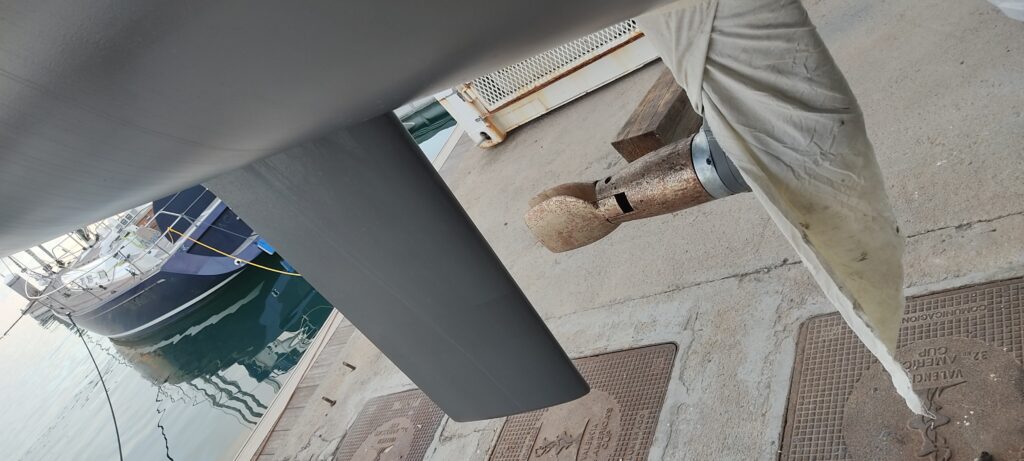
With the plumbing disconnected, the selector cable came off, then the output shaft was pulled out of the gear case — worth doing before lifting the saildrive itself, since it makes the whole unit lighter and easier to work out through the top of the hull. From there it was down to six bolts holding the gear case to the bell housing, and the saildrive lifted clear.
What came out wasn’t reassuring. The seal carrier showed real wear in the track where the seals run — a groove that shouldn’t have been there, and enough of it that it had started chewing into a bearing. Some bearings had pitting from metal swarf working its way through the assembly, tiny scratch marks that told the story of gears that had already started shedding material. The oil between the two seals — the one that separates the outer water seal from the inner oil seal — was milky, a sign water had been getting past the first line of defence. It hadn’t reached the actual saildrive oil yet, which was still clean, but it was on its way. Add in an engine mount that had seen better days, and the whole exercise justified itself before the new boot was even ordered.
Sourcing the parts wasn’t simple either. Volvo Penta parts from the UK, post-Brexit, meant navigating import duties on top of the usual wait — one more small tax on keeping a European-built boat running smoothly for a family that isn’t in Europe to stay.
The saildrive service ran alongside the rest of the haul-out list — finishing the rudders, fairing and filling the daggerboards, building up the hull’s primer coats toward the final antifoul. None of it happens in isolation on a boat this size; the yard period is one long list, and the saildrive just happened to be the job that opened up the biggest can of worms.
More About Saildrives
This is part one of the saildrive service — the teardown and inspection. Part two of this service — the reassembly, new boot, and getting Paikea watertight again — is covered in Servicing a Volvo Penta Saildrive.
For the full equipment reference on Paikea as she stands today, visit Paikea’s Systems