Key Message: Sailing a performance catamaran upwind efficiently requires managing the interplay between boat speed and sail trim. As acceleration pulls the apparent wind forward, the mechanical limit of your jib car track often becomes the deciding factor between pointing high and maintaining power. This real-world demonstration from a Gunboat 68 delivery shows how understanding this trade-off is essential for optimizing upwind performance.
Author: Shayne and Anna
Efficient upwind sailing in a performance catamaran is a dynamic balance of power and precision. It’s not just about sheeting in and pointing as high as the numbers suggest; it’s about understanding how your boat’s speed alters the wind you feel and how your hardware limits your options.
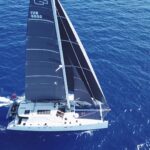
During a recent delivery of a Gunboat 68 across the Gulf of Leon in winds ranging from 18 to 32 knots, we had a perfect opportunity to demonstrate this balance in real-time, from heavy-weather reefing to fine-tuning for flat-water speed.
The Apparent Wind Effect in Practice
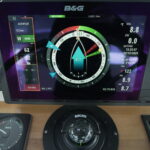
A common point of confusion for sailors is seeing the true wind angle (TWA) increase on the instruments while sailing hard on the wind. As we accelerated in the Gunboat, the boat speed began to significantly influence the apparent wind.
- At lower speeds, we saw a true wind angle of around 44-45 degrees.
- As we accelerated, the apparent wind was pulled forward, and the true wind angle increased to 53 degrees.
This isn’t the boat sliding sideways; it’s the boat moving fast enough to change the apparent wind direction. The faster you go, the more the wind you feel—the apparent wind—comes from further forward. This is the “apparent wind effect” that performance multihulls and dinghies exploit.
The Real-World Limiter: Your Jib Car Track
This is where theory meets the deck. As the apparent wind moves forward, you need to sheet your headsail flatter and tighter to maintain an efficient angle of attack. However, you are physically limited by your hardware.
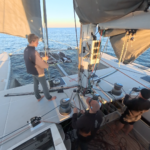
In our case, the jib car was already at its innermost position on the track. This meant we could not sheet the sail any flatter. We had reached the boat’s mechanical limit for pointing ability.
This created a clear trade-off:
- Pinch: Try to point higher than the sail trim allowed, stalling the sail and losing speed.
- Foot: Ease slightly to a lower true wind angle, keeping the sail powered and the boat moving fast through the water.
We chose to foot, accepting a slightly wider angle to maintain high boat speed and power, which ultimately provides better Velocity Made Good (VMG) to windward.
The Professional Takeaway
The key lesson is to understand your boat’s trim limits before you’re on the water. Know how far in your jib cars can travel. When you’re sailing upwind and the breeze builds, don’t just watch the wind angles. Check your car position. If it’s maxed out, your options are to either reef to depower and point higher, or accept a lower pointing angle to maintain speed. It’s a practical decision that directly impacts your performance.
See More Systems in Detail
This kind of real-time performance analysis is what we document in depth. In the Youngbarnacles Members Hub, our series on this Gunboat 68 covers its deck layout and sail systems.
See the playlist below for more on Sailing Large Performance Multihulls or visit our Free Performance Sailing Resources page for more.
- Apparent Wind vs. True Wind: The Biggest Misconception in Sailing
 Authors: Shayne and Anna Introduction You’re sailing downwind on a beautiful performance catamaran. You glance at the instruments. One display says you’re going upwind at 150 degrees. Another says you’re going downwind. Which one is right? The answer is both. And that confusion is the biggest misconception in sailing. In this guide—filmed onboard the Gunboat… Read more: Apparent Wind vs. True Wind: The Biggest Misconception in Sailing
 - The Art and Science of the Self-Tacking Jib: Why It’s More Complicated Than You ThinkAuthor: Shayne and Anna Introduction If you’ve ever spent a long day on the water tacking up a tight channel, you know the appeal of a self-tacking jib. The promise is simple: ease, simplicity, and the ability to short-hand the boat without a grinders’ pit crew on the rail. But as with anything in sailing,… Read more: The Art and Science of the Self-Tacking Jib: Why It’s More Complicated Than You Think
- A Privileged View: Showcasing the Iconic Gunboat 66 “Outnumbered”Author: Shayne & Anna As liveaboard sailors and marine professionals, we’re constantly surrounded by beautiful boats. But every so often, we encounter a vessel that is truly special—an icon that stops you in your tracks. The Gunboat 6602, “Outnumbered,” is one of those boats. We’ve been entrusted with a unique task: caring for this legendary performance… Read more: A Privileged View: Showcasing the Iconic Gunboat 66 “Outnumbered”
- Atlantic Emergency: Managing a Rudder Failure on a Gunboat 68TOPIC:This post details a serious offshore emergency aboard a Gunboat 68, where a collision with an unknown object destroyed a rudder. It covers the immediate response, damage control, and the challenging sail to the Azores, showcasing professional-grade seamanship and problem-solving. Author: Shayne The second leg of our Gunboat 68 transatlantic delivery from Antigua to France presented… Read more: Atlantic Emergency: Managing a Rudder Failure on a Gunboat 68
- The Art of Light-Air Passagemaking: Sailing a Gunboat 68 Across the AtlanticTOPIC:This post analyzes a transatlantic delivery on a Gunboat 68, focusing on the techniques and technologies that enable high average speeds in light conditions. It covers the relationship between speed and comfort, advanced sail aerodynamics, and practical rules for optimizing mast rotation. Author: Shayne What defines a true performance cruiser? It’s not just top speed in… Read more: The Art of Light-Air Passagemaking: Sailing a Gunboat 68 Across the Atlantic