The Hybrid Design Workflow: Building a Boat Shower Floor with Cardboard, CAD, and 3D Scanning: Walk through the hybrid design process for a custom boat shower floor. See how cardboard prototyping, CAD, 3D scanning, and 3D printing combine to solve complex drainage and access problems in a marine refit.
Author: Shayne and Anna
Introduction
Designing a complex, one-off part for a boat interior—like a shower floor that must drain perfectly, provide access, and integrate plumbing—requires more than guesswork. It demands a methodology that bridges intuitive understanding and digital precision. For our latest refit project, we employed a hybrid workflow, moving seamlessly from physical prototyping to advanced digital verification and fabrication. This post breaks down that process, from “Cardboard Assisted Design” to the final 3D print preparation.
Phase 1: Cardboard Assisted Design (The “Other” CAD)
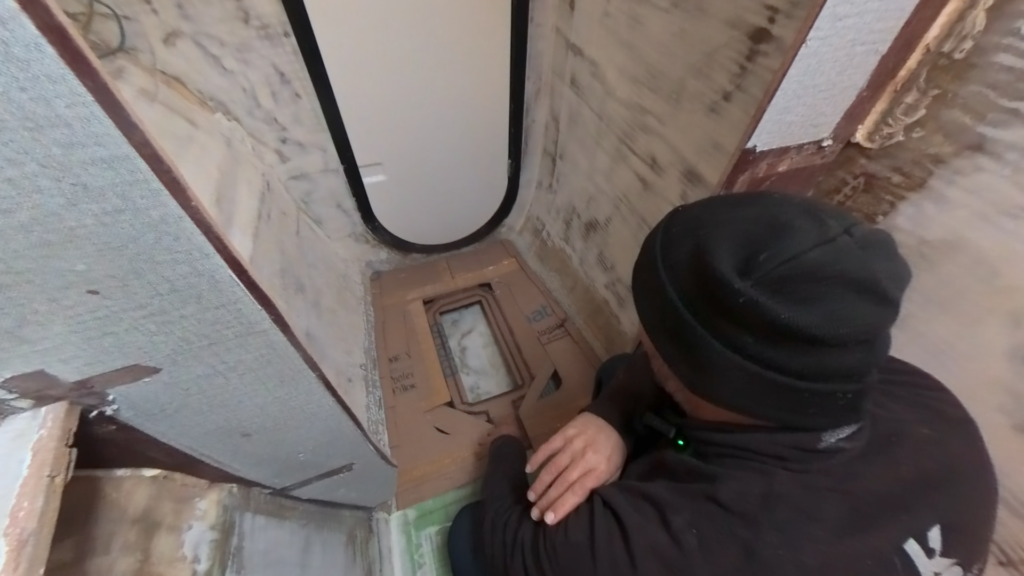
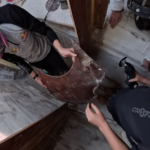
It all starts in the real world. Before a single polygon is modeled, we create full-scale mock-ups using foam board and cardboard. This “Cardboard Assisted Design” phase is irreplaceable for:
- Ergonomics & Spatial Awareness: Understanding how the floor feels in the space, the reach to the hatch, and the overall scale.
- Initial Problem Solving: Quickly testing ideas for drainage direction and hatch placement in three dimensions.
- Creating a Template: The cardboard model provides the exact outline and key landmark locations to transfer onto the final foam core material.
This hands-on stage informs every digital decision that follows, grounding the design in physical reality.
Phase 2: Translation to Digital CAD
The cardboard model provides the essential framework, which is then digitized. In the computer-aided design (CAD) software, we build upon this foundation with precision:
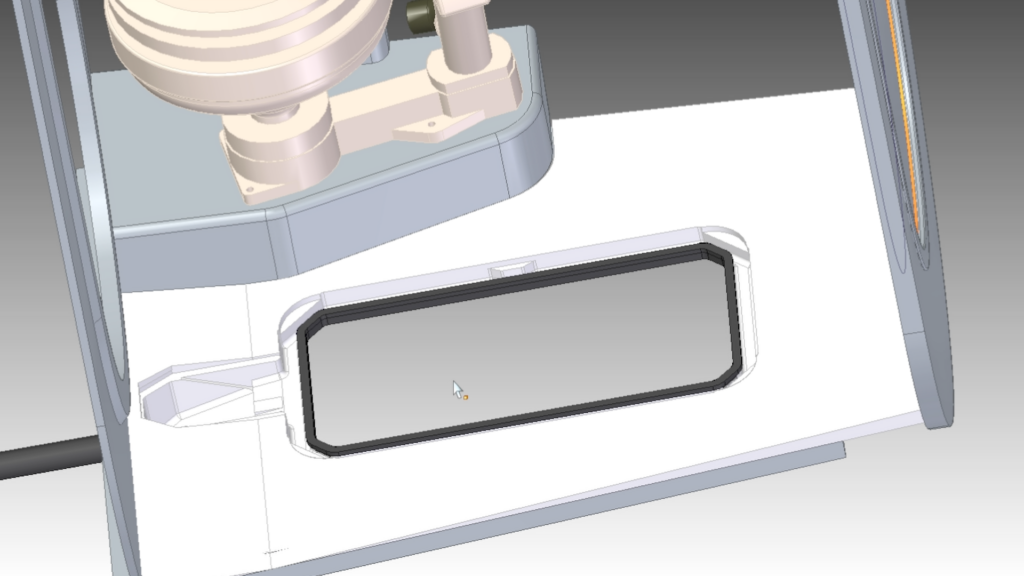
- Defining Drainage Geometry: We model exact falls (slopes) by creating tapered wedge sections in the foam core. The design features a central valley to collect water from both the fore and aft sections of the floor, mitigating issues from boat trim changes.
- Hatch Engineering: The large inspection hatch is more than a hole. Its design includes:
- Seal Compression Stops: Small steps in the hatch surround prevent over-compression and damage to the neoprene seal.
- Flow-Through Geometry: Ramps and radii in corners prevent water and scum from pooling, ensuring everything drains into the gutter.
- Dual Retention: The model accommodates both a simple bungee cord system and a backup mechanical hook-and-wingnut option.
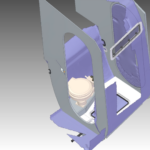
- Integrated Systems Design: The sump is modeled with a steep fall and a step to hold a stainless steel mesh hair trap. A carbon fiber tube is routed through a bulkhead, separating the wet collection area from the dry pump location—a critical lesson learned from past flooding experiences.
Phase 3: Verification with 3D Scanning
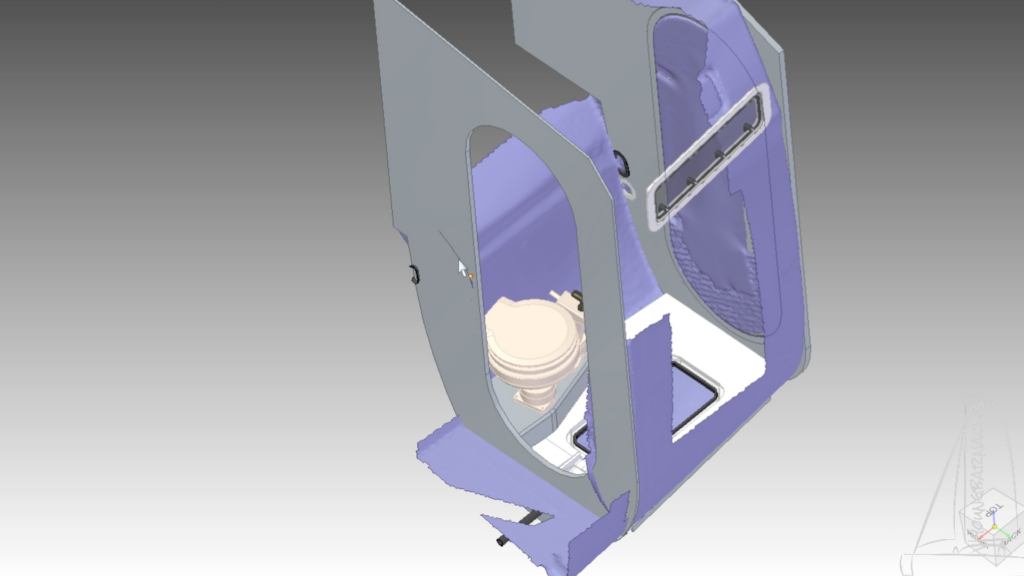
Even with careful measurements, the curved, organic shapes of a boat hull can differ from idealized CAD models. To ensure a perfect fit for bulky components like the toilet, we employed 3D scanning.
- We scanned the specific compartment, creating a “point cloud” reality check.
- This scan was imported into the CAD environment, where we could overlay our designed components.
- The result was twofold: confidence that the toilet placement was feasible (no clashes with the actual hull), and the ability to tweak nearby bulkhead models to match the boat’s true shape. For complex refits, scanning is an invaluable tool for bridging the digital/physical gap.
Phase 4: Preparing for Fabrication – 3D Printing the Mould
With the design verified, the CAD model shifts from a virtual part to a tool for making the part. The negative space of our drain and sump cavity is used to create a positive mould.
- The complex mould geometry is split into sections that fit within the build volume of our FDM 3D printer.
Conclusion
The journey from a rough cardboard mock-up to a ready-to-print mould file exemplifies modern practical fabrication. It combines the irreplaceable tactile feedback of physical prototyping with the accuracy, testability, and fabrication power of digital tools. This hybrid approach—Cardboard, CAD, Scan, Print—ensures that the final composite part isn’t just theoretically sound, but perfectly suited to the real-world, irregular environment of a boat. It demonstrates that thoughtful process is the most critical tool in the builder’s kit.
More Floor Construction
Building new composite floors has helped us make big gains on our quest to remove weight and lighten Paikea.
- Solving Boat Shower Drainage with Cardboard, CAD, 3D Scanning & 3D Printing
 The Hybrid Design Workflow: Building a Boat Shower Floor with Cardboard, CAD, and 3D Scanning: Walk through the hybrid design process for a custom boat shower floor. See how cardboard prototyping, CAD, 3D scanning, and 3D printing combine to solve complex drainage and access problems in a marine refit. Author: Shayne and Anna Introduction Designing… Read more: Solving Boat Shower Drainage with Cardboard, CAD, 3D Scanning & 3D Printing
 - The Boat Shower Floor Blueprint: Drainage, Hatches & Avoiding Bilge FloodsWhen your floor needs to drain, provide access, and never flood the bilge. A deep dive into the logic behind our custom shower hatch. Key Topic: Join Shayne & Anna in the bilges for a marine design deep-dive. We’re solving the boat shower’s trickiest puzzle: creating a floor that drains properly, includes mandatory access hatches,… Read more: The Boat Shower Floor Blueprint: Drainage, Hatches & Avoiding Bilge Floods
- Diagnosing and Repairing Hull Delamination and Core Damage.The Problem: From Floor Installation to Structural Repair Author: Shayne and Anna During the installation of new cabin soles in our Catana 42 refit, a routine task uncovered a significant structural issue. The discovery process is a textbook example of why systematic disassembly is critical. Initial Indicators: The Technical Failure:In a cored composite structure (like… Read more: Diagnosing and Repairing Hull Delamination and Core Damage.
- Re-Engineering a Hull: Load Paths, Daggerboards, and a New Structural BulkheadAuthor: Shayne and Anna Key Message: The most important part of a structural refit is understanding and optimizing load paths. By relocating a bulkhead to align with the strongest part of the daggerboard foil, we significantly increase Paikea’s structural integrity and sailing performance. Introduction: Identifying a Structural Flaw During Paikea’s refit, we noticed a discrepancy. On… Read more: Re-Engineering a Hull: Load Paths, Daggerboards, and a New Structural Bulkhead
- Refit Progress: Templating, Infusing, and Building a New Laminating TableKey Message: A major refit is a series of small, repetitive, and precise steps. By creating a family “assembly line” for templating and infusion, we’re efficiently producing lightweight, custom composite floors while constantly improving our workshop tools. Author: Anna & Shayne Introduction: The Flooring Assembly Line The transformation of Paikea’s interior continues, one floor panel at… Read more: Refit Progress: Templating, Infusing, and Building a New Laminating Table