Authors: Shayne and Anna
Introduction
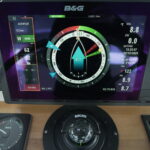
You’re sailing downwind on a beautiful performance catamaran. You glance at the instruments. One display says you’re going upwind at 150 degrees. Another says you’re going downwind. Which one is right?
The answer is both. And that confusion is the biggest misconception in sailing.
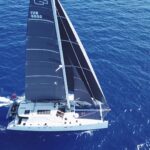
In this guide—filmed onboard the Gunboat 66 Outnumbered —we break down the difference between apparent wind and true wind, why dagger boards matter, and what it really means to be a “wind speed boat.”
What is True Wind?
True wind is the speed and direction of the wind if you were standing still. On a dock. On a boat at anchor. Not moving.
If you’re sitting still in the middle of the ocean, the wind you feel on your face is the true wind.
What is Apparent Wind?
Apparent wind is the wind you feel when the boat is moving. It’s a combination of the true wind plus the wind created by the boat’s own forward motion.
Think of it like riding a bicycle on a still day. There’s no true wind, but as you pedal, you feel wind on your face. That’s apparent wind created by your motion.
On a sailboat, the apparent wind is what the sails actually see. It’s what fills the canvas and drives the boat forward.
Generating Your Own Wind
On a performance windspeed catamaran like this Gunboat 66, things get interesting.
We started sailing deep downwind with the Code Zero up. Our true wind angle was 150 degrees—well aft of the beam. But as the boat accelerated, the apparent wind began to climb forward, eventually settling around 60 degrees.
Think about that for a moment.
The true wind was still behind us. But the apparent wind—the wind the boat was actually sailing to—was now forward of the beam.
This is what defines a true performance boat. It goes fast enough to generate its own wind, allowing it to sail at much tighter angles to the true wind than a displacement boat ever could.
Dagger Boards: Grip, Slip, and Safety
When the apparent wind shifts forward, the loads on the rig change. The sails start pulling more sideways. That’s where dagger boards come in.
With the Code Zero up and the apparent wind at 125 degrees, we didn’t need full boards down. In fact, we wanted a little slip—a bit of sideways drift—to prevent climbing too high toward the coast.
We pulled the boards halfway up.
But if we were going to bring the apparent wind all the way forward to 55 or 60 degrees, we’d need the boards fully down to resist that lateral force and convert it into forward motion.
The Safety Angle
Here’s something often overlooked: dagger boards are safer than fixed keels.
With fixed keels, you have maximum grip all the time. If a gust hits, the sails have something solid to trip over—and the boat can capsize.
With dagger boards, you can pull them up. Less grip means less capsizing moment. You can depower the boat instantly by reducing lateral resistance.
That’s a huge safety advantage.
Autopilot: The Most Common Mistake
We see this all the time: someone sailing downwind with the autopilot on heading hold.
Here’s what happens:
- Boat accelerates down a wave
- Apparent wind rushes forward
- Autopilot, locked to a compass heading, does nothing
- Spinnaker shoulder collapses
- Kite collapses, boat slows down
- Apparent wind moves aft, spinnaker refills with a loud BOOF
- Repeat
This cycle is inefficient, uncomfortable, and hard on gear.
The solution is wind mode (apparent wind angle). This tells the autopilot to steer like a human—keeping the telltales flowing, holding a constant angle to the apparent wind. As the boat accelerates, the autopilot bears away slightly. As it slows, it heads up.
The result? Smooth, fast, efficient sailing.
The “Wind Speed” Lie
This is the biggest misconception of all.
We see YouTube videos where someone claims, “We’re doing wind speed!” They show speed over ground at 10 knots and apparent wind speed at 10 knots. Case closed, right?
Wrong.
True wind speed is the only metric that matters.
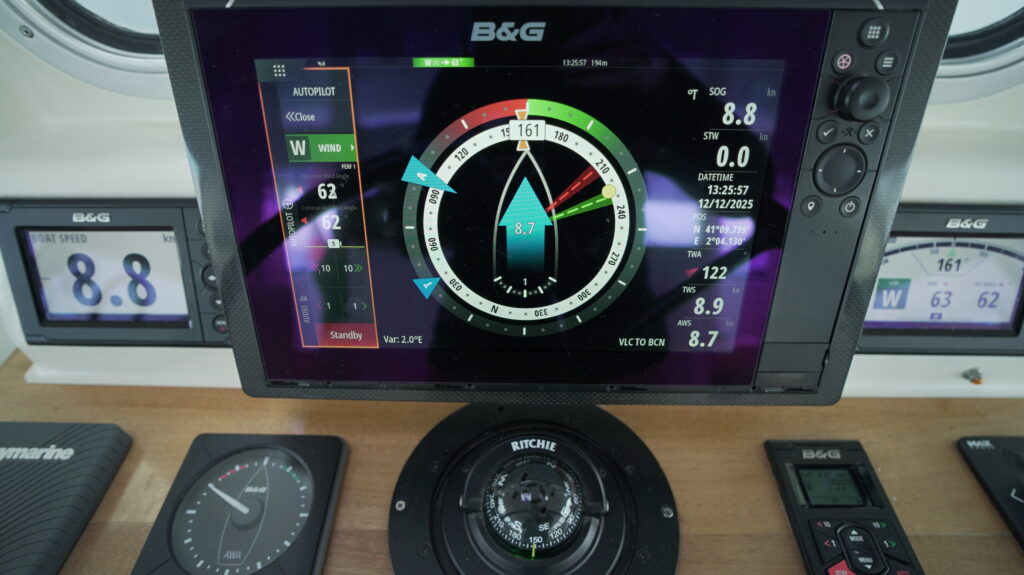
In the video, we caught a moment where our speed over ground hit 8.7 knots and apparent wind speed was 8.7 knots. But our true wind speed was over 20 knots. We were surfing down a wave, which made the apparent wind drop. It was a coincidence, not a benchmark.
A true wind speed boat is one that can sail at the speed of the true wind. Later in the video, we hit 8.3 knots boat speed in 8 knots of true wind. That’s the real deal.
If you’re comparing your boat speed to apparent wind speed downwind, you’re fooling yourself. Downwind, apparent wind is always lower than true wind. It’s physics.
GPS vs. Speed Through Water
One technical note: on this boat, the paddle wheel speedo was broken (missing paddles and fouled). So we calibrated all instruments to GPS speed over ground.
Some purists will argue this isn’t correct. But in reality, for calculating true wind, GPS speed is often more accurate—especially in areas with minimal current. It eliminates errors from fouled sensors or calibration drift.
That’s a debate for another day.
Conclusion
Understanding apparent wind versus true wind isn’t just academic. It affects:
- Sail selection
- Dagger board trim
- Autopilot settings
- Performance benchmarks
- Safety decisions
Next time you see someone claiming their boat is a “wind speed boat,” look closely. Are they using true wind or apparent wind?
Want to Learn more about Large Performance Multihulls?
These videos are a collection filmed on large performance multihulls including the Gunboat68, Gunboat 66 and Altantic72.
- Apparent Wind vs. True Wind: The Biggest Misconception in Sailing
 Authors: Shayne and Anna Introduction You’re sailing downwind on a beautiful performance catamaran. You glance at the instruments. One display says you’re going upwind at 150 degrees. Another says you’re going downwind. Which one is right? The answer is both. And that confusion is the biggest misconception in sailing. In this guide—filmed onboard the Gunboat… Read more: Apparent Wind vs. True Wind: The Biggest Misconception in Sailing
 - The Art and Science of the Self-Tacking Jib: Why It’s More Complicated Than You ThinkAuthor: Shayne and Anna Introduction If you’ve ever spent a long day on the water tacking up a tight channel, you know the appeal of a self-tacking jib. The promise is simple: ease, simplicity, and the ability to short-hand the boat without a grinders’ pit crew on the rail. But as with anything in sailing,… Read more: The Art and Science of the Self-Tacking Jib: Why It’s More Complicated Than You Think
- A Privileged View: Showcasing the Iconic Gunboat 66 “Outnumbered”Author: Shayne & Anna As liveaboard sailors and marine professionals, we’re constantly surrounded by beautiful boats. But every so often, we encounter a vessel that is truly special—an icon that stops you in your tracks. The Gunboat 6602, “Outnumbered,” is one of those boats. We’ve been entrusted with a unique task: caring for this legendary performance… Read more: A Privileged View: Showcasing the Iconic Gunboat 66 “Outnumbered”
- Atlantic Emergency: Managing a Rudder Failure on a Gunboat 68TOPIC:This post details a serious offshore emergency aboard a Gunboat 68, where a collision with an unknown object destroyed a rudder. It covers the immediate response, damage control, and the challenging sail to the Azores, showcasing professional-grade seamanship and problem-solving. Author: Shayne The second leg of our Gunboat 68 transatlantic delivery from Antigua to France presented… Read more: Atlantic Emergency: Managing a Rudder Failure on a Gunboat 68
- The Art of Light-Air Passagemaking: Sailing a Gunboat 68 Across the AtlanticTOPIC:This post analyzes a transatlantic delivery on a Gunboat 68, focusing on the techniques and technologies that enable high average speeds in light conditions. It covers the relationship between speed and comfort, advanced sail aerodynamics, and practical rules for optimizing mast rotation. Author: Shayne What defines a true performance cruiser? It’s not just top speed in… Read more: The Art of Light-Air Passagemaking: Sailing a Gunboat 68 Across the Atlantic
- Catamaran Doors Jammed? Why It’s a Sign of Structural FlexKey Message: Jammed doors on a catamaran are more than an inconvenience; they are a primary indicator of a hull flexing beyond its design intent. Using a real-world demonstration from a high-performance multihull, we break down why this common issue should not be accepted as normal, even on older boats. This article provides a professional perspective… Read more: Catamaran Doors Jammed? Why It’s a Sign of Structural Flex
- Want to sail FAST? It’s not always smooth sailing!Key Message: The pursuit of speed on a performance catamaran demands a direct trade-off with comfort, governed by inescapable physics. Driving a hull through waves at 12 knots transforms the motion below decks into a persistent, high-frequency “jiggle” that can make rest and routine tasks challenging, even on a well-built, luxury vessel. This isn’t a design… Read more: Want to sail FAST? It’s not always smooth sailing!
- Sailing Upwind in a Performance Catamaran: Mastering Apparent WindKey Message: Sailing a performance catamaran upwind efficiently requires managing the interplay between boat speed and sail trim. As acceleration pulls the apparent wind forward, the mechanical limit of your jib car track often becomes the deciding factor between pointing high and maintaining power. This real-world demonstration from a Gunboat 68 delivery shows how understanding… Read more: Sailing Upwind in a Performance Catamaran: Mastering Apparent Wind