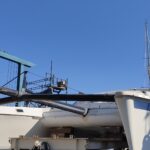
Executing multiple complex hull projects with a focus on structural integrity and performance gains.
Author: Shayne & Anna
Key Message: A systematic, professional approach allows multiple major refit projects to be run in parallel, turning a daunting workload into a series of manageable, high-impact upgrades.
Introduction
Transforming a boat’s hull lines is one of the most ambitious projects an owner can undertake. For us, it was a necessary step to improve both form and function. This project log covers the intense, multi-faceted work period where we executed transom extensions, full hull fairing, and began the journey of creating new high-performance rudders—a journey that took a thrilling turn with the acquisition of an ex-America’s Cup foil.
The Transom Extension: Adding Form and Function
The original transoms offered little practical space for boarding or swimming. Our goal was to create integrated swim platforms without compromising structural integrity.
The Process: After carefully cutting back the existing transom, we built a foam-and-fiberglass framework, vacuum-bagging the initial layers for optimal consolidation. The final structural glass work tied the new extension seamlessly into the existing hull grid, creating a strong, monolithic structure.
The Payoff: This extension provides secure access from the water and a more practical platform for stern-to mooring, significantly enhancing liveaboard comfort and safety.
Hull Fairing and Systems Rationalization
With the structure complete, the focus shifted to the hull surface itself.
The Great Sand-Off: We stripped the hulls down to the epoxy primer, a dusty but critical step to achieve a perfect base for new antifouling. A fair hull is a fast hull, reducing drag and improving sailing performance.
Removing Redundant Skin Fittings: Every through-hull is a potential point of failure. We systematically identified and glassed over unused seacocks, reducing complexity and enhancing overall safety.
The Rudder Project: A Tale of Discovery and Opportunity
The removal of the old rudders revealed more than we expected and opened the door to a major performance upgrade.
The Discovery: Upon extraction, we found the old rudders were water-logged, adding significant weight and compromising the core material. This confirmed the necessity of our planned rebuild.
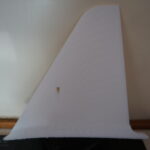
The Opportunity: Rather than building from scratch, we sourced a rudder from the Spanish Ibedrola America’s Cup campaign. This provided us with a proven, high-performance foil shape to use as a master for creating our new rudders.
The Method: We created a “splash mold” from the America’s Cup rudder. This process involves taking a precise female mold directly from the existing object, allowing us to reproduce its exact hydrodynamics in our new, custom-built rudders.
Conclusion
This phase of the refit was about laying the groundwork for massive performance and lifestyle gains. By methodically tackling structural modifications, surface preparation, and leveraging high-performance opportunities, we are systematically transforming Paikea into the modern, capable performance cruiser we envision.
Author: Shayne and Anna Key Topic: Adding a 23kg 3D printer to our weight-conscious catamaran is a strategic trade-off: the tool’s onboard manufacturing capability enables us to create custom, performance-enhancing parts like rudder winglets and solve unique marine challenges, ultimately providing more value than the weight it adds. It seems counterintuitive: we’re working tirelessly to lighten our… Read more: Why Our Catamaran Now Has a 23kg 3D Printer | Performance Upgrades
TOPIC:This post details a serious offshore emergency aboard a Gunboat 68, where a collision with an unknown object destroyed a rudder. It covers the immediate response, damage control, and the challenging sail to the Azores, showcasing professional-grade seamanship and problem-solving. Author: Shayne The second leg of our Gunboat 68 transatlantic delivery from Antigua to France presented… Read more: Atlantic Emergency: Managing a Rudder Failure on a Gunboat 68
Author: Shayne & Anna TOPICS:This post details the emergency procedures and sailing techniques we used to safely cross the Atlantic after losing a rudder. It covers strategic use of daggerboards, sail balance for steering control, and advanced weather routing to manage an offshore crisis. Losing a rudder 800 nautical miles from land presents a sobering reality… Read more: How We Sailed Our Catamaran 800 Nautical Miles With One Rudder
Key Message: This post details the immediate response to losing a rudder offshore, covering crisis leadership, technical diagnosis using onboard instrumentation, and the strategic decisions that ensured a safe passage to land. Author: Shayne & Anna The moment of truth in any offshore passage comes not when things are going well, but when they go wrong.… Read more: Crisis at Sea: How We Managed Losing a Rudder 800nm From Land
Key Topic: Facing a firm launch deadline, we executed a coordinated final push on our catamaran’s critical systems. This involved servicing the saildrives, preparing new rudders for future winglets by installing a carbon rod backbone, and fabricating custom fairings to improve hull hydrodynamics. With a focus on engineering robust solutions—from reinforcing foils to managing a… Read more: The Pre-Splash Push: Integrating Engine Work, Composite Rudder Mods, and Custom Fairings
Want to see More?
Inside the Youngbarnacles Members Hub, we have extra content and details on our projects including Rudder Ventilation Anaylsis video which talks through some of the issues faced when considering the design of our new rudders.
 Author: Shayne and Anna Key Topic: Adding a 23kg 3D printer to our weight-conscious catamaran is a strategic trade-off: the tool’s onboard manufacturing capability enables us to create custom, performance-enhancing parts like rudder winglets and solve unique marine challenges, ultimately providing more value than the weight it adds. It seems counterintuitive: we’re working tirelessly to lighten our… Read more: Why Our Catamaran Now Has a 23kg 3D Printer | Performance Upgrades