
How to Sail Upwind in Your Catamaran
Catamarans have a reputation for sailing upwind badly, and daggerboards get blamed for most of it — either credited as the magic fix or dismissed as pointless clutter in the saloon. Neither view is quite right. Daggerboards genuinely do provide extra grip compared to the keeled hulls on most charter-style catamarans, but they’re a smaller part of the picture than most sailors assume. The real gains come from the sails — specifically, sail shape and sheeting angle — and understanding that properly changes how you sail upwind regardless of what’s under the hulls.
Reading Sail Shape Properly
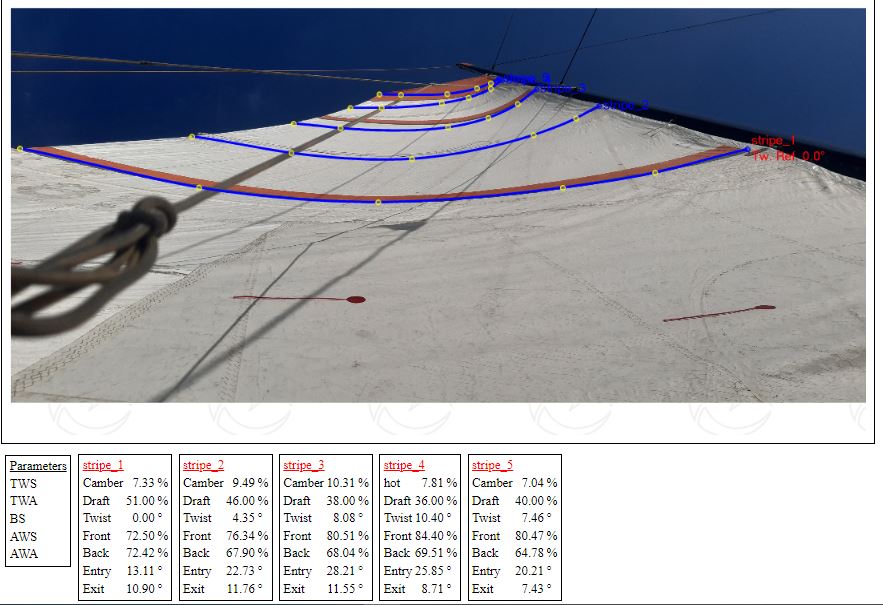
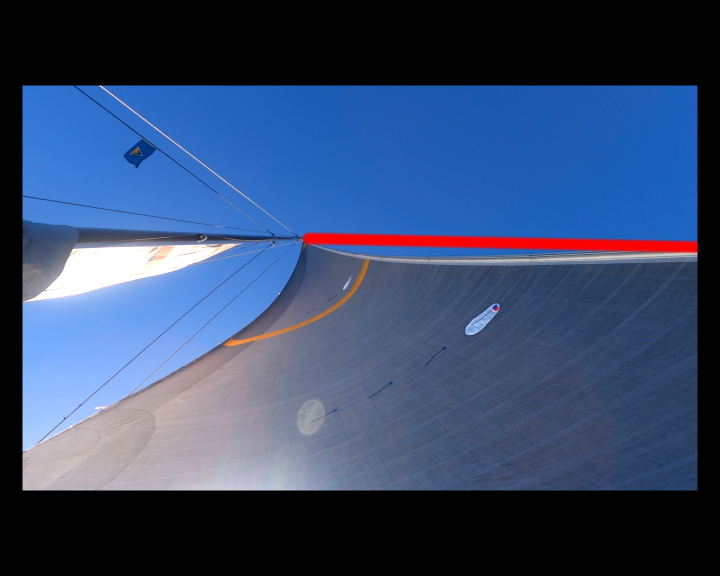
Sail stripes exist for a reason beyond looking fast — they’re a genuine visual tool for reading fullness and shape at a glance, on both main and jib. On a catamaran, the target upwind is relatively flat sails, and stripes make it possible to actually see whether you’re achieving that or just assuming it.
Forestay tension plays a bigger role in this than most sailors give it credit for. A tight forestay gives a stable, predictable sail shape. A sagging forestay does the opposite — sail shape actually changes cyclically as the boat moves through waves, going fuller as the bow drops into a wave and flattening again as it comes back up and straightens out. That constantly shifting shape is genuinely hard to trim against, because you’re not fighting one problem, you’re fighting a moving target.
The entry angle of the jib sets a hard ceiling on how close to the wind you can sail, full stop. A jib that’s too full and too baggy simply won’t fill properly at a tight apparent wind angle — somewhere around 30 degrees — no matter how well everything else is trimmed. If the entry angle is wrong, nothing downstream fixes it.
Sheeting Angle and the Exit Slot
The gap between the jib’s clew and the mainsail — the exit slot — needs the right sheeting angle to work efficiently, and it’s a second, independent limit on how close you can point. Even with good sail shape, too wide an exit slot bleeds efficiency and caps your pointing angle. A barber hauler, pulling the jib sheet in toward the boom, can close that slot up in favourable conditions and let the boat point noticeably higher — worth experimenting with rather than leaving the sheet lead in a fixed default position.
The Mainsail and Reading Twist
The same stripe-based approach applies to the mainsail — reading fullness and twist visually, backed up by onboard polar and trim software for more precise data on draft position and depth. A flat, controlled main shape is what actually drives the boat upwind rather than just adding drag, and it’s worth resisting the temptation to just look powerful rather than trim for genuine efficiency.
Reading Apparent vs. True Wind Upwind
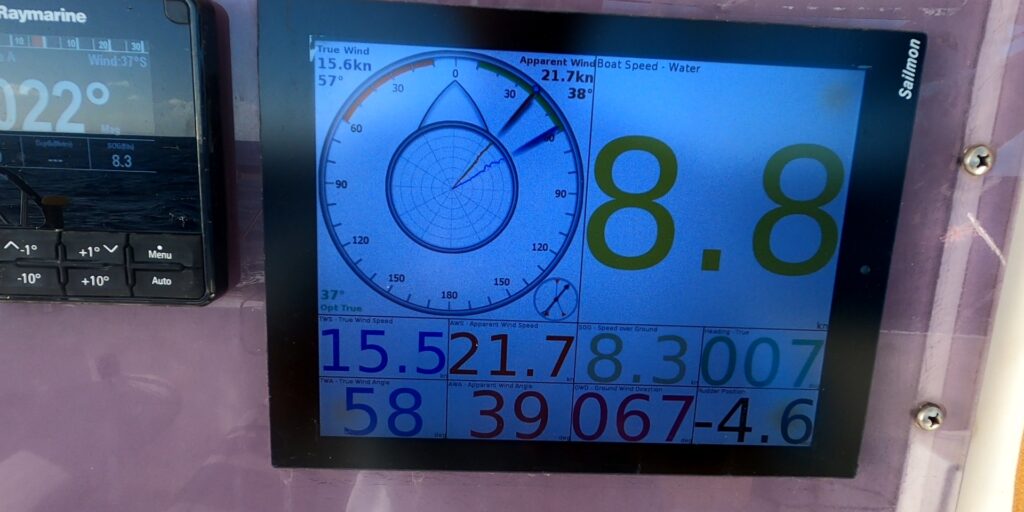
Apparent wind speed will always read higher than true wind speed sailing upwind — a fairly dramatic difference in some conditions, with the sails genuinely feeling several knots more breeze than what’s actually blowing over open water. That’s not an instrument error; it’s the boat’s own forward motion adding into the wind it’s sailing into. Apparent wind angle also drags forward of true wind angle upwind, the same phenomenon that happens (in the opposite direction) sailing downwind — worth understanding as one continuous relationship rather than two separate facts to memorise.
Weather Helm and Why It Matters
A small amount of weather helm — the boat’s natural tendency to round up into the wind, requiring slight rudder correction to hold a straight course — is actually a good thing upwind, not a flaw to eliminate entirely. With the rudder held at a slight angle correcting for that tendency, it’s effectively doing double duty: steering the boat, and adding a small amount of extra lift to windward in the process, much the way a daggerboard does. Too much weather helm, though, just adds drag and slows the boat down rather than helping — the goal is a small amount, not none at all and not an aggressive amount either.
Sailing on One Rudder
This particular session was sailed with only one rudder working — a real constraint at the time, not a deliberate technique demonstration, and part of a much longer stretch sailing this way. Paikea ran on a single rudder for close to two years throughout the Caribbean, right up until a replacement was finally built just before leaving St Martin to head to Barcelona for Shayne’s role with the French America’s Cup team. If you want the full story of how the rudder was lost and how the crew handled 800 nautical miles to St Lucia on what remained, it’s covered properly in Crisis at Sea: How We Managed Losing a Rudder 800nm From Land and How We Sailed Our Catamaran 800 Nautical Miles With One Rudder.
Sailing upwind on a single rudder changes the trim priorities noticeably. Boat speed becomes even more critical than usual, since a rudder needs water flowing across it properly to generate grip — sail too slow, and both the remaining rudder and the daggerboards lose effectiveness together, compounding the problem rather than one compensating for the other. Easing the traveller down, rather than easing the mainsheet directly, reduces load on the single rudder and, somewhat counterintuitively, actually helps the boat go faster rather than slower — less load fighting the rudder means less drag overall, even with a marginally less powered-up sail.
Shaking Out a Reef
With more sail area unrolled from a third reef, boat speed picked back up — and with it, pointing angle improved too, without giving up meaningful speed. The logic ties directly back to the rudder-and-daggerboard grip point above: more sail area, more drive, more boat speed, and more boat speed means more grip from both the daggerboards and the remaining rudder. It’s a compounding relationship, not a simple trade-off between speed and height.
Mast Rotation: The Upgrade Still Waiting
Rotating the carbon wing mast genuinely improves both pointing angle and speed upwind — a real, proven gain, not a marginal one. At the time of this sail, though, it wasn’t being used regularly, for a practical reason: without a mast rotation angle sensor properly integrated, rotating the mast throws off the boat’s other instrument readings, corrupting the polar data still being built out. Sometimes the right call is holding off on a genuine performance gain until the supporting systems are actually in place to use it properly, rather than chasing speed at the cost of data quality you’ll need later.
For more on the sheeting angle, jib entry angle, and telltale reading covered briefly here, the full breakdown is in How to Trim the Jib Upwind on a Catamaran. And for how daggerboard position specifically changes across different upwind conditions, see the Daggerboard Placement Guide. This post is part of the Paikea rudder story. Read the full series in sequence here → Paikea’s Rudders: The Full Story
In the Members Library
If you haven’t already, start with Paikea’s Rudders: The Full Story on the free site for the complete rudder evolution. Members get behind the scenes photos and description of our Rudder Build series plus in depth video covering underwater footage and analysis of rudder ventilation.
Composite Rudder Evolution and Design →