
Antigua Downwind Blast: Racing the Clock and Losing a Spinnaker
Some passages get planned weeks in advance. This one got planned around a party invitation and a six-hour weather window — get from Green Island, on the easternmost tip of Antigua, all the way around to Jolly Harbour on the western side, with enough time left over for beers and shopping before the afternoon started.
Morning Kiting at Green Island
Green Island is known locally as one of Antigua’s better kite surfing spots, and the morning made the case for that reputation clearly — a barrier reef protecting a genuinely large stretch of flat water, ideal for wing foiling before the day’s real sailing began. Getting in early paid off, with clean conditions and the beach still mostly empty.
Planning the Passage Around a Deadline
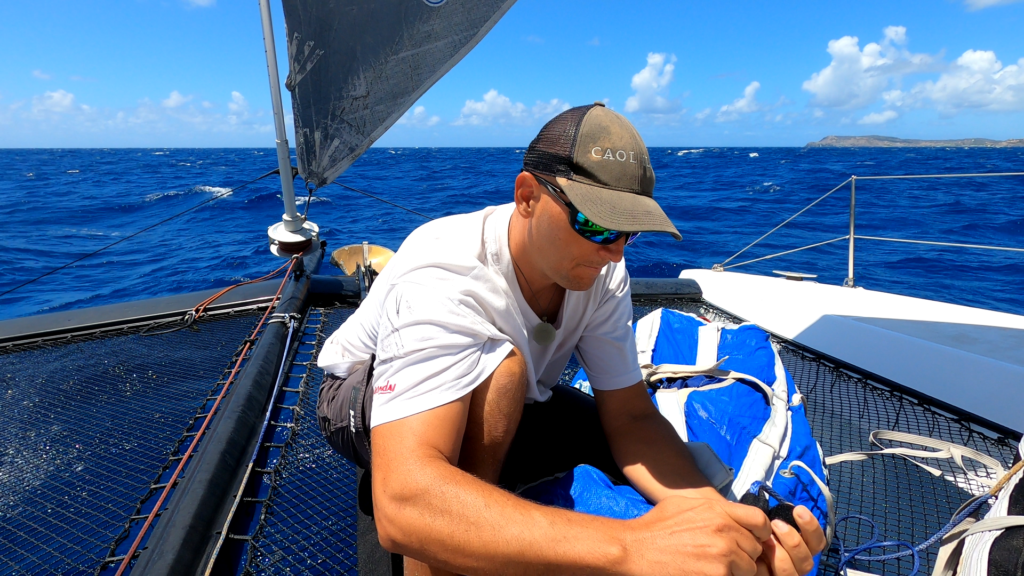
With the party starting at 4pm and departure at 10am, the math was tight but workable — roughly fourteen nautical miles, sailed downwind for most of it thanks to the prevailing easterly. The plan traced almost the same track as the trip up to Green Island in reverse: hold port tack down the coast, gybe onto starboard somewhere around the island’s southern corner, and likely drop the kite before finishing the approach into Jolly Harbour on a sail reach, once the wind started bending around the island’s lee.
Navigation ran on qtVlm through a Raspberry Pi setup rather than the boat’s built-in Raymarine system — genuinely nicer instrumentation, with the honest caveat that the crew was still more fluent on the Raymarine simply from familiarity, a good reminder that the “best” system on paper isn’t always the most usable one in the moment.
Sailing on One Rudder, Properly Loaded Up
This passage happened while still sailing with only the starboard rudder — the boat’s rudder loss mid-Atlantic crossing was still very much a live constraint on how Paikea handled, not just a story from the past. With the remaining rudder now on the leeward side for this point of sail, grip in the water was noticeably reduced, and conditions built to genuinely testing — 21 to 22 knots apparent wind, 18 knots true, the boat clearly feeling the difference. Steve, the autopilot, wasn’t up to handling the boat reliably in these conditions with only one rudder working, which meant Shayne hand-steering through some genuinely demanding moments.
One detail worth understanding about single-rudder handling: rudder position relative to the boat’s centreline matters enormously for how it behaves. A rudder positioned forward tends to spin the bow around uncontrollably; positioned aft, with more drag behind the pivot point than in front of it, the boat holds a straighter, more predictable line. It’s a simple piece of practical physics that made a real, tangible difference to how manageable the boat was to steer through this stretch.
Cavitation showed up more than once during the sail too — air being drawn down from the surface into the rudder blade, momentarily robbing it of grip and control right when it was needed most. It’s a genuinely disorienting thing to feel happen underfoot, and a good reason single-rudder sailing in a real breeze demands real concentration rather than routine autopilot cruising.
This single-rudder handling wasn’t a one-off emergency workaround — Paikea sailed like this for close to two years throughout the Caribbean, right up until a replacement rudder was finally built just before leaving St Martin to head back to Barcelona for Shayne’s role with the French America’s Cup team. The full story of how the rudder was lost in the first place, and how the crew sailed 800 nautical miles to St Lucia on what remained, is worth reading in full: Crisis at Sea: How We Managed Losing a Rudder 800nm From Land and How We Sailed Our Catamaran 800 Nautical Miles With One Rudder.
A Spinnaker Doesn’t Survive the Day
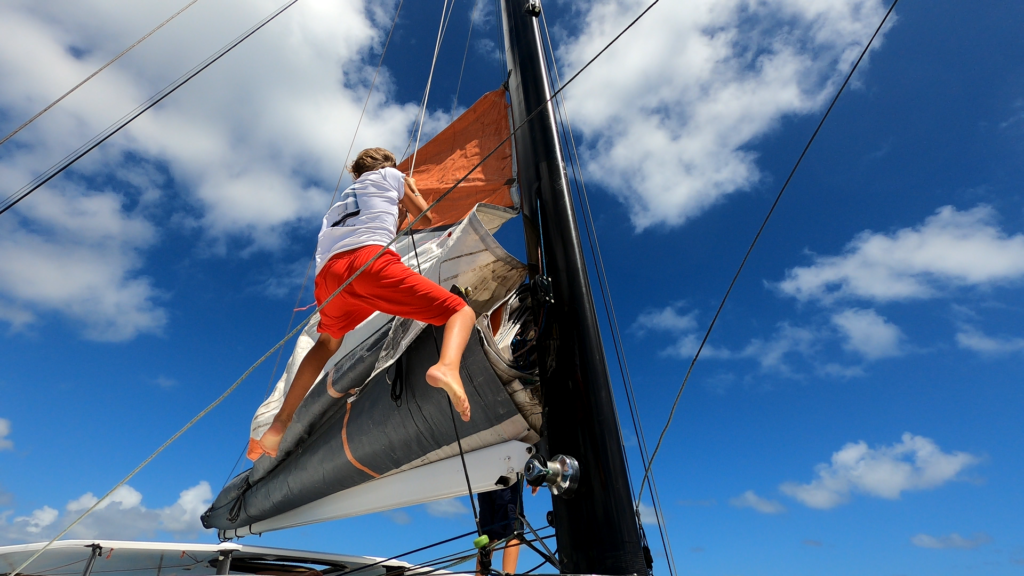
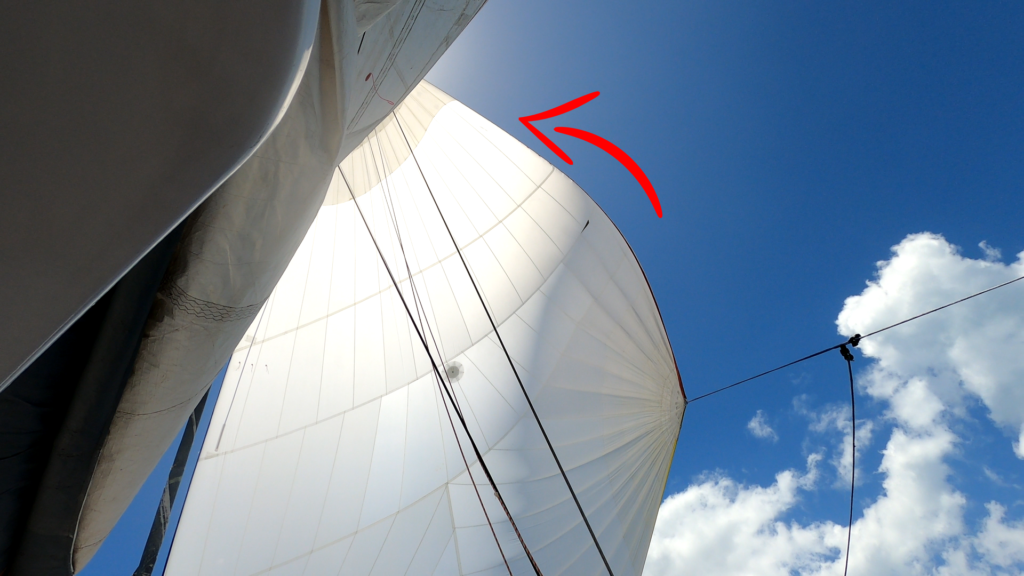
Somewhere in the middle of a fast, physical downwind blast, the fractional spinnaker — Frankie, a genuine favourite by this point in the trip — got badly twisted around the jib. Untangling it mid-sail didn’t happen cleanly enough, and the sail came away torn, split into two pieces rather than a single small failure. Not the catastrophic all-at-once blowout of a first spinnaker loss earlier in the trip, but a real loss all the same, and one more item added to a growing list of gear that hadn’t survived the crossing intact.
The Numbers
Total passage time: two hours and fifty-five minutes, including hoisting, dropping sail, motoring in and out of anchorages, and getting the anchor up and down — all folded into an average speed of 8.3 knots for the leg. A genuinely fast run under difficult single-rudder conditions, at the cost of one spinnaker and a fair bit of concentration.
In the Members Library
This post is part of the Paikea rudder story. If you haven’t already, start with Paikea’s Rudders: The Full Story on the free site for the complete rudder evolution. Members get behind the scenes photos and description of our Rudder Build series plus in depth video covering underwater footage and analysis of rudder ventilation.
Composite Rudder Evolution and Design →
so glad you med it in time to rock the beach with Lotta and all the other 13 boat crews. What a day to remember.
Cu soon in Europe
Christian from Lady Blue
Yeah! We had a blast in Antigua with you all x