Author: Anna and Shayne
Key Topic: This blog post provides a technical breakdown of the initial stages of the Paikea refit, detailing the engineering rationale behind the full interior strip-out for weight optimization and the systematic approach to addressing a hull stress crack. We also present a quantitative analysis of the performance gains from replacing stainless steel rudder stocks with carbon fiber composites, including the procedural steps for seized component extraction and the plan for fabricating new rudders from engineered molds.
Introduction
The refit of our Catana 42, Paikea, has commenced at a shipyard in Barcelona. The initial phase focuses on two primary objectives: a full interior strip-out for weight reduction and modernization, and a structural assessment following the discovery of a hull laminate crack. This post documents the technical scope and initial findings.
1. Interior Strip-Out for Weight Optimization
The decision to remove the entire interior is driven by engineering and practical considerations. The original construction utilizes solid wood and plywood, which is susceptible to moisture retention and rot, and adds significant mass.
Scope of Removal:
- Complete galley, saloon seating, and all cabinetry
- Nav station and all lining panels
- Timber flooring and bunk structures
- All bathroom fixtures and joinery
The future interior will be reconstructed using composite sandwich construction with foam cores, offering a superior strength-to-weight ratio and enhanced durability. This systematic weight reduction is a fundamental step in improving the vessel’s performance and sailing characteristics.
2. Structural Assessment and Hull Crack Identification
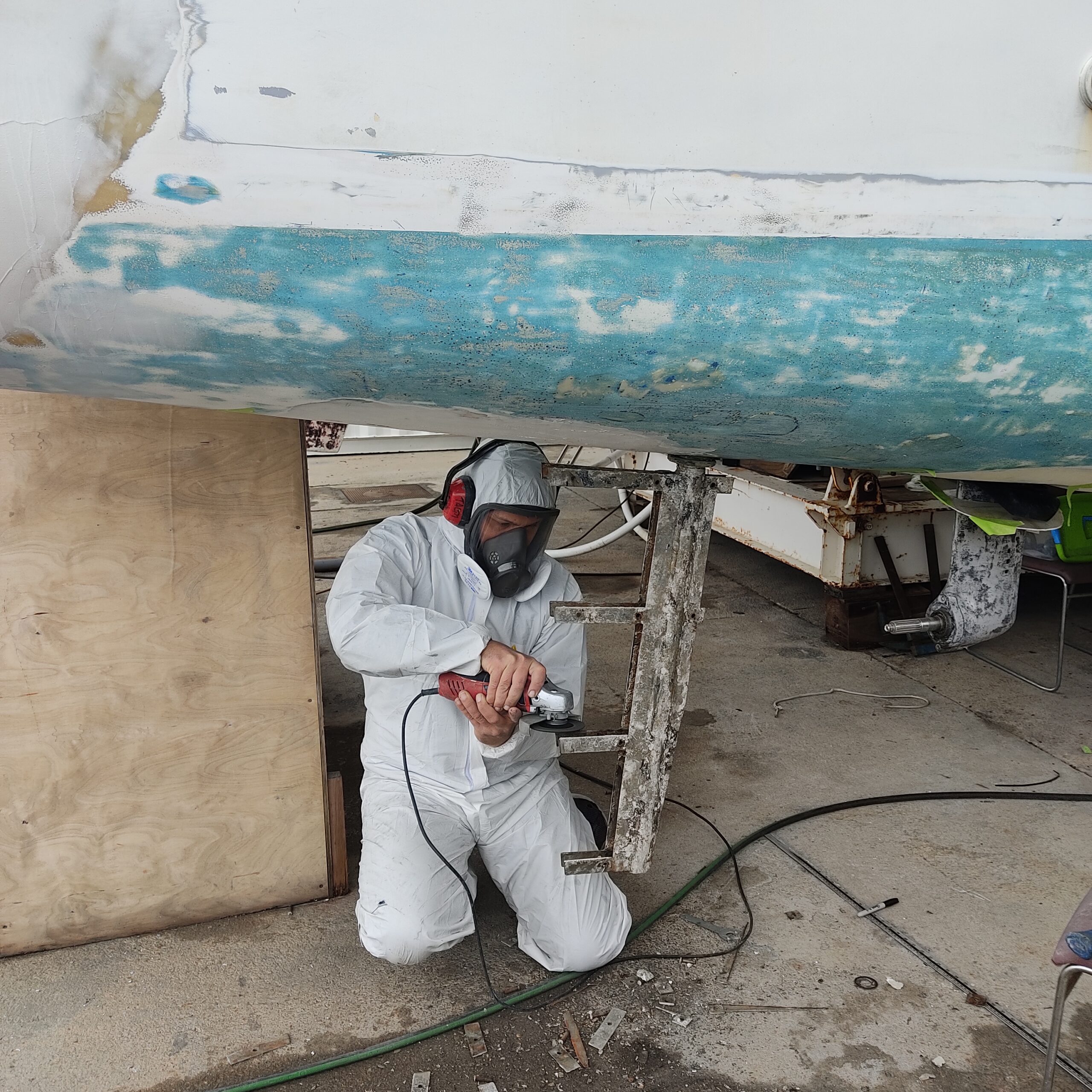
During the initial settlement on the yard blocks, a pre-existing crack in the hull laminate was observed to be propagating. Investigation indicated the cause was incorrect block placement during a previous haul-out, which had created a localised hard spot.
Procedure:
- Immediate temporary support was added to distribute load and prevent further propagation.
- The Travelift was scheduled for a return to re-support the hull.
- Blocks will be repositioned to align with primary internal structural members, as per the vessel’s design specifications.
This is a standard procedure for managing hull stresses on the hardstand but underscores the critical importance of correct yard practices and hull support.
3. Rudder Stock Extraction and Comparative Analysis
The scheduled lift presented an opportunity to remove the rudders for inspection. The starboard rudder stock was seized within its tiller arm due to corrosion. The grub screw was non-functional, requiring the use of a cold chisel to create a separation force between the clamped components, successfully freeing the assembly.
A quantitative analysis was performed on the extracted components:
- Carbon Fiber Rudder Stock (fabricated in St. Martin): 7.5 kg
- Original Stainless Steel Rudder Stock: 29.8 kg
The data confirms a mass reduction of 22.3 kg per side. This reduction in unsprung weight at the extremities of the vessel significantly improves steering response and reduces loading on bearing surfaces.
4. Next Phase: Rudder Fabrication and Systems Review
With the rudders removed, the project can progress to the next stages:
- Fabrication of a new, port-side rudder to match the existing carbon unit.
- Evaluation of performance enhancements, such as winglets.
- Assessment of fabrication methods, with a preference for CNC-machined molds if resources allow.
- Continued interior demolition and systems review, including addressing water ingress points at window seals and reorganising wiring layouts.
Conclusion
The project initiation has successfully identified key scope items and underlying structural issues. The path forward involves systematic execution of the interior demolition, corrective hull support, and the engineering of new, matched steering components. This methodical approach is fundamental to a successful refit outcome.
See our Rudders
- Why Our Catamaran Now Has a 23kg 3D Printer | Performance Upgrades
 Author: Shayne and Anna Key Topic: Adding a 23kg 3D printer to our weight-conscious catamaran is a strategic trade-off: the tool’s onboard manufacturing capability enables us to create custom, performance-enhancing parts like rudder winglets and solve unique marine challenges, ultimately providing more value than the weight it adds. It seems counterintuitive: we’re working tirelessly to lighten our… Read more: Why Our Catamaran Now Has a 23kg 3D Printer | Performance Upgrades
 - Atlantic Emergency: Managing a Rudder Failure on a Gunboat 68TOPIC:This post details a serious offshore emergency aboard a Gunboat 68, where a collision with an unknown object destroyed a rudder. It covers the immediate response, damage control, and the challenging sail to the Azores, showcasing professional-grade seamanship and problem-solving. Author: Shayne The second leg of our Gunboat 68 transatlantic delivery from Antigua to France presented… Read more: Atlantic Emergency: Managing a Rudder Failure on a Gunboat 68
- How We Sailed Our Catamaran 800 Nautical Miles With One RudderAuthor: Shayne & Anna TOPICS:This post details the emergency procedures and sailing techniques we used to safely cross the Atlantic after losing a rudder. It covers strategic use of daggerboards, sail balance for steering control, and advanced weather routing to manage an offshore crisis. Losing a rudder 800 nautical miles from land presents a sobering reality… Read more: How We Sailed Our Catamaran 800 Nautical Miles With One Rudder
- Crisis at Sea: How We Managed Losing a Rudder 800nm From LandKey Message: This post details the immediate response to losing a rudder offshore, covering crisis leadership, technical diagnosis using onboard instrumentation, and the strategic decisions that ensured a safe passage to land. Author: Shayne & Anna The moment of truth in any offshore passage comes not when things are going well, but when they go wrong.… Read more: Crisis at Sea: How We Managed Losing a Rudder 800nm From Land
- The Pre-Splash Push: Integrating Engine Work, Composite Rudder Mods, and Custom FairingsKey Topic: Facing a firm launch deadline, we executed a coordinated final push on our catamaran’s critical systems. This involved servicing the saildrives, preparing new rudders for future winglets by installing a carbon rod backbone, and fabricating custom fairings to improve hull hydrodynamics. With a focus on engineering robust solutions—from reinforcing foils to managing a… Read more: The Pre-Splash Push: Integrating Engine Work, Composite Rudder Mods, and Custom Fairings
- Building Rudders Designed for Wings: An America’s Cup Inspired ProjectLeveraging professional-grade components and techniques to fabricate high-performance rudders on a cruiser’s budget. Key Message: True innovation in a refit often comes from creatively repurposing existing high-performance technology and combining it with meticulous, professional fabrication techniques. Author: Shayne & Anna Introduction Replacing Paikea’s non-original and failing rudders was a top priority. While designing from scratch was an… Read more: Building Rudders Designed for Wings: An America’s Cup Inspired Project
- Major Hull Surgery: Transom Modifications, Fairing, and Sourcing an America’s Cup Rudder
 Executing multiple complex hull projects with a focus on structural integrity and performance gains. Author: Shayne & Anna Key Message: A systematic, professional approach allows multiple major refit projects to be run in parallel, turning a daunting workload into a series of manageable, high-impact upgrades. Introduction Transforming a boat’s hull lines is one of the most ambitious… Read more: Major Hull Surgery: Transom Modifications, Fairing, and Sourcing an America’s Cup Rudder
 - Hull Surgery: Uncovering the Truth Behind a Major Rudder ImpactKey Message: A proper repair requires understanding the original failure. By grinding back a poor previous fix, we uncovered the full story of a major grounding and executed a permanent, structural solution that also informs our future rudder design. Author: Shayne & Anna Introduction: Uncovering a Hidden Failure During our refit, a small, suspicious repair above… Read more: Hull Surgery: Uncovering the Truth Behind a Major Rudder Impact