Key Message: Hauling a large catamaran is a significant logistical operation that requires meticulous preparation and the right equipment. When a travel lift isn’t an option, a crane becomes the necessary—and dramatic—solution.
Author: Anna & Shayne
A Long-Awaited Milestone
After nearly three years of sailing and living aboard, the time had come for Paikea’s first haul-out under our ownership. This wasn’t just a routine lift; it was the essential first step to accessing the hulls for major repairs and upgrades. However, we immediately faced a challenge: Paikea’s beam was too wide for the local travel lift, necessitating a more complex operation with a large crane.
1. The Preparation: A Family Affair
Haul-out preparation is a meticulous process that the entire family contributed to over two days.
Stripping the Rig: We removed the mainsail, labeled all the battens for easy re-assembly, and removed the boom.
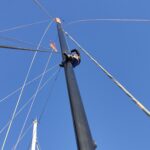
Mast Prep: Shayne went up the mast to rig a dedicated halyard for the crane to use during mast removal.
Systems Management: We emptied the water tanks to reduce weight and ensure stability during the lift.
2. The Lift Day: Teamwork and Precision
The operation required coordination between the crane operator, our family, and helping friends.
Mast Removal: The crane first lifted the mast out and placed it safely on supports—a nerve-wracking but smooth operation.
The Main Lift: With the mast removed, the crane repositioned to lift the hull. Large slings were carefully placed under the hulls to balance the boat as it was lifted from the water.
The Cradle Transfer: The most complex part involved temporarily placing the boat on wooden blocks, switching the sling configuration, and then lifting the boat again just high enough for a custom cradle to be slid underneath by a forklift.
Conclusion: Ready for the Next Phase
Seeing Paikea safely settled in the boatyard was a huge relief and a triumph of planning and teamwork. While using a crane was more complex than a standard travel-lift haul-out, it was the only way to access the hulls for the critical work ahead. The boat is now securely positioned, ready for us to begin the next phase of her refit.
First task will be to get all those layers of antifouling off Paikea and have a good look at the hulls under the water.
More About our Carbon Rig
Our Carbon Fiber rotating rig is more than just finding an old mast and sticking it on Paikea. Learn the engineering and thought process behind adapting America’s Cup technology to our cruising catamaran.
Author: Shayne & Anna Key Message: Mast rake isn’t just a number; it’s the primary control for balancing your yacht’s steering. Getting it wrong creates dangerous handling characteristics, while getting it right makes the boat a joy to sail. Introduction: A Chain Reaction from an Upgrade Two years ago, we replaced Paikea’s front beam with a… Read more: Correcting Mast Rake: Why Rig Geometry is Critical for Boat Balance
Key Message: The successful adaptation of an America’s Cup mast for cruising proves that high-performance engineering and practical, safe operation are not mutually exclusive. Every decision—from the rotating system and custom spanner to the choice of simple lowers over spreaders—was driven by a core principle: optimize for real-world strength, safety, and simplicity. This rig is not… Read more: Engineering Paikea’s Rig: Adapting America’s Cup Technology for Cruising
Author: Shayne and Anna Key Message: The centerpiece of our rig is a mast with a legendary past: Rig #12 from Team New Zealand’s 2000 America’s Cup campaign. Rescued from a Valencia scrapyard where it was destined to be chopped into pieces, this carbon fiber wing mast represents an incredible piece of sailing history. We simply couldn’t stand… Read more: From America’s Cup to Our Catamaran: Rescuing a Carbon Legend
 Author: Shayne & Anna Key Message: Mast rake isn’t just a number; it’s the primary control for balancing your yacht’s steering. Getting it wrong creates dangerous handling characteristics, while getting it right makes the boat a joy to sail. Introduction: A Chain Reaction from an Upgrade Two years ago, we replaced Paikea’s front beam with a… Read more: Correcting Mast Rake: Why Rig Geometry is Critical for Boat Balance