Author: Shayne and Anna
Key Message: Major structural changes require professional composite engineering expertise. This project demonstrates what is possible but should not be attempted without a deep understanding of load paths and advanced laminating techniques.
Introduction
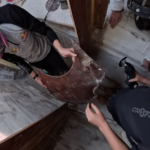
On a boat, space is a premium. To improve the livability and accessibility of Paikea’s narrow hulls, we undertook one of our most nerve-wracking projects to date: widening a doorway through a main structural bulkhead that also houses a critical carbon fiber chainplate.
This post details the why and the how of this complex procedure, emphasizing that this is a demonstration of professional composite engineering, not a DIY guide.
The Challenge: Balancing Access with Integrity
The goal was simple: create a wider, more accessible passageway. The execution, however, was complex. The bulkhead in question is a primary structural member, and the new cutout would be made perilously close to the carbon fiber chainplate, a component that handles immense rigging loads. The risk of compromising the boat’s structural integrity was significant.
This is not a task for a jigsaw and hope. It required:
- Precise Calculation: Understanding the new load paths and stress concentrations created by the modification.
- Strategic Planning: Designing a reinforcement schedule that would not just restore but enhance the strength of the bulkhead.
- Expert Execution: Meticulous laminating skills to implement the design correctly.
The Process: Precision and Reinforcement
The procedure followed a careful sequence:
- Careful Cutting: The initial opening was cut with precision, leaving a minimal margin near the chainplate.
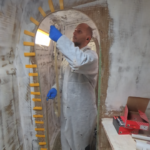
- Systematic Reinforcement: The new edges of the doorway were heavily reinforced with unidirectional carbon fiber, chosen for its exceptional strength along a single axis, perfect for transferring the new loads around the opening.
- Professional Finishing: The exposed edges were sealed and finished with a structural edge cap, a critical step for both durability and preventing water ingress into the core material.
The result is a cleaner, more open space that is significantly stronger than the original structure.
A Critical Disclaimer: Do Not Try This at Home
It must be stressed: this is not a project for amateur boat builders. While we document our process, Shayne’s actions are informed by years of professional experience in composite engineering for high-performance applications.
We strongly recommend that anyone considering similar modifications consult a qualified composites engineer or naval architect. What we make look straightforward is the result of complex behind-the-scenes calculations and a deep understanding of materials science.
Want More?
- Diagnosing and Repairing Hull Delamination and Core Damage.
 The Problem: From Floor Installation to Structural Repair Author: Shayne and Anna During the installation of new cabin soles in our Catana 42 refit, a routine task uncovered a significant structural issue. The discovery process is a textbook example of why systematic disassembly is critical. Initial Indicators: The Technical Failure:In a cored composite structure (like… Read more: Diagnosing and Repairing Hull Delamination and Core Damage.
 - Bulkhead Reinforcement on a Catamaran: Beam Theory ExplainedBulkhead Reinforcement on a Performance Catamaran Why Beam Theory Matters More Than “More Fibreglass” During refits, bulkheads often get treated as simple partitions—something to hang doors off or separate spaces. On a performance multihull, that assumption can be dangerously wrong. On Paikea, our 1990 Lock Crowther Catana 42s, bulkheads are structural elements. They tie hull… Read more: Bulkhead Reinforcement on a Catamaran: Beam Theory Explained
- Modifying Boat Bulkheads: The Engineering Behind Increasing HeadroomTopic Overview: This post details the process and engineering rationale behind cutting down a structural bulkhead to improve livability. We explain the load path disruption, the calculations for reinforcement, and the practical execution using unidirectional carbon fiber to restore and enhance structural integrity. Author: Shayne and Anna A boat refit often involves a trade-off between structural integrity… Read more: Modifying Boat Bulkheads: The Engineering Behind Increasing Headroom
- Bulkhead Reinforcement: Unidirectional Fibreglass and Edge CappingRestoring structural integrity and finishing a cut composite panel. Author: Shayne Key Message: Cutting into a cored panel necessitates a two-stage process to restore its structural integrity: first, reintroducing in-plane stiffness and strength along the cut edge with a strategic reinforcement (like unidirectional glass); and second, re-establishing the critical load path between the skins and sealing the core with… Read more: Bulkhead Reinforcement: Unidirectional Fibreglass and Edge Capping
- Weight, Performance, and Payload: The Logic Behind Our Catamaran RefitTopics: An engineering analysis of weight reduction in a catamaran refit, covering the strategic goals of increasing payload capacity and the critical considerations of balance, center of gravity, and structural integrity. Author: Shayne & Anna The systematic replacement of Paikea’s timber interior with composite structures continues with the installation of a new bunk and bulkhead. This work is part… Read more: Weight, Performance, and Payload: The Logic Behind Our Catamaran Refit