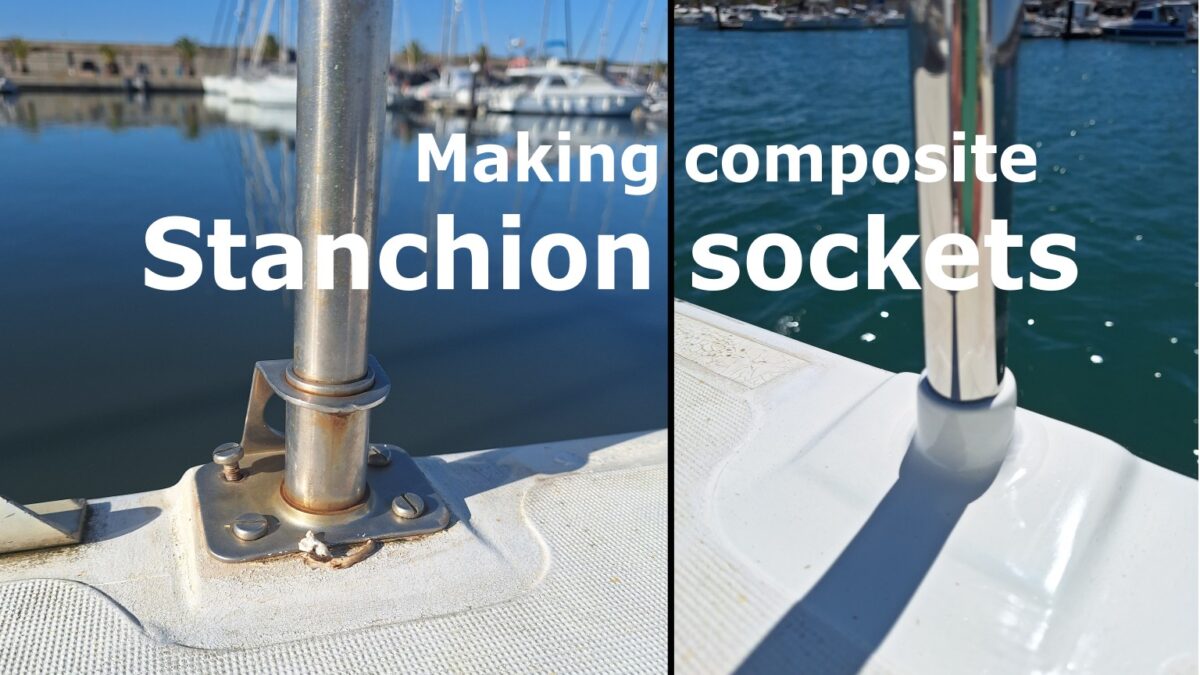
Key Message: Choosing materials isn’t about what’s “strongest,” but about how they handle loads and, just as importantly, how they fail. A pultruded carbon spiggot might seem high-tech, but its failure mode makes it a dangerously poor choice for a lifeline system.
Author: Shayne and Anna
Introduction
In our first post, we covered the hands-on process of laminating our carbon fiber staunchion sockets. Now, we delve into the engineering rationale behind the entire system. This isn’t just about making a strong socket; it’s about creating a safe, reliable, and repairable lifeline system b
y understanding the fundamental properties of metals and composites.
1. The Core Difference: Isotropic Metal vs. Anisotropic Composites
The most critical concept to grasp is the difference in how materials handle loads.
- Metals (Stainless Steel, Titanium) are Isotropic: They have the same strength in all directions—length, width, and thickness. A metal staunchion can handle bending, shear, and compression from any angle without specialized engineering. It’s a reliable, “one-size-fits-all” material for complex, multi-directional loads.
- Composites (Carbon, Fiberglass) are Anisotropic: Their strength is directionally dependent. A laminate is only strong in the direction of the fibers. A unidirectional pultrusion, for example, is incredibly strong along its length but has very little strength in other directions, relying almost entirely on the much weaker resin matrix for hoop strength and shear resistance.
2. The Danger of Pultruded Carbon Spiggots
This anisotropy is why using a pultruded carbon tube as a spiggot (the part that fits into the socket) is a fundamentally flawed and dangerous idea.
- Incorrect Fiber Orientation: A pultruded part has all its fibers running lengthwise (0°). When inserted into a socket, it faces bending and shear loads.
- Reliance on Resin: Without ±45° fibers to handle these loads, the part depends entirely on the resin’s ability to prevent the fibers from sliding apart (interlaminar shear). Under a high load, the resin will fail catastrophically.
- The Result: A pultruded spiggot will fail suddenly and without warning, compromising the entire lifeline system at a critical moment.
Our Solution: Our custom laminated sockets use a quasi-isotropic (QI) laminate with fibers in 0°, ±45°, and 90° orientations. This creates a “mini bulkhead” that is capable of handling the complex bending, shear, and hoop stresses at the deck interface, making it a far superior socket than a simple metal cup.
3. System-Level Thinking: The Mode of Failure is Everything
A lifeline system isn’t a collection of parts; it’s an integrated safety system. Its behavior under failure is as important as its strength.
- The Goal: The easiest-to-replace part should be the designed failure point. On a boat, that’s the staunchion itself, not the deck structure.
- Metal Staunchion Failure Mode: When overloaded (e.g., by a flogging jib), a stainless steel staunchion will bend and buckle. It may be compromised, but it often remains attached, keeping the lifeline largely intact. It fails in a predictable, relatively safe manner.
- Carbon Staunchion Failure Mode: Carbon fiber stores immense energy and releases it explosively. A carbon staunchion doesn’t just break; it shatters, sending sharp, splinter-like shards flying. This creates a secondary hazard and completely destroys the system’s integrity instantly.
This is why we chose new stainless steel staunchions over carbon. For this specific application, the predictable, ductile failure of metal is a vital safety feature that carbon cannot provide.
Conclusion: The Right Material for the Right Job
This project underscores a core principle at Youngbarnacles: there is no “best” material, only the most fit-for-purpose.
- We use carbon fiber for our chainplates, where high tensile strength and stiffness are paramount, and the failure mode is controlled.
- We use a quasi-isotropic composite laminate for the sockets, to create a strong, integrated deck fitting.
- We use stainless steel for the stanchions, where impact resistance and a predictable, non-catastrophic failure mode are critical for safety.
Understanding “why” we make these choices is what separates a simple repair from professional-level marine engineering. It’s the difference between just building something and building something right.
Missed the Stanchion Socket Build?
The fabrication of these carbon stanchion sockets is documented in detail on our site, from the initial engineering rationale to the full lamination process. This project is representative of the practical, professional-grade content available in the Youngbarnacles Membership, which includes behind-the-scenes technical videos and deep-dives on composite construction.
- Laminating Stanchion Sockets & The Truth About Peel Ply
 Key Message: A successful composite lamination is defined by understanding the loads, mastering the process, and knowing the hidden details—like why you must always sand a peel ply surface before secondary bonding. Author: Shayne and Anna Introduction In the sweltering 32°C heat of the boat shed, we’re finishing the final staunchion socket on Paikea’s starboard side.… Read more: Laminating Stanchion Sockets & The Truth About Peel Ply
 - Making Composite Stanchion Sockets: An Engineering Approach to Safety & Aesthetics
 Key Message: A successful upgrade to a critical safety system requires understanding not just how to build it, but why you choose specific materials and processes. The goal is a solution that is stronger, cleaner, and fails in a predictable, safe manner. Author: Shayne and Anna Introduction The original stainless steel stanchion bases on Paikea were functional but… Read more: Making Composite Stanchion Sockets: An Engineering Approach to Safety & Aesthetics
 - Staunchion Sockets: A Masterclass in Material Selection and Failure ModesKey Message: Choosing materials isn’t about what’s “strongest,” but about how they handle loads and, just as importantly, how they fail. A pultruded carbon spiggot might seem high-tech, but its failure mode makes it a dangerously poor choice for a lifeline system. Author: Shayne and Anna Introduction In our first post, we covered the hands-on process… Read more: Staunchion Sockets: A Masterclass in Material Selection and Failure Modes