Key Message: By repurposing high-modulus carbon fiber from America’s Cup masts, we engineered a custom front-end system that is lighter, stronger, and far more functional than the original, unlocking new sail options and improving overall performance.
Author: Shayne & Anna
Introduction: A Dual Project Under Pressure
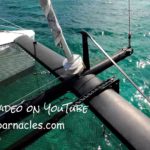
This project captures the essence of our refit philosophy: ambitious, resourceful, and on a deadline. With a two-week window before a scheduled haulout, we undertook two major upgrades in parallel: Anna recut a large RC44 spinnaker into a fractional asymmetric, while Shayne engineered and built a completely new carbon fiber front beam and longeron to fly it from.
1. The “Why”: Unlocking Performance and Versatility
The original aluminum front beam was a functional but limiting component.
- Lack of Options: It provided no attachment point for an inner forestay (for a storm sail or trinket) and no bow sprit for flying modern asymmetric sails like code zeros and gennakers.
- Weight Savings: Replacing heavy aluminum with carbon fiber contributes significantly to our overall weight reduction goal.
- The Goal: To create a robust, integrated system that would serve as a strong anchor point for the rig and a platform for a larger, more versatile sail plan.
2. The Material: Recycled America’s Cup Mast Sections
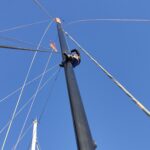
The core of this project is the material itself: sections of mast from a former America’s Cup challenger.
- Provenance: This is the same high-modulus carbon fiber used in the rotating wing mast we built previously, offering an incredible strength-to-weight ratio.
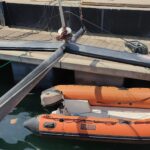
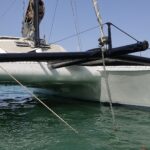
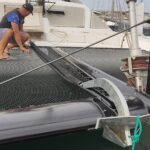
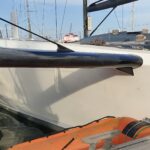
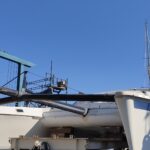
- The Design Challenge: We had to work with pre-cut sections. The longest piece (the top mast section) became the longeron (bow sprit), while two thicker, shorter sections were used as the port and starboard beams that connect through the hulls.
3. The Build: Precision in the Grinding Bay
The construction was a masterclass in composite fabrication under time constraints.
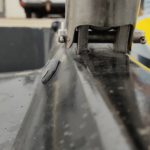
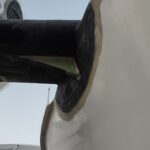
- Complex Geometry: Joining the cylindrical mast sections at precise angles required meticulous cutting and fairing. Shayne used a custom “secret brew” of milled fibers and filler powders to create strong, non-cracking coves in the structural joints.
- The Pressure: The project was a race against the clock, needing to be structurally complete before the boat was hauled out for hull work. This included gluing new core into the deck and ensuring the entire assembly was perfectly aligned.
Conclusion: A Transformation Achieved
Despite the pressure, the project was a success. The new carbon structure is not just a replacement; it’s a fundamental upgrade that changes Paikea’s capabilities. It’s lighter, stiffer, and now provides the dedicated attachment points needed for a modern sailing inventory, from storm sails to performance-reaching sails.
Further Reading on the Project Paikea Refit
Interested in our front beam project? See the rest of our videos:
- The Carbon Fiber Longeron & America’s Cup Rig: Dual Upgrades That Transformed Our Catamaran
 Author: Shayne and Anna Key Topic: While our salvaged America’s Cup rotating rig was a monumental upgrade, the custom carbon fiber longeron stands as its crucial counterpart, fundamentally changing how we… Read more: The Carbon Fiber Longeron & America’s Cup Rig: Dual Upgrades That Transformed Our Catamaran
 - Carbon Fiber vs. Aluminum Beam: A Catamaran Structural UpgradeTopic: We replaced our Catamaran 42’s original aluminum front beam with a custom carbon fiber beam and longeron. This wasn’t just a simple material swap; it was a complete structural… Read more: Carbon Fiber vs. Aluminum Beam: A Catamaran Structural Upgrade
- Real-World Test: How Our New Carbon Front Beam Handled a Choppy SeaAuthor: Shayne and Anna Key Message: This sea trial proved that true performance isn’t just about strength or weight savings, but about how upgrades transform the sailing experience in real-world… Read more: Real-World Test: How Our New Carbon Front Beam Handled a Choppy Sea
- From America’s Cup to Our Catamaran: Rescuing a Carbon LegendAuthor: Shayne and Anna Key Message: The centerpiece of our rig is a mast with a legendary past: Rig #12 from Team New Zealand’s 2000 America’s Cup campaign. Rescued from a Valencia scrapyard… Read more: From America’s Cup to Our Catamaran: Rescuing a Carbon Legend
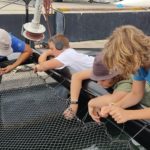
- Why We Chose Dyneema for Our Catamaran Trampoline (And How to Install It)Author: Shayne and Anna After completing our major carbon fiber front beam transformation, the final piece was installing a trampoline worthy of the upgrade. We chose Dyneema netting—the same high-performance material… Read more: Why We Chose Dyneema for Our Catamaran Trampoline (And How to Install It)
- From Racing Mast to Custom Bow Pole: Reincarnating America’s Cup CarbonKey Topic: This upgrade represents the ultimate expression of our refit philosophy: giving the world’s best materials a brilliant second life. We transformed salvaged sections of an America’s Cup mast into… Read more: From Racing Mast to Custom Bow Pole: Reincarnating America’s Cup Carbon
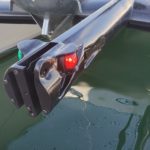
- Carbon Fiber Anchor Roller & Stealth Nav Lights – Finishing Paikea’s Front EndKey Message: With the major structural work complete, we’re adding the final functional details to Paikea’s new carbon front end. This post covers the fabrication of a custom carbon fiber anchor roller, the installation… Read more: Carbon Fiber Anchor Roller & Stealth Nav Lights – Finishing Paikea’s Front End
- Engineering a Bespoke Forestay Attachment & Mastering “Wet Preg”Key Topic: Replacing our catamaran’s aluminum beam with carbon fiber meant reinventing how critical components attach. For the forestay, this led to a unique engineering solution: a custom transverse pin and… Read more: Engineering a Bespoke Forestay Attachment & Mastering “Wet Preg”
- The Vacuum Bag Reveal: Assessing Our Carbon Fiber Beam LaminateKey Message: The de-bagging process confirmed a successful vacuum bag: our complex carbon fiber beam-to-hull joint emerged perfectly consolidated into tight corners, with a peel-ply finish ready for paint after… Read more: The Vacuum Bag Reveal: Assessing Our Carbon Fiber Beam Laminate
- The Pre-Splash Push: Integrating Engine Work, Composite Rudder Mods, and Custom FairingsKey Topic: Facing a firm launch deadline, we executed a coordinated final push on our catamaran’s critical systems. This involved servicing the saildrives, preparing new rudders for future winglets by… Read more: The Pre-Splash Push: Integrating Engine Work, Composite Rudder Mods, and Custom Fairings
- Beyond Flat Panels: Vacuum Bagging a Complex Carbon Fiber Beam-to-Hull JointTopic: Successfully vacuum bagging a structural joint is the true test of composite skill. This guide details the advanced techniques for consolidating a carbon fiber laminate on a complex, multi-dimensional… Read more: Beyond Flat Panels: Vacuum Bagging a Complex Carbon Fiber Beam-to-Hull Joint
- Installing the Carbon Fibre Martingale: Precision Fitting & Engineering NuancesAuthor: Shayne & Anna TOPICS:This post details the final installation of a critical structural component on our Catana 42. It covers the transition from 3D CAD model to physical fitting, the… Read more: Installing the Carbon Fibre Martingale: Precision Fitting & Engineering Nuances
- Reinforcing the Front Beam: Engineering a Carbon Fibre MartingaleAuthor: Shayne and Anna Key Topic: This post details the fabrication of our carbon fiber Seagull Striker and Martingale. We explain the engineering logic behind reinforcing the beam and show… Read more: Reinforcing the Front Beam: Engineering a Carbon Fibre Martingale
- Engineering a Carbon Fiber Front Beam & Longeron from America’s Cup MastsKey Message: By repurposing high-modulus carbon fiber from America’s Cup masts, we engineered a custom front-end system that is lighter, stronger, and far more functional than the original, unlocking new sail… Read more: Engineering a Carbon Fiber Front Beam & Longeron from America’s Cup Masts