Key Topic: This article breaks down the practical high-performance logic behind a professional race boat’s deck layout, specifically the use of paired left and right-hand winches to optimize lead angles and minimize friction. We then pivot to a no-compromise analysis of the safety systems used for working aloft, detailing the full climbing harness, fall arrest gear, and protocols that keep professionals safe at the masthead of a 115-foot supermaxi. The focus is on the intelligent, scalable principles that can be applied to any performance-oriented sailing vessel.
Author: Shayne and Anna
If you’ve ever wondered how the deck layout on a grand-prix race boat can inform your own sailing, this is for you. It’s not about exotic materials; it’s about intelligent, practical design. Recently, while preparing for a regatta on a 115-foot supermaxi, we documented two core principles: optimized deck gear and uncompromising safety.
The High-Performance Winch Grid
Walk into the pit of any serious race boat, and you’ll find a grid of winches—both left and right-hand models. The reasoning is elegantly simple.
As Shayne explains in the video, the primary driver is minimizing the lead angle from the clutch bank to the winch drum. By pairing a left-hand and right-hand winch, lines can be led to the “insides” of the pair, creating a straight, efficient pull.
- Benefit: Reduced friction and wear on lines.
- Benefit: More power and smoother grinding.
- Benefit: A cleaner, less cluttered deck during complex maneuvers.
The takeaway for any cruising or performance sailor is this: if you’re designing a deck layout or adding new hardware, always think about the natural lead of the line. A small investment in planning can yield significant performance and ease-of-use returns.
A Non-Negotiable Safety Practice: Notice the arrows on the winches. Even in the professional world, we clearly label the direction of operation. This eliminates guesswork and potential danger during chaotic moments. This is one of the simplest and most effective safety upgrades you can make on any boat.
Professional Gear for Working Aloft
The second half of the video transitions to a topic where there is no room for compromise: safety while working at the masthead. The system we use is built for reliability and endurance, allowing us to work effectively hundreds of feet in the air.
1. The Harness: A Full-Body Arborist System
We forego simple bosun’s chairs in favor of a full climbing harness, specifically a Petzl Podium kit designed for arborists and industrial climbers. This isn’t just a seat; it’s an integrated system comprising:
- Leg Holsters: Distribute weight and prevent you from slipping out.
- Waist Belt & Shoulder Straps: Provide full-body support and multiple attachment points.
- Integrated Seat (The “Podium”): This is the game-changer. It allows you to sit securely for hours, turning the harness into a stable work platform. As Shayne notes, this seat is what makes four-day projects aloft possible.
2. The Fall Arrest System: Your Last Line of Defense
The primary halyard is your main support, but a backup is essential. Our system includes:
- A Fall Arrest Device (Petzl ASAP): This is clipped to a second, independent halyard. If the primary fails, this device locks onto the rope, arresting a fall.
- A Shock-Absorbing Lanyard: This specially woven webbing is designed to tear apart in a controlled manner during a fall, dramatically reducing the arresting force and preventing injury.
- A Dynamic Rope: The secondary halyard itself is a stretchy dynamic climbing rope, providing an additional layer of shock absorption.
3. The Human Element: Trust and Communication
The most critical piece of gear is the person on the winch. Clear, pre-arranged hand signals are vital, especially when radio comms fail. A good winch operator doesn’t just hoist; they are a mindful partner in your safety, understanding when to move slowly, hold position, or lower with care.
Practical Takeaways for Your Boat
You may not be heading up a supermaxi rig, but the principles are scalable:
- Analyze your deck leads. Can you improve them with fairleads or a different winch orientation?
- Label your winches with clear, durable arrows.
- If you go aloft, invest in the best safety gear you can. A certified climbing harness and a proper fall arrest system are worth every penny. Never rely on a single point of failure.
Want More?
A catamaran’s rigging is its backbone, transferring immense loads from the sails to the structure. In this collection, we break down the systems and hardware that make it work, from the engineering of custom carbon fiber chainplates and the servicing of hydraulic rams to the practicalities of winch selection, sail handling, and the safety protocols for working aloft. These videos provide a professional perspective on building, maintaining, and trusting your rig.
- How to Tune Your Multihull Rigging: A Complete Step-by-Step Guide
 Author: Shayne and Anna Key Topic: Properly tuning your multihull’s rigging is a critical follow-up after replacing standing rigging. This guide breaks down the step-by-step process used by professionals to achieve a straight mast, correct pre-bend, and balanced tension, transforming a basic rig replacement into an optimized sailing system for both performance and safety. You’ve invested… Read more: How to Tune Your Multihull Rigging: A Complete Step-by-Step Guide
 - Sidestays vs. Capsize: Debunking a Dangerous Myth in Catamaran SailingKey Message: This post tackles a pervasive myth in catamaran sailing: that sidestays should be designed to break before a hull flies. We explain the flawed logic, the physics of righting moment, and why the sailor’s awareness is the most critical safety system on the water. Author: Shayne and Anna A dangerous piece of advice often… Read more: Sidestays vs. Capsize: Debunking a Dangerous Myth in Catamaran Sailing
- Our Criteria for a Great Second Hand MultihullKey Message: Our search for a true passage-making catamaran was governed by a disciplined, three-part framework that prioritized fundamental performance over cosmetic comfort. We required a lightweight, second-hand multihull with a proven design, clean underbodies, and daggerboards—non-negotiable features for efficient, seaworthy bluewater sailing. This unwavering focus on a boat’s core sailing attributes, rather than its… Read more: Our Criteria for a Great Second Hand Multihull
- How we made our waterline markersHow to make waterline markers and why we think it’s such a good idea. Continuing on from our previous video on watching your weight, Shayne goes through the process of how we made the waterline markers for our catamaran. The idea behind this trick is to monitor how our boat is sitting in the water.… Read more: How we made our waterline markers
- Boat Weight Management: Why Your Multihull’s Performance Depends On ItTopic: Want a Faster, Safer Catamaran? Start by Managing Your Weight Author: Shayne and Anna It’s a familiar scene for any cruiser: storage lockers full of “essential” gear, spares for spares, and projects-in-waiting. But on a performance multihull, this accumulation isn’t just clutter—it’s a direct threat to your safety and comfort. As we prepared to… Read more: Boat Weight Management: Why Your Multihull’s Performance Depends On It


Hi.
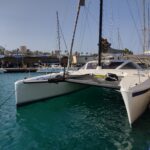
I have a catamaran now harboured in Cartagena In Spain, a TRT1200 with some work to be done.
The main deck was lowered at the yard were it was build. Slamming is the consequence of a bad dessision. Is it possible for you to raise the deck during the next 8 months.
A friend of mine and one of the naval architects on the boat Marius Rosvold gave me your name.
Best regards from
Niels Pontoppidan
Natekrene 1
6863 Leikanger
Norway
Hi Niels,
That sounds like a big job! It’s not something I would be in a position to do right now, however, if you send me an email with some more information I can see if I can put you in touch with the right people.
Cheers,
Shayne
Email – syasperformane@hotmail.com