Key Message: A successful composite lamination is defined by understanding the loads, mastering the process, and knowing the hidden details—like why you must always sand a peel ply surface before secondary bonding.
Author: Shayne and Anna
Introduction
In the sweltering 32°C heat of the boat shed, we’re finishing the final staunchion socket on Paikea’s starboard side. This isn’t just a simple patch; it’s a 12-layer lamination of 300g carbon double bias, vacuum-bagged to perfection. In this post, we’ll break down the why behind the robust construction and share a piece of crucial composite wisdom that separates amateur work from professional practice.
1. Why 12 Layers? The Hidden Loads in a Simple Socket
It seems excessive until you understand the forces at play. A staunchion only needs to handle a 52kg load at the top. However, due to the lever effect, the load multiplied at the base of the socket is significantly higher.
We learned this lesson dramatically when Olly’s lightweight carbon pump board, designed to our limits, failed under a heavier user. The sound was a “shotgun” report—the telltale sign of a carbon structure releasing immense stored energy. Analysis showed the skin was handling over 3.5 tons of compression load before failure.
The same principle applies to our staunchion sockets. The long lever of the staunchion multiplies the force, translating into significant bending moments where the socket meets the deck. The 12 layers of carbon are not overkill; they are a calculated necessity to distribute these concentrated loads over a large area, ensuring long-term integrity and safety.
2. The Vacuum Bagging Toolkit: More Than Just Suction
We chose vacuum bagging over hand lamination or infusion for this repair for specific reasons:
- Complex Geometry: The vertical and curved surface makes it difficult for dry fabric to conform without bridging. Vacuum pressure acts as a giant, uniform clamp, forcing the fabric into every contour.
- Consolidation: With 12 layers, achieving proper compaction and resin distribution by hand is nearly impossible. The vacuum bag ensures a consistent, void-minimized laminate.
- Why Not Infusion? On an existing hull, the porosity of the old laminate is a major risk. A vacuum test on a seemingly solid 20mm thick glass keel from a reputable yard once revealed it “leaked like a sieve,” pulling trapped solvents from the laminate. Infusion requires an airtight seal, which is often not guaranteed on older hulls.
Our bagging sequence is a precise sandwich:
- Laminate: Pre-wet carbon.
- Peel Ply: Creates a resin-rich, textured surface for future sanding.
- Perforated Release Film: Allows excess resin and air to bleed out in a controlled manner while preventing the next layer from sticking.
- Breather Fabric: Acts as a highway for air and excess resin to travel to the vacuum source, ensuring an even pressure distribution across the entire part.
3. The Peel Ply Myth: A Critical Safety and Practice Note
This is one of the most important takeaways. You must always sand a peel ply surface before making a secondary bond.
Many believe the textured surface left by peel ply is ideal for bonding. This is incorrect and not best practice. Here’s why:
- Release Coatings: Peel ply fabrics (nylon or polyester) are coated with a release agent so they can be cleanly removed after cure. This same release agent contaminates the surface, compromising bond strength.
- Microscopic Evidence: Under magnification, the peel ply surface is a molded replica of the fabric, not a chemically active bonding surface.
- Industry Knowledge: This is well-documented in composites literature, including seminal articles like “Curse of the Dreaded Knit Nylon Peel Ply.” The aviation and aerospace industries are particularly stringent about this.
The textured surface is excellent for sanding, as the grit can bite into the resin-rich peaks and valleys. But for a strong, reliable secondary bond, sanding is non-negotiable.
See the “The Curse of the Dreaded Peel Ply” technical article on our Free Resources Page to learn more.
Conclusion: Process Defines Performance
Laminating a staunchion socket is a microcosm of professional composite work. It demonstrates how understanding fundamental engineering principles—levers, load distribution, and material science—directs the practical application. Choosing the right process (vacuum bagging) and executing it with attention to critical details (like preparing peel ply surfaces) is what delivers a result that is not just good, but structurally sound and durable.
The goal is never to use the most advanced process, but to use the most appropriate one to create the best possible part for its intended purpose.
Missed the Stanchion Socket Build?
The fabrication of these carbon stanchion sockets is documented in detail on our site, from the initial engineering rationale to the full lamination process. This project is representative of the practical, professional-grade content available in the Youngbarnacles Membership, which includes behind-the-scenes technical videos and deep-dives on composite construction.
- Laminating Stanchion Sockets & The Truth About Peel Ply
 Key Message: A successful composite lamination is defined by understanding the loads, mastering the process, and knowing the hidden details—like why you must always sand a peel ply surface before secondary bonding. Author: Shayne and Anna Introduction In the sweltering 32°C heat of the boat shed, we’re finishing the final staunchion socket on Paikea’s starboard side.… Read more: Laminating Stanchion Sockets & The Truth About Peel Ply
 - Making Composite Stanchion Sockets: An Engineering Approach to Safety & Aesthetics
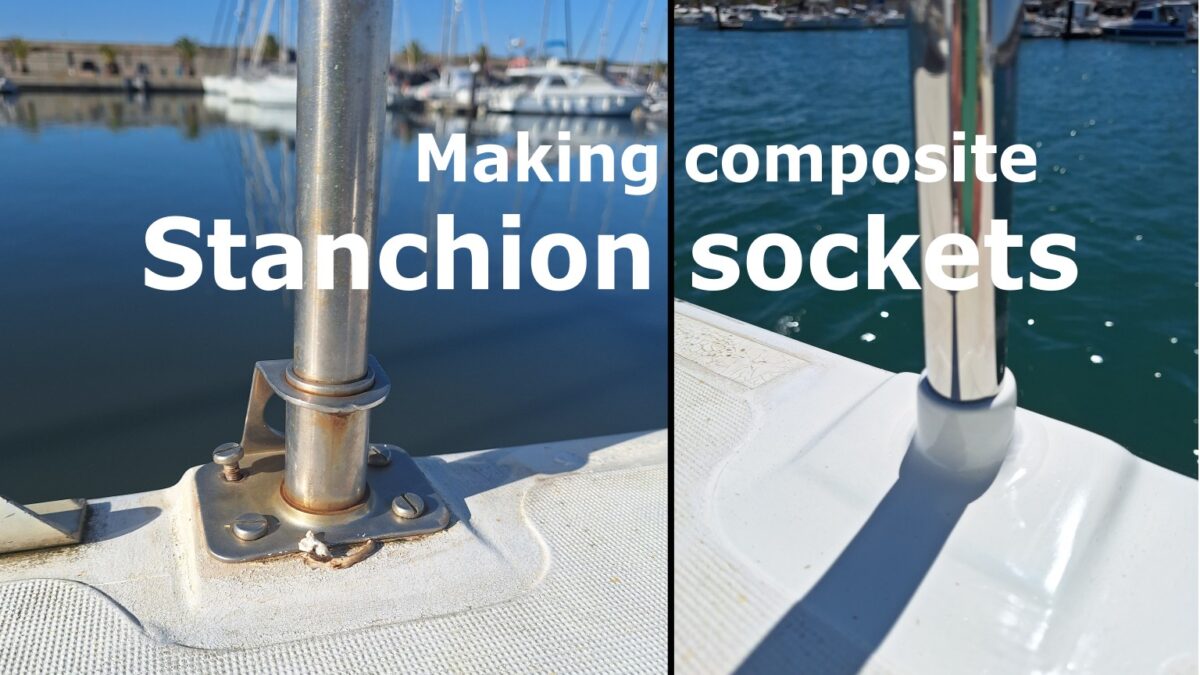
 Key Message: A successful upgrade to a critical safety system requires understanding not just how to build it, but why you choose specific materials and processes. The goal is a solution that is stronger, cleaner, and fails in a predictable, safe manner. Author: Shayne and Anna Introduction The original stainless steel stanchion bases on Paikea were functional but… Read more: Making Composite Stanchion Sockets: An Engineering Approach to Safety & Aesthetics
 - Staunchion Sockets: A Masterclass in Material Selection and Failure ModesKey Message: Choosing materials isn’t about what’s “strongest,” but about how they handle loads and, just as importantly, how they fail. A pultruded carbon spiggot might seem high-tech, but its failure mode makes it a dangerously poor choice for a lifeline system. Author: Shayne and Anna Introduction In our first post, we covered the hands-on process… Read more: Staunchion Sockets: A Masterclass in Material Selection and Failure Modes