Key Message: Practical Skills for Real-World Sailing
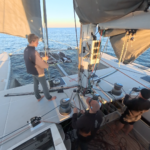
Reefing is a fundamental skill, but doing it effectively while sailing downwind on a catamaran requires specific techniques. This guide, filmed in 16 knots of breeze on our Atlantic crossing, breaks down the practical process of reefing a mainsail controlled by a halyard lock and a sticky track. We focus on the real-world challenges—like preventing the boom from crashing and managing sail wrap on the shrouds—to provide a clear, actionable method for safely reducing sail area without sacrificing control or boat speed.
Author: Shayne and Anna
The Setup: Boom Control is the First Step
Before touching any reefing lines, securing the boom is critical. On a catamaran without backstays, the combination of the mainsheet and topping lift acts as a temporary backstay and boom preventer.
- Topping Lift: Keep it tight to lift the boom, which helps the mainsail twist and depower while preventing the boom from swinging violently.
- Mainsheet: Keep it snug to control the leech tension and further stabilize the boom. This setup minimizes chaotic movement, making the entire process safer and more controlled.
The Process: A Step-by-Step Walkthrough
The sequence of operations is key to a smooth reef, especially with a halyard lock.
- Ease the Cunningham: This releases tension on the luff, essential for disengaging the halyard lock.
- Release the Halyard Lock: With the load off the sail’s luff, the halyard can be eased, lowering the sail until the first reef cringle is at the boom.
- Address “Sticky” Cars: A common issue on many boats. We demonstrate how to manually assist the sail slides past a high-friction point in the track.
- Haul the Reefing Line: This pulls the new tack and clew down simultaneously. A key insight is to maintain boat speed during this step, as the apparent wind reduction makes it easier to pull the sail down and reduces wrap on the shrouds.
- Re-Tension the Halyard: Re-engage the halyard lock or re-clutch the halyard.
- Re-Trim the Sail: Adjust the Cunningham (or reef line) to tension the new luff. Then, adjust the mainsheet and ease the topping lift to set the proper leech tension and sail shape for downwind sailing.
Conclusion: A Faster, More Balanced Boat
A timely reef is not just about reducing power; it’s about optimizing performance. In our case, the boat speed increased after reefing, as the reduced sail area created a more balanced helm and efficient sail shape for the conditions. Mastering this downwind reefing process—with its emphasis on preparation, sequence, and boom control—ensures you can confidently shorten sail to match the conditions, keeping the boat and crew safe while maintaining pace toward your destination.
Sailing a Performance Catamaran: Techniques from Paikea
The theory of multihull sailing is one thing; applying it to a real, cruising vessel in ocean conditions is another. In this series, we use our Catana 42, Paikea, as a living case study to demonstrate practical, high-performance techniques. From reefing and downwind trim to managing apparent wind and heavy weather, these posts translate professional racing principles into actionable skills for the serious cruising sailor.
- Apparent Wind vs. True Wind: The Biggest Misconception in Sailing
 Authors: Shayne and Anna Introduction You’re sailing downwind on a beautiful performance catamaran. You glance at the instruments. One display says you’re going upwind at 150 degrees. Another says you’re going downwind. Which one is right? The answer is both. And that confusion is the biggest misconception in sailing. In this guide—filmed onboard the Gunboat… Read more: Apparent Wind vs. True Wind: The Biggest Misconception in Sailing
 - The Art and Science of the Self-Tacking Jib: Why It’s More Complicated Than You ThinkAuthor: Shayne and Anna Introduction If you’ve ever spent a long day on the water tacking up a tight channel, you know the appeal of a self-tacking jib. The promise is simple: ease, simplicity, and the ability to short-hand the boat without a grinders’ pit crew on the rail. But as with anything in sailing,… Read more: The Art and Science of the Self-Tacking Jib: Why It’s More Complicated Than You Think
- Offshore Reality Check: Performance Analysis and Emergency Assessment Mid-AtlanticAuthor: Shayne and Anna Topic: This post provides a professional analysis of an Atlantic upwind passage, demonstrating the Catana 42 Paikea’s performance capabilities with real-time data on wind angles and boat speed. It details the immediate emergency response to a sudden structural bang at sea, outlining the systematic procedure for inspecting daggerboards and hull integrity. The article… Read more: Offshore Reality Check: Performance Analysis and Emergency Assessment Mid-Atlantic
- Ocean Passage Engineering: Systems Analysis and Arrival Planning 40 Miles OffshoreTopic: 40 miles from the Azores after a 14-day Atlantic crossing, we handle mid-ocean gear failure while planning our next jib sheeting system upgrade. This professional analysis covers block replacement, floating ring technology, and track system design for optimal sail control, demonstrating how continuous improvement integrates with routine offshore sailing. We combine practical repair work with… Read more: Ocean Passage Engineering: Systems Analysis and Arrival Planning 40 Miles Offshore
- 30-Knot Atlantic Sailing: Performance Analysis and 17-Knot SurfTopic: Author: Shayne and Anna Introduction The midpoint of an Atlantic crossing often brings the most challenging conditions, and our passage to the Azores delivered 30-knot winds and building seas. These conditions provided the ultimate test of Paikea’s heavy-air capabilities and our family’s offshore systems, from spinnaker management to performance diagnostics in demanding ocean conditions. 1.… Read more: 30-Knot Atlantic Sailing: Performance Analysis and 17-Knot Surf