Restoring structural integrity and finishing a cut composite panel.
Author: Shayne
Key Message: Cutting into a cored panel necessitates a two-stage process to restore its structural integrity: first, reintroducing in-plane stiffness and strength along the cut edge with a strategic reinforcement (like unidirectional glass); and second, re-establishing the critical load path between the skins and sealing the core with a structural edge cap.
Introduction
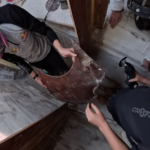
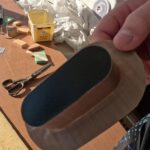
During the interior refit of Paikea, we cut through the existing bulkheads to make larger doorways in the hulls. However, we cannot just leave a foam and e-glass panel edge cut and the foam exposed. In order to keep the strength in the bulkhead we need to ensure we reintroduce the strength and stiffness by reinforcing the cut out and adding an edge capping to tie the two skins on each side of the bulkhead together. The goal was to create a strong, lightweight reinforcement that would resist flexing around a bunk opening. This report details the decision to use unidirectional fibreglass and the method developed to laminate it into a narrow channel and then place an edge capping to tie the 2 sides together and improve strength.
1. The Problem: Exposed Core and a Weakened Structure
The act of cutting through the sandwich panel severs the continuous fibreglass skins, creating a weak point along the edge. The exposed core is vulnerable to moisture ingress and impact damage, and the panel loses a significant degree of its inherent stiffness. Simply filling the edge with putty is structurally inadequate.
2. Laminate Design and Material Selection
The primary requirement was to restore axial stiffness along the length of the bulkhead edge.
- Material: Unidirectional E-glass was selected as it places the maximum number of fibres in the direction of the required load path, offering an efficient stiffness-to-cost ratio for this application.
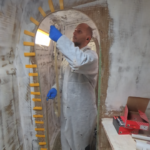
- Laminate Schedule: The design specified a channel 20mm wide by 5mm deep, filled with 10 layers of 600gsm uni, creating a robust, stiff spine along the cut edge.
3. The Wet-Out and Placement Challenge
The primary difficulty was impregnating and placing the dry, springy unidirectional tape into a narrow, vertical channel.
- Pre-wetting: The uni was pre-impregnated with epoxy on a separate surface.
- Handling Difficulty: The wetted fibre bundle became difficult to handle and roll to the required diameter without the woven “W fibre” found in bi-axis fabrics to hold it together.
- Solution: The laminate was carefully rolled and worked into the channel in stages, a time-consuming process that leveraged the 40-minute pot life of the epoxy system.
4. A Practical Consolidation Method
Without a workshop and all the precise tools available, an effective consolidation method was needed to compact the fibres and remove excess resin.
- Technique: Highly adhesive masking tape was applied tightly over the channel opening, acting as a temporary flexible dam holding the fiber in place while it cured.
- Result: This method applied sufficient pressure to consolidate the laminate effectively, resulting in a well-compacted part with minimal voids after cure.
5. The Essential Final Step: Structural Edge Capping
With the unidirectional reinforcement cured, the final step is to apply a structural edge cap.
- Primary Purpose: Re-establishing the Load Path. The most critical function of the edge cap is to structurally tie the two outer skins of the bulkhead together. In an uncut panel, loads are distributed across the continuous skins. Cutting the panel severs this path. The edge cap acts as a bridge, allowing stresses and loads to transfer from one skin to the other, restoring the panel’s monolithic structural behaviour.
- Secondary Purpose: Sealing and Durability. The edge cap also seals the exposed core from moisture ingress and provides a durable, finished edge that protects against impact and prevents delamination from starting at this vulnerable point.
Conclusion
This two-stage process of adding unidirectional reinforcement and a structural edge cap is a fundamental and correct method for finishing any cut composite panel. It ensures the structural integrity of the bulkhead is not only maintained but enhanced, while providing a durable, long-lasting finish.
Want More?
See more of our cutting out bulkheads in the posts below. If you are interested in a deep dive into composites, then consider joining our Youngbarnacles Members Hub, we provide detailed discussions on our projects that share real world tips on how to use cutting edge materials in your own projects. You can check out our Members Forum Discussion on Edge Capping there too.
- Diagnosing and Repairing Hull Delamination and Core Damage.
 The Problem: From Floor Installation to Structural Repair Author: Shayne and Anna During the installation of new cabin soles in our Catana 42 refit, a routine task uncovered a significant structural issue. The discovery process is a textbook example of why systematic disassembly is critical. Initial Indicators: The Technical Failure:In a cored composite structure (like… Read more: Diagnosing and Repairing Hull Delamination and Core Damage.
 - Bulkhead Reinforcement on a Catamaran: Beam Theory ExplainedBulkhead Reinforcement on a Performance Catamaran Why Beam Theory Matters More Than “More Fibreglass” During refits, bulkheads often get treated as simple partitions—something to hang doors off or separate spaces. On a performance multihull, that assumption can be dangerously wrong. On Paikea, our 1990 Lock Crowther Catana 42s, bulkheads are structural elements. They tie hull… Read more: Bulkhead Reinforcement on a Catamaran: Beam Theory Explained
- Modifying Boat Bulkheads: The Engineering Behind Increasing HeadroomTopic Overview: This post details the process and engineering rationale behind cutting down a structural bulkhead to improve livability. We explain the load path disruption, the calculations for reinforcement, and the practical execution using unidirectional carbon fiber to restore and enhance structural integrity. Author: Shayne and Anna A boat refit often involves a trade-off between structural integrity… Read more: Modifying Boat Bulkheads: The Engineering Behind Increasing Headroom
- Bulkhead Reinforcement: Unidirectional Fibreglass and Edge CappingRestoring structural integrity and finishing a cut composite panel. Author: Shayne Key Message: Cutting into a cored panel necessitates a two-stage process to restore its structural integrity: first, reintroducing in-plane stiffness and strength along the cut edge with a strategic reinforcement (like unidirectional glass); and second, re-establishing the critical load path between the skins and sealing the core with… Read more: Bulkhead Reinforcement: Unidirectional Fibreglass and Edge Capping
- Weight, Performance, and Payload: The Logic Behind Our Catamaran RefitTopics: An engineering analysis of weight reduction in a catamaran refit, covering the strategic goals of increasing payload capacity and the critical considerations of balance, center of gravity, and structural integrity. Author: Shayne & Anna The systematic replacement of Paikea’s timber interior with composite structures continues with the installation of a new bunk and bulkhead. This work is part… Read more: Weight, Performance, and Payload: The Logic Behind Our Catamaran Refit
- The Right Way to Laminate a Penetration in a Composite StructureAuthor: Shayne and Anna Topic Overview: This post details the professional method for creating a strong, watertight penetration in a fiberglass hull or bulkhead. We cover the laminate rule of thumb, the step-by-step laminating technique using a 3D-printed plug, and the critical design feature that ensures the plug can be removed. Every hole drilled in a boat… Read more: The Right Way to Laminate a Penetration in a Composite Structure
- The Correct Way to Put a Hole in a Structural BulkheadTopic Overview: This post explains the structural engineering behind making penetrations in boat bulkheads. We’ll dissect why failures happen, using real-world examples, and detail a three-part reinforcement strategy to create a strong, reliable opening that maintains the integrity of the entire structure. Author: Shayne and Anna A bulkhead is not just a wall; it is a primary… Read more: The Correct Way to Put a Hole in a Structural Bulkhead
- Composite Door Installation, Flow Coat Application, and Steering System AnalysisAuthor: Shayne and Anna Topic: This post details the ongoing refit of the starboard stateroom, focusing on the practical installation of a composite door and the application of flow coat as a substrate for insulation. It provides a technical analysis of chronic hydraulic steering failures, evaluating the components beyond repair and outlining the engineering rationale for a… Read more: Composite Door Installation, Flow Coat Application, and Steering System Analysis
- Managing Multiple Refit Projects: Chainplates, Windows, and RiggingKey Message: Coordinated Project ExecutionPreparing a boat for an ocean crossing often involves a final push to complete a list of outstanding projects. For us, this meant simultaneously executing three key tasks: installing the second carbon fiber chainplate, repairing rotten window frames, and adjusting the forestay. This article outlines how we managed these parallel projects… Read more: Managing Multiple Refit Projects: Chainplates, Windows, and Rigging
- The Engineering Behind Our Bulletproof Composite ChainplatesAuthor: Shayne and Anna Key Topic: Replacing our catamaran’s rotten, failing chainplates became an exercise in advanced composite engineering. By moving from a traditional bolted stainless steel strap to a fully integrated carbon fiber chainplate laminated within a new foam-core bulkhead, we eliminated the weak points of the old system. This post breaks down how distributing… Read more: The Engineering Behind Our Bulletproof Composite Chainplates
- How to Bolt into Carbon Fibre: Threaded Inserts vs. HelicoilsKey Message: Mounting hardware to a carbon fibre structure requires a method that ensures both ultimate strength and long-term serviceability. For our Spectra watermaker installation, this meant bonding custom carbon plates to the bulkhead and using threaded inserts—specifically, thread certs—to create a robust, removable mount without drilling into the primary laminate. This approach, which we break… Read more: How to Bolt into Carbon Fibre: Threaded Inserts vs. Helicoils