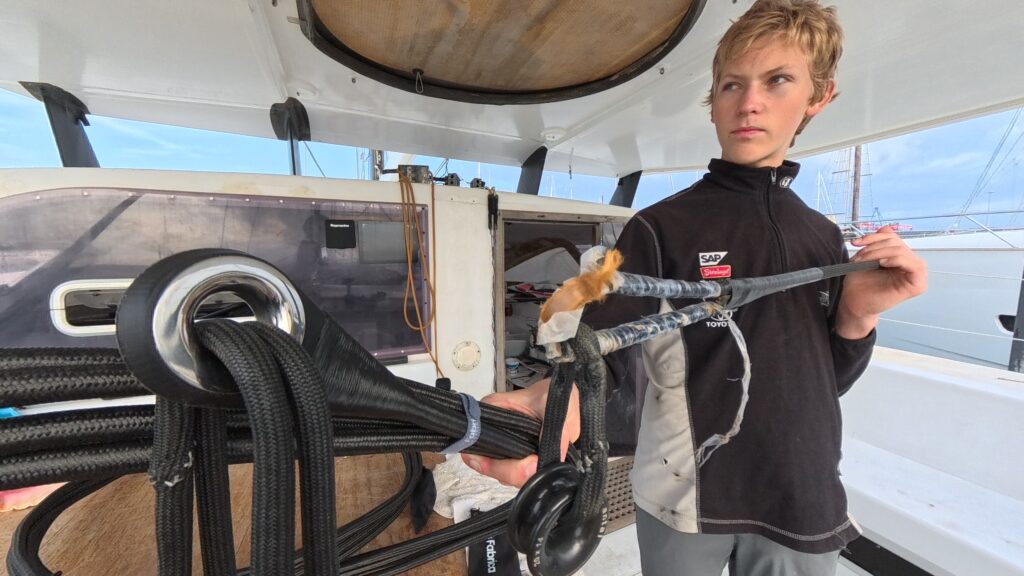
The new synthetic stays from Fabrica are on Paikea, and this post covers how we fitted synthetic stays on a rotating rig and why each connection is set up the way it is. Shayne talks through the top and bottom attachments, the dog bone he machined, why some stays have turnbuckles and others don’t, and what a rotating rig really means for dock tune.
This isn’t a DIY how-to. We fitted them a lot differently to the conventional method, and with Shayne at the top of the mast for the swap there isn’t much footage of that part. What we can do is show you the result and explain the thinking behind it.
See our video below:

Fitting the stays with the rig still standing
The conventional job starts with taking the rig out of the boat. You lay it on its side in the yard, take off the old stays, fit the new ones, then bring in a crane to put the rig back and tune it at the dock. We did it differently. Shayne went up the mast, took each old stay out while he was up there, and fitted the new one in its place while the rest of us worked from deck.
Once the port side was in, the boys pulled some tension on. The new stays are a bit bigger in diameter than the stainless wire they replaced, but each one is lighter than the wire stay that was there before. Shayne’s verdict was that it’s worth the effort.
The top connection: loop, dog bone and a bigger hole
At the mast, each stay ends in a loop that sits over a dog bone on a Nitronic 50 pin. Shayne machined the dog bones from the old Nitronic rod stays that came with the America’s Cup mast. The old setup used the metal eye from the original aluminium rig, with a big pin and washers and a lashing holding the loop on.
The new loops are a little bigger than the old ones, so the dog bones needed some work. Shayne took the tall shoulders down with a grinder and a flap disc rather than make smaller loops, because the loops were already made. Even then he had to slightly modify the hole the loop goes through. As he puts it, rigger’s rule: if there’s a hole, fill it, and this one is about as full as a hole gets.
The dog bone is tied to the loop with a Spectra macramé whipping, so it can’t fall down the mast while the stay goes in or comes out. Shayne says that’s him thinking about future him. Ideally the pin would have a hole for a loose captive whipping, but he didn’t add one when he built it, and he isn’t going to drill Nitronic 50 with a hand drill.
One detail to watch for in the footage: the bottom half of the loop doesn’t go into the hole separately from the top half. It comes up through the top half and sits on top of it on the dog bone. Shayne says there’s a reason for that arrangement. From the deck, his side-by-side shots show the new top connection is a little more aerodynamic than the old one.
Why turnbuckles on the main sidestays and lashings on the lowers
Paikea’s lowers and her main sidestays are set up differently at the bottom, and there’s history behind that. When the new carbon mast went in, the stainless wire stays from the old aluminium rig were only a couple of years old with plenty of miles left, so Shayne kept them. He did need lowers, and he found an old PBO set from the 2007 America’s Cup boats hidden in a back corner that looked like scrap. He recycled them, and they turned out to be just about the right length, if a little long.
Because they were long, they hung low to the deck, so there was no room for a turnbuckle. With the old stainless chainplates there was nowhere to fit one anyway, so a lashing was the only option, and Shayne carried it over into the new system. A lashing is super lightweight and super simple, and once it’s in the right place it lasts and stays put. The downside is that it’s a pain to adjust, especially to get port and starboard accurate. Shayne has to go sailing to get it right, tweaking the leeward side, tacking, then doing the other side.
The old lowers were also due for replacement. The black cover had broken down from UV exposure and was falling apart, and Shayne says PBO is quite good if you can keep it out of the sun.
The main sidestay, the big one that holds the mast up, has a turnbuckle. A lashing would have worked, but tuning the rig that way is a pain. A mechanical screw turnbuckle lets Shayne wind in and out accurately and get the mast upright in the boat, unless you have a mast jack system, which is a whole different subject. A turnbuckle also keeps the load cell options open, either load cell pins or a load cell turnbuckle body. With a lashing those options get more challenging.
Small details at the turnbuckle end
The turnbuckle has a toggle at the top and the bottom. Shayne wanted to stay open to different load cell arrangements, so he kept this style of turnbuckle. The upper pin isn’t a normal clevis pin with a split pin. It’s a pin and nut with locking grub screws, which is a lot slicker than the standard setup, and it’s something we do on a few things.
Finding the right toggle was harder than it should have been. Shayne knew where to get one for the Blue Wave turnbuckle, but finding someone who would actually sell it to him was a pain. He ended up with a BSI fitting on a Blue Wave turnbuckle, which works perfectly well except that the hole drilled for the locking screw sits 90° different between the two. That means the turnbuckle body has to sit at 45 degrees. It isn’t a showstopper, but several of us in the family have OCD, so it’s annoying.
The cool thing about these stays is that the ends can be set up however you want. The lashing eye is built into the bottom of the cable, and on the turnbuckle stays the bottom of the cable has an arrangement for a clevis pin. It all blends together neatly with the turnbuckle. Paikea’s setup is nothing fancy and nothing exotic, with a bit of legacy left over from the old system.
How much dock tune does a rotating rig need?
A question came up after an earlier video: because the rig rotates, do we need a looser dock tune? Shayne’s answer is that the simple version is no, and in reality it’s sometimes yes, depending on how the rig is designed.
Dock tune is the pretension you put in the stays at the dock. When the boat is fully loaded, the windward stay stretches and the pretension on the leeward side comes down to basically zero. The aim is that the leeward stays never go slack. If they do, the rigging is either too loose or too stretchy.
If a rig is designed to rotate under full load, you can carry full dock tune all the time and the mast will still rotate. On a multihull there’s one more factor, which is platform stiffness. A full carbon race boat might be stiff enough that the hulls don’t flex enough to change the tension in the stays. Paikea isn’t a carbon race boat. She’s fibreglass, so the platform bends, moves and twists a bit. So yes, with a rotating rig you do need rig tension.
Plenty of boats do run a looser rig, for two reasons. In the first, the mast ball arrangement isn’t well designed, so the rig can’t rotate under full load. Those boats run a lower dock tune so they can rotate the mast through tacks and gybes while the boat is unloaded, and once it’s loaded the mast and ball lock up. In the second, the stay attachments don’t match the mast’s rotation axis, so the leeward stay needs to be looser than the dock tune stretch allows in order to wrap around the mast as it rotates. On a well-designed rotating rig you carry a good amount of dock tune.
What’s next
The forestay is still to come. We need to fit the furling cable and the new furler that goes with it, so there’s another video on that. For now we’re happy with what we’ve got.
In the Library
This post is part of our synthetic rigging build on Paikea. For the full story, start with Paikea’s Synthetic Rigging, and for the mast these stays attach to, see Paikea’s rotating carbon fibre mast. The Performance Sailing Hub has more on tuning and how a catamaran rig behaves.
Members get the behind-the-scenes details discussions on the Nitronic dog bones Shayne machined, loop arrangment and how the stays connect to the mast plus loads more technical discussion on our rig setup.
In This Series
- Replacing Wire Sidestays with Synthetic
- Synthetic Headstay Furling Explained
- Inside the Fabrica Workshop: How Synthetic Rigging Is Actually Made
- Synthetic Stays on a Rotating Carbon Rig