Topic Overview: This post details the process and engineering rationale behind cutting down a structural bulkhead to improve livability. We explain the load path disruption, the calculations for reinforcement, and the practical execution using unidirectional carbon fiber to restore and enhance structural integrity.
Author: Shayne and Anna
A boat refit often involves a trade-off between structural integrity and owner comfort. One of the most impactful comfort modifications is improving headroom, but cutting into a primary structural member like a bulkhead is not a decision to be taken lightly. This post breaks down the process and engineering behind safely executing this change on our Catana 42, Paikea.
The project has two parallel tracks: the finish work in the cabins and the major structural modification of a door bulkhead.
Phase 1: The Finish Work – Sanding, Painting, and Installation
Before the boat can be reassembled, the new composite components must be finished.
- Sanding and Fairing: All new laminates, like the taping around Harry’s bunk, require careful sanding to remove drips, high spots, and prepare the surface for painting. This creates a professional, clean substrate.
- Painting the Builders: The new structural builders are painted with a tough, durable paint. This not only protects the composite but also brightens the interior spaces.
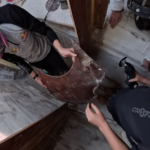
- Installing Pre-Made Components: We reinstalled a salvaged carbon fiber/Nomex floor panel, a testament to the “if it ain’t broke, don’t fix it” philosophy. The panel, originally built from America’s Cup tooling, was simply trimmed and re-edged with a thickened epoxy filler to seal the core and prevent water ingress.
Phase 2: The Structural Modification – Engineering for Headroom
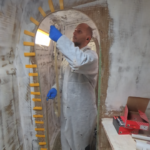
The core of this update was cutting approximately 150mm from the bottom of a door bulkhead to prevent head injuries and improve the feeling of space.
The Engineering Problem:
A bulkhead acts as the web of a large I-beam or box beam, where the hull and deck act as the flanges. Cutting the bottom of the bulkhead has two major effects:
- It Reduces Beam Depth: The depth of a beam is a critical factor in its stiffness (stiffness is proportional to the depth cubed). Halving the depth makes the beam dramatically more flexible.
- It Increases Loads: With a shallower beam, the tension and compression loads in the remaining flanges become much higher. The original ±45° glass fibers, excellent for handling shear and torsion, are inefficient at carrying these new, higher direct loads.
The Engineering Solution:
To compensate, we must re-engineer the load path by adding unidirectional (UD) carbon fiber.
- Strategic Placement: UD carbon is placed along the bottom edge of the cut bulkhead, effectively creating a new, stiff bottom flange for our now-shallower beam.
- Precise Integration: A trough is routed into the bulkhead’s core to accommodate the UD carbon. This allows the reinforcement to be installed flush, maintaining a clean geometry for finishing.
- Edge Capping: The newly cut edges are sealed and reinforced with glass tape, often with additional lightweight UD strips underneath for extra belt-and-braces strength against localised loads.
Conclusion: A Calculated Risk Becomes a Smart Upgrade
This modification was only possible because other refit work had already strengthened the boat’s overall structure. The new, fully bonded floors act as massive longitudinal stiffeners, picking up some of the load previously handled by the bulkhead. This holistic approach to structural engineering—understanding how one change affects the whole system—is what allows for successful and safe customizations.
By applying these principles, we transformed a constant hazard into a more livable space without compromising the vessel’s ability to handle high-performance sailing loads.
Want to Learn More?
- Diagnosing and Repairing Hull Delamination and Core Damage.
 The Problem: From Floor Installation to Structural Repair Author: Shayne and Anna During the installation of new cabin soles in our Catana 42 refit, a routine task uncovered a significant structural issue. The discovery process is a textbook example of why systematic disassembly is critical. Initial Indicators: The Technical Failure:In a cored composite structure (like… Read more: Diagnosing and Repairing Hull Delamination and Core Damage.
 - Bulkhead Reinforcement on a Catamaran: Beam Theory ExplainedBulkhead Reinforcement on a Performance Catamaran Why Beam Theory Matters More Than “More Fibreglass” During refits, bulkheads often get treated as simple partitions—something to hang doors off or separate spaces. On a performance multihull, that assumption can be dangerously wrong. On Paikea, our 1990 Lock Crowther Catana 42s, bulkheads are structural elements. They tie hull… Read more: Bulkhead Reinforcement on a Catamaran: Beam Theory Explained
- Modifying Boat Bulkheads: The Engineering Behind Increasing HeadroomTopic Overview: This post details the process and engineering rationale behind cutting down a structural bulkhead to improve livability. We explain the load path disruption, the calculations for reinforcement, and the practical execution using unidirectional carbon fiber to restore and enhance structural integrity. Author: Shayne and Anna A boat refit often involves a trade-off between structural integrity… Read more: Modifying Boat Bulkheads: The Engineering Behind Increasing Headroom
- Bulkhead Reinforcement: Unidirectional Fibreglass and Edge CappingRestoring structural integrity and finishing a cut composite panel. Author: Shayne Key Message: Cutting into a cored panel necessitates a two-stage process to restore its structural integrity: first, reintroducing in-plane stiffness and strength along the cut edge with a strategic reinforcement (like unidirectional glass); and second, re-establishing the critical load path between the skins and sealing the core with… Read more: Bulkhead Reinforcement: Unidirectional Fibreglass and Edge Capping
- Weight, Performance, and Payload: The Logic Behind Our Catamaran RefitTopics: An engineering analysis of weight reduction in a catamaran refit, covering the strategic goals of increasing payload capacity and the critical considerations of balance, center of gravity, and structural integrity. Author: Shayne & Anna The systematic replacement of Paikea’s timber interior with composite structures continues with the installation of a new bunk and bulkhead. This work is part… Read more: Weight, Performance, and Payload: The Logic Behind Our Catamaran Refit