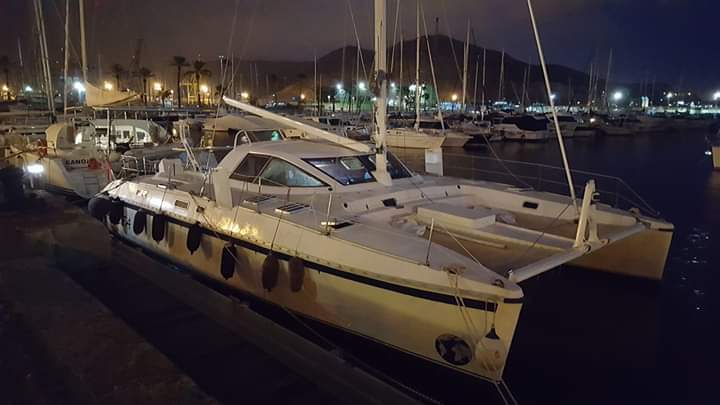
Our Criteria for Buying a Second Hand Multihull
Between us we have over 50 years of professional experience in the marine industry — America’s Cup campaigns, Volvo Ocean Race, grand prix carbon fabrication, offshore racing at every level. When we went looking for a boat to sail from Europe to New Zealand with our three boys, we applied everything we knew to find the right one on a limited budget.
This page covers what we looked for, what we found, and what we’d tell anyone seriously considering an older performance multihull.
Start Here — What Makes a Boat Worth Buying
Before you look at specific boats, you need to understand what makes a sailing boat actually perform. Not what the brochure says, not whether it has daggerboards or carbon construction — what the physics of the thing actually tells you.
Shayne’s article on defining performance is the right place to start. It’s pinned in the members forum but the principles apply to every boat on this page.
What Makes a Performance Boat?
The Short Version
If you want additional ideas on what other older second hand designs are worth looking at and why, this Short covers it in under a minute.

The key point: Australian and New Zealand designs from the last thirty years — Crowther, Schionning, Grainger and others — are primarily sailing boats first. That’s what you want. A lot are home builds, quality varies, and you need to know what you’re looking at. More on that below.
The Full Story — Our Criteria and How We Found Paikea

We didn’t exactly apply a disciplined framework to buying Paikea. We found her on the internet, made a deal, flew to Italy, and bought her. Impulse purchase is closer to the truth.
But there was logic behind it — criteria we’d worked out from our racing background that filtered what we were even looking at.
Why a Catamaran
With three boys and a plan to sail from Europe to New Zealand, space and stability were practical considerations. But the bigger reason was that we came from multihull sailing — beach cats, offshore multihulls, racing on two hulls. We understand how they work and we enjoy sailing them. A trimaran would have worked too. We just couldn’t find the right one.
The Budget
We weren’t going into debt for a boat. That meant secondhand, and in the catamaran world that meant looking at older boats — thirty years and up. The budget constraint turned out to be a good thing. A thirty year old boat that has done serious miles has already shown you what’s going to break. What’s survived has survived for a reason.
What We Were Actually Looking For
This is where the racing background shaped everything. We weren’t looking for a floating apartment. We were looking for a proper sailing boat — something that would move efficiently through the water, handle ocean passages, and not fight us the whole way.
Daggerboards. Non-negotiable. Daggerboards give you windward performance, reduced drag off the wind, and the ability to get into shallow lagoons — critical for the Caribbean and Pacific. Anyone who has sailed beach cats knows how much difference board placement makes. The same fundamentals apply on a big boat. Boats without boards weren’t in the picture.
Skinny hulls. Hull shape tells you a lot about how a boat was designed to behave. Light boats have skinny hulls because they don’t need to displace as much water. Fat hulls on a catamaran usually mean a heavy boat. We were looking for designs where the hulls were slim and the displacement was kept honest.
Canted hulls. This one wasn’t a criteria exactly — it was a bonus that got Shayne excited. Paikea’s hulls are canted, not asymmetric. When you’re racing A-Class cats you cant the hulls deliberately because the leeward hull in the water sits bolt upright on its designed waterlines. On a cruising cat you’re never going to fly a hull, but the same principle gives you free righting moment without adding weight. It’s just extra power built into the geometry.
A designer with a track record. Lock Crowther designed this boat. He’s a legend in Australian multihull design — pushed the light fast catamaran category forward significantly. We’d raced a 40 foot Crowther in Australia. Knowing the designer meant knowing what the thinking behind the boat was and trusting that the fundamentals were right.
A yard with a reputation. We didn’t know Catana well when we started looking. A bit of research told us quickly that it was a well-built boat. A friend had a Catana 471 and gave us good feedback. Between the designer and the yard there was enough confidence to keep looking seriously at the boat.
Proven miles. Paikea — she was called Andromede then — had already been to Australia, done the milk run to Asia with her first owners, crossed the Atlantic twice with her second owner, and been halfway around the world by the time we found her. A boat that has done all of that and is still floating has told you something important about itself.
What We Found in Italy
She was a state. Interior worn out. Windows all crazed. The owner had tried to fix things himself and done a poor job. No working electronics, no autopilot, no wind instruments, dead truck batteries, one of three solar panels working, engines so old the hour meter had stopped. One proper rudder and one emergency replacement the previous owner had fitted.
Anna was ready to walk away. Shayne put in an offer.
The logic was that with everything that was wrong on the surface, the things that mattered were still right. They got Olly in — a surveyor with experience in the TP52 programme — to go through the boat properly. What they were looking for was structural: hull to beam junctions, beam to hull connections, mast step, chainplates, internal bonding, bulkhead tapings. The evidence in the areas they could access would indicate how the rest of the boat had been built — there’s a general theme to how a yard works and it shows up consistently.
The bulkheads were done properly — composite foam and glass taped in, not random plywood glued with sealant. The core was foam not balsa, which mattered. Vacuum bagged foam core into the mould — state of the art for the time, still solid practice now. The only plywood in the structure was at hard points under fittings and winches, which was standard for the era. Some of those inserts had taken moisture over thirty years and needed replacing — including one chainplate insert — but nothing structural, nothing that couldn’t be fixed.
The boat had done three transatlantic crossings before we owned it. If there was going to be a structural problem it would have shown up. It hadn’t.
Shayne bought it.
What We’d Tell Someone Looking Now
The market hasn’t changed much. There are plenty of catamarans that function well as a platform for life at anchor. There are not many that are genuinely good sailing boats. If you’re going to cross oceans the distinction matters.
Go back to basics. Two hulls, two beams, one mast, two rudders, daggerboards. Look at a beach cat and understand why it sails the way it does — the same fundamentals scale up. Then start with hull shape and core material before you look at the interior or the electronics.
If you don’t have the background to assess the structure yourself, get someone who does to look at it with you. The cosmetics and systems are problems you can fix. The structure either is or isn’t sound and you need to know which before you buy.
The older Australian and New Zealand designs — Crowther, Schionning, Grainger and others — are serious sailing boats. A lot are home builds and quality varies enormously. Know what you’re looking at or get advice from someone who does.
The value is in the design and build quality. Everything else is fixable.
Take the Conversation Further
If you’re seriously looking at boats, the members forum is where to bring specific questions. Post the boats you’re considering in the Buying a Performance Multihull category and Shayne will give you his honest take. There’s already good discussion there on design philosophy and what to look for.
The membership also gives you access to Shayne’s full performance boat framework — how to measure efficiency across points of sail and where specific designs sit on the curve. Essential reading before you commit to anything.