What Makes a Performance Boat?
The term “performance” is being thrown around too much. Every second boat listing uses it, marketing teams love it, and it has become almost meaningless as a result. Before you can evaluate whether a boat is genuinely a performance boat — or whether it will perform for your intended use — you need an actual definition.
Here’s one that works.
Forget the Categories
The standard ways of categorising boats — race boat, cruiser-racer, cruising boat, charter boat, monohull, multihull — describe what a boat is and how it’s used, not how it performs. A race boat is not automatically a performance boat. Many boats designed and built to the old IOR rule were slow. Conversely, some cruising boats outperform many racing boats.
The presence of daggerboards does not make a catamaran a performance boat. Being built entirely of carbon fibre does not make a boat a performance boat. Both assumptions have produced expensive and deeply disappointing vessels.
A Gunboat can be a race boat, a cruising boat, and a charter boat simultaneously. Categories tell you nothing useful about performance.
A Definition That Actually Works
Performance is about efficiency. Specifically, it’s about how much of the available wind energy gets converted into boat speed.
True wind speed is the energy input — the fuel. Boat speed through the water is the output. Express boat speed as a percentage of true wind speed and you have a simple, honest efficiency number that applies to any boat regardless of how it’s built, what it’s made of, or what category it falls into.
If you’re sailing at 8 knots in 16 knots of true wind, you’re at 50% efficiency. If you’re sailing at 16 knots in 16 knots of true wind, you’re at 100%. There are now boats — foiling race boats in particular — that exceed 100%, sailing faster than the wind that’s driving them.
Everything is measured against true wind speed, not apparent wind. This is critical. A performance multihull will drag its apparent wind forward 40 to 50 degrees — a boat sailing at 45 degrees apparent wind angle can easily be at 90 degrees true wind angle. That is not sailing upwind. Using apparent wind to measure performance flatters the numbers and obscures what the boat is actually doing.
Your instruments also need to be properly calibrated for this data to mean anything. Uncalibrated instruments produce numbers that feel impressive and measure nothing.
Three Categories of Performance
Based on efficiency — boat speed as a percentage of true wind speed — boats fall into three categories:
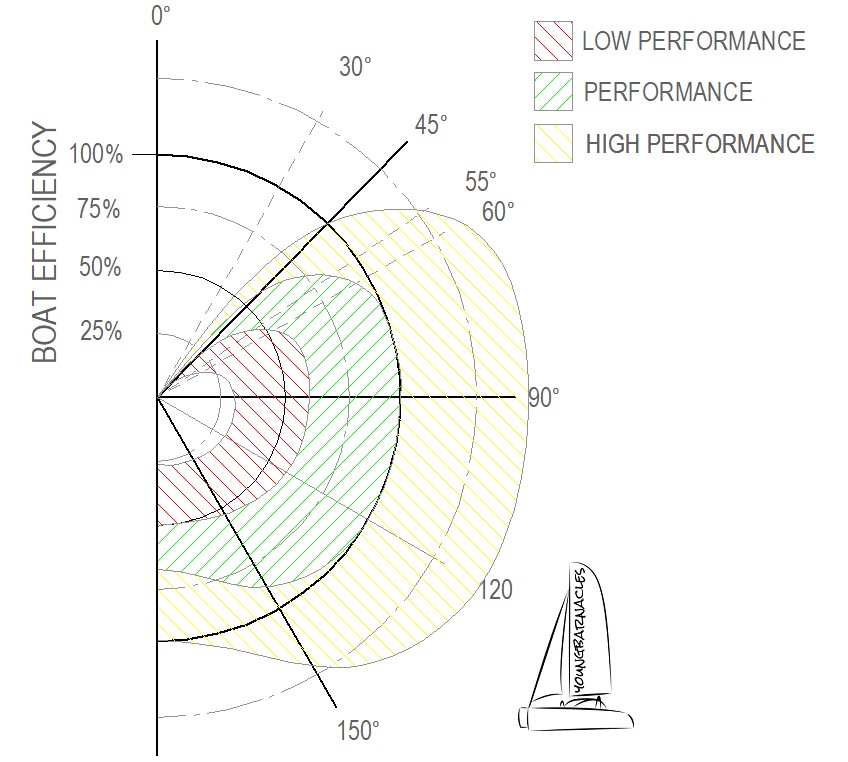
Low Performance — efficiency below the thresholds below across most points of sail.
Performance — sits in the middle range. A genuinely good cruising boat that performs well in the conditions it was designed for.
High Performance — at or above wind speed on reaching and downwind angles, strong upwind numbers.
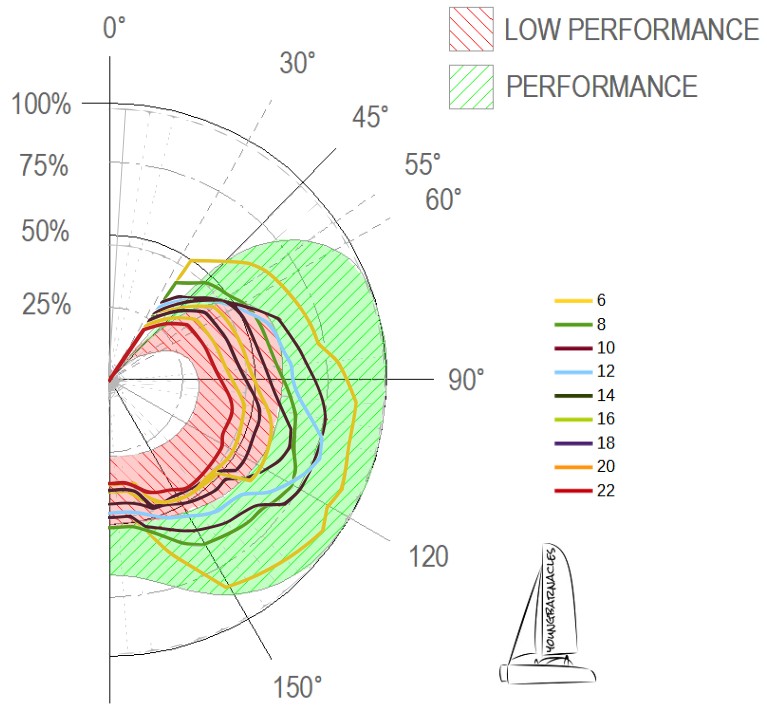
The line between categories isn’t sharp. A boat may be high performance downwind and only performance upwind. A boat optimised for light airs may be excellent at 8 knots and ordinary at 20. What you’re looking for in a passage-making boat is consistent efficiency in 8 to 16 knots of true wind — the most common wind range for comfortable sailing worldwide, before wave state becomes a significant factor.
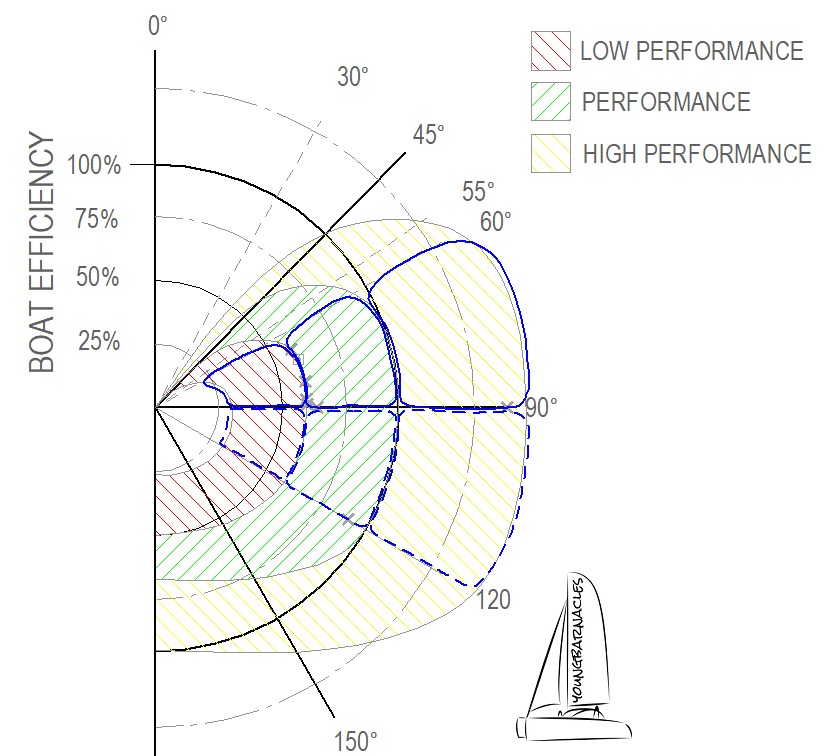
Upwind
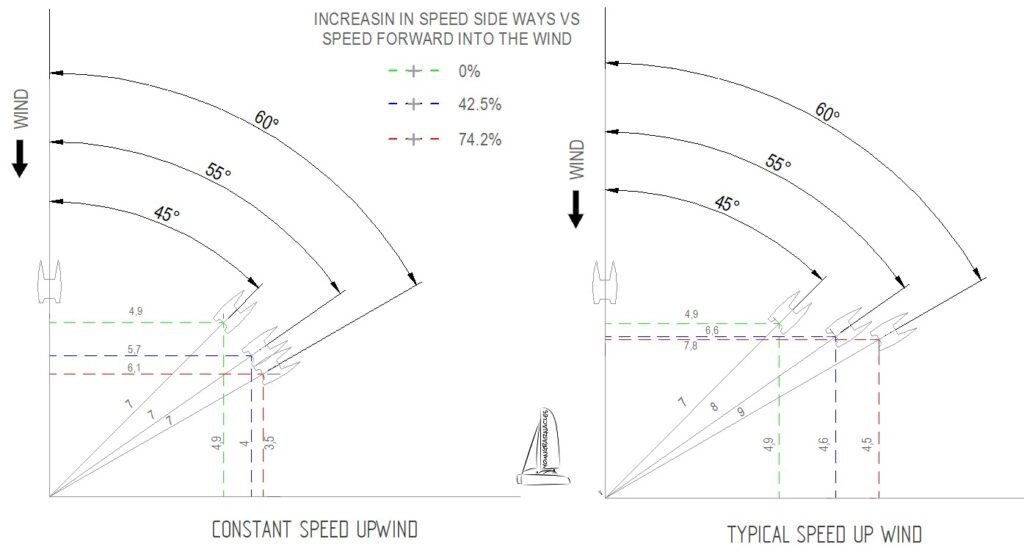
Upwind sailing is the critical safety factor. The ability to make ground to windward means the ability to sail off a lee shore, avoid danger, and keep your options open in deteriorating conditions. For passage making it also defines how broad your cruising range can be.
The upwind zone is 40 to 55 degrees true wind angle. At 45 degrees true, your forward progress into the wind equals your sideways drift. At 55 degrees you’re going sideways 50% faster than you’re going forward — that’s the outer boundary of what counts as upwind sailing.
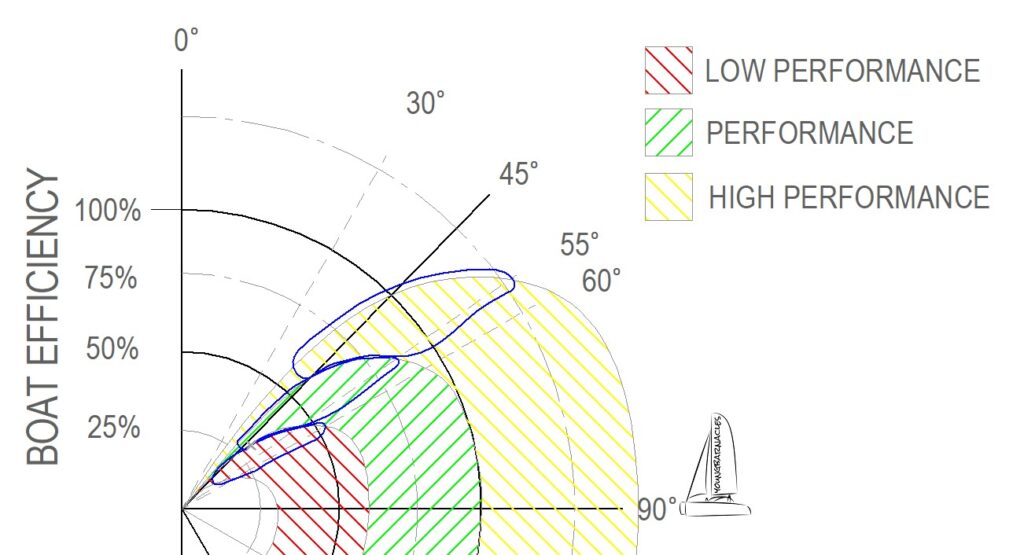
Upwind efficiency by category:
- Low Performance: 10–40% of true wind speed
- Performance: 40–55% of true wind speed
- High Performance: 55%+ of true wind speed
Reaching
This is where multihulls excel. The reaching zone is 60 to 120 degrees true wind angle — tight reaching from 60 to 90 degrees, broad reaching from 90 to 120 degrees.
Reaching efficiency by category:
- Low Performance: 50–60% of true wind speed
- Performance: 60–100% of true wind speed
- High Performance: 80–200% of true wind speed
Foiling race boats are now reaching 300% of wind speed on a reach.
Downwind
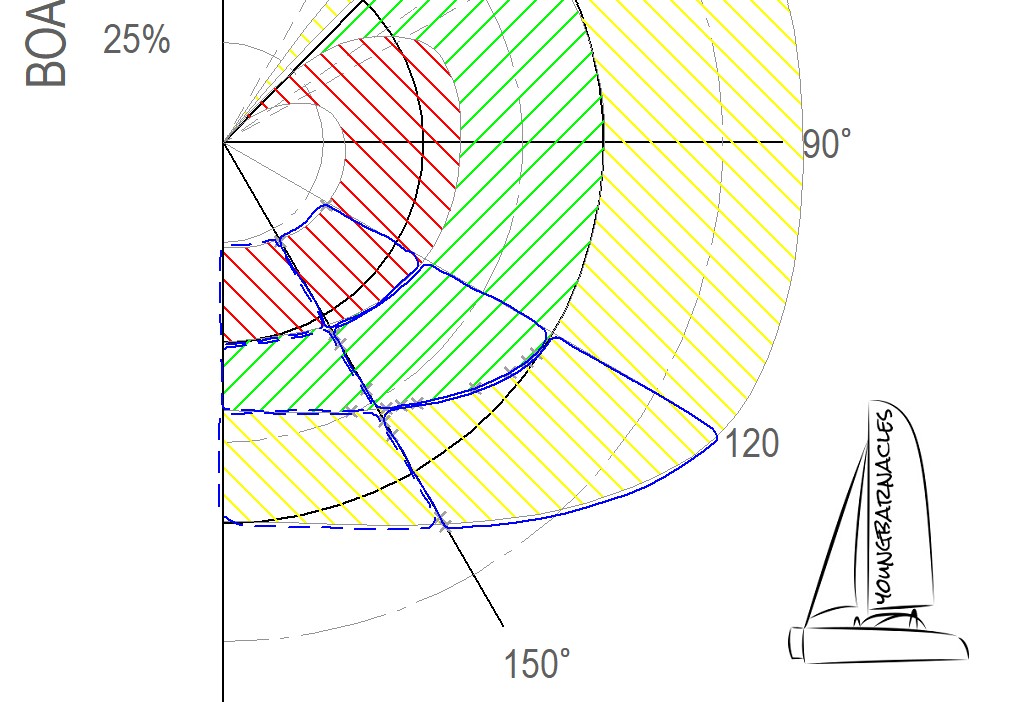
The downwind zone is 120 to 180 degrees true. The 120 to 150 degree range is the most effective for apparent wind sailing — boats are still fast and VMG is good. From 150 to 180 degrees efficiency drops, though VMG running dead downwind can still be competitive on fast boats.
Downwind efficiency by category:
- Low Performance: 40–50% of true wind speed
- Performance: 50–80% of true wind speed
- High Performance: 70–100%+ of true wind speed
Performance Changes
One of the most important things to understand about multihull performance is how dramatically it changes with weight. Add enough weight to a high performance catamaran and it becomes a low performance boat. Remove weight from a heavy cruising cat and performance improves significantly. The efficiency number is not fixed — it’s a reflection of the boat in its current state of loading.
This is why weight management matters so much on a performance multihull, and why a second-hand boat that has accumulated years of gear, spares, and clutter will perform very differently from the same hull sailed clean and light.
Where Does Paikea Sit?
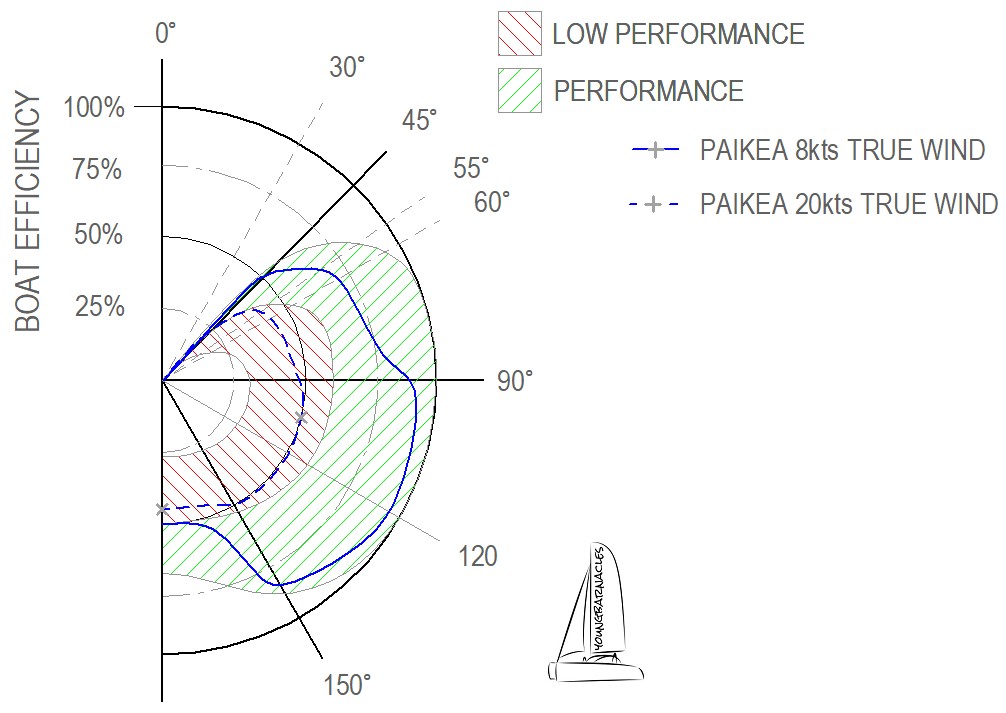
We have more than 3,000 miles of calibrated data on Paikea. She is a Catana 42 built in 1990, heavily modified with a rotating carbon rig, new carbon front end, and custom rudders. The data shows she is most efficient in 8 knots of wind and less efficient at 20 knots — she was optimised for the light-to-moderate wind range that covers most of the world’s cruising grounds. She sits across the Performance and High Performance boundary depending on point of sail and conditions.
She is not a racing boat. She was never intended to be. But she is a genuine performance cruiser — and the numbers prove it.
Want to talk through how a specific boat you’re considering sits on this scale? Join the discussion in the members forum — continue the conversation here.