Author: Shayne and Anna
Key Message: A dramatic vacuum infusion implosion taught us that in composite boat building, true expertise isn’t about avoiding failure—it’s about mastering the art of the recovery. By diagnosing the precise physics of our mistake and executing a meticulous salvage, we transformed a catastrophic failure into one of the strongest, most reliable structures on our catamaran.
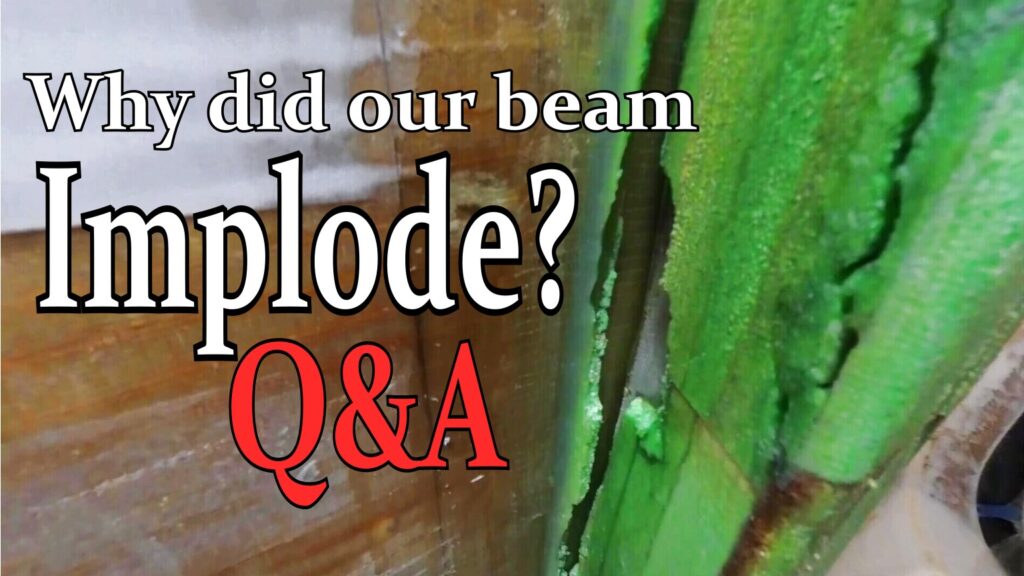
There’s a moment in every boat project where everything hangs in the balance. For us, that moment came during what should have been a routine vacuum infusion of a critical structural box beam. One second everything was proceeding perfectly, the next—catastrophe.
The Setup: A Crucial Stiffener for the Hull
We’ve been working on stiffening Paikea’s hull with a custom box beam to replace a partial bulkhead that didn’t provide adequate support. The engineering was sound: this beam would tie into the frame below the floor and blend into the deck, creating crucial support for the hull panel that experiences loads from waves, water pressure, and docking.
The construction used 10mm rigid PVC foam core—specifically a recycled “second quality” material perfect for this application. As we noted: “I would not use this foam core in a structurally critical part… but I can use it here because its requirements in that member are so low that this recycled foam core is more than capable of doing the job.”
The Implosion: A Week’s Work Lost in a Second
We had everything ready for infusion. The foam core was sealed, and we were confident in our setup. Just before starting, I emphasized the critical factor:
“It’s super super super important that this is airtight because when I vacuum bag and in particular, I’m going to infuse the laminate on here. I do not want to have an air leak to this cavity here. If I have an air leak into this cavity, this will implode.”
The infusion began perfectly. Resin was flowing through the laminate beautifully. Then, in a heart-stopping moment:
“it’s sucking in some resin pretty fast. Just imploded. Damn.”
A week’s worth of work—template making, foam cutting, careful fitting—compromised in seconds. The vacuum had found a weakness, and the results were devastating.
The Autopsy: Diagnosing the Catastrophe
The aftermath required serious diagnosis. We received numerous questions from our community, and the answers reveal important lessons about composite construction.
Why a Hollow Section?
Weight and cost. A solid foam beam would have been eight times heavier and eight times more expensive. For a performance cruiser where every gram counts, the hollow option was the only sensible choice.
Could a Bladder Bag Have Helped?
Not really. With the beam closed at both ends, inserting and removing a bladder would have been nearly impossible. The risk of incomplete filling or bladder failure remained high.
What About Different Core Materials?
The 80kg/m³ PVC foam we used is typically safe for infusion. Lower densities risk crushing under full vacuum. As for XPS or expanding foams? “Don’t. Horrible foams in boats are just a disaster… every time there’s been a pour foam or an expanding foam involved, it’s always been a soggy, deteriorating, moldy, stinky mess.”
The Root Cause
This wasn’t a core crush—it was an implosion. A tiny pinhole in our skin allowed the vacuum to evacuate air from inside the hollow section, creating a vacuum chamber. The external atmospheric pressure (about 1 ton per square meter) did the rest, collapsing the walls at their weakest points—the glued seams of our recycled foam.
The Salvage Operation: How We Recovered
Salvaging the situation required careful planning. The critical unidirectional fibers on the hull and deck flange remained intact—we just needed to repair the former.
Step 1: Heat and Reform
Using a heat gun at about 65°C, we warmed the collapsed PVC foam and polyester resin until they became pliable. Through strategically placed holes, we used tools to gently push and pull the material back into shape.
Step 2: Reinforce and Seal
The original mistake was skipping the external skin. This time, we hand-laminated 300g double-bias glass over the entire repaired beam. This served two purposes:
- Creating a completely airtight seal
- Adding significant structural strength
Step 3: Successful Re-infusion
With the beam properly sealed and reinforced, we performed the infusion again—this time with perfect results. The finished beam was strong, lightweight, and only about 100g heavier than originally planned.
Lessons Forged in Failure
- Respect Material Limitations: That recycled foam was perfect as a former but couldn’t maintain a vacuum seal across its glued seams.
- Don’t Skip Steps: I knew I should have applied that outer skin first. Rushing to save time ultimately cost us a week.
- Failure Teaches Resilience: The difference between amateur and professional work isn’t perfection—it’s knowing how to recover from mistakes.