Author: Shayne and Anna
Topic: This post details the ongoing refit of the starboard stateroom, focusing on the practical installation of a composite door and the application of flow coat as a substrate for insulation. It provides a technical analysis of chronic hydraulic steering failures, evaluating the components beyond repair and outlining the engineering rationale for a proposed conversion to a carbon tube mechanical system, directly linking rudder stock to deck. The content demonstrates the interconnected nature of boat systems, where a structural repair directly influences decisions on mechanical upgrades and interior finishing techniques.
Introduction
Refit work on Paikea continues with focused attention on the starboard stateroom, where we’re combining practical repairs with systems upgrades. This phase demonstrates the interconnected nature of boat work, where a simple door installation leads to broader considerations of surface finishing and mechanical system improvements.
1. Composite Door Installation and Frame Preparation
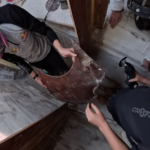
The starboard stateroom door installation required careful preparation following earlier hull crack repairs:
- Frame Modification: Necessary enlargement of the door frame to accommodate new dimensions
- Composite Construction: Door built using foam core with fiberglass skin and carbon fiber reinforcement at hinge points
- Sealing Importance: Critical attention to sealing for engine room separation – addressing sound, fumes, and fire protection
- Material Selection: Use of Spar Bond adhesive and epoxy resin for strong, durable bonds
This work exemplifies the precision required in custom boat fittings where standard solutions rarely apply.
2. Surface Preparation and Flow Coat Application
A key technical decision involved surface preparation before insulation installation:
Why Flow Coat Instead of Bare Glass:
- Creates smooth, consistent surface for adhesive bonding
- Easier future removal of insulation materials
- Avoids microscopic fiber hairs that complicate adhesive cleanup
- Provides adequate surface for non-visible areas
Technical Comparison:
- Flow Coat vs Gel Coat: Identical except for wax content that enables complete cure
- Application Considerations: Thick, brushable consistency ideal for filling minor imperfections
- Weight Trade-off: Acknowledged heavier option but practical for the application
3. Hydraulic Steering System Analysis and Upgrade Planning
The persistent hydraulic oil leaks have reached critical stage, requiring system evaluation:
Failure Points Identified:
- Corroded aluminum pump casting at hose connections
- Worn hydraulic rams beyond seal replacement viability
- Air intrusion compromising hydraulic functionality
- Reservoir leaks contaminating living spaces
Proposed Mechanical Solution:
- Carbon tube extension from rudder stock to deck level
- Tiller arm quadrant installation for direct mechanical steering
- Improved feedback and feel compared to hydraulic systems
- Elimination of ongoing leak issues
4. Bulkhead Systems Integration
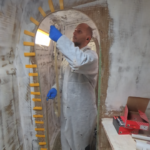
Concurrent work involved rerouting services and sealing bulkhead penetrations:
- Removal of obsolete wiring passages
- Strategic planning for future service runs
- Foam core integration for structural filling
- Polyester filler application for permanent seals
This systematic approach ensures clean, functional spaces while maintaining structural integrity.
5. Technical Insights: Resin Systems and Curing Chemistry
The project provided opportunity to explain important composite concepts:
- Polyester Limitations: Not fully waterproof, leading to blistering below waterline
- Wax Function: Creates oxygen barrier for complete surface cure in styrenated systems
- Bonding Requirements: Wax surfaces require thorough preparation for secondary bonding
- Catalyst Precision: Critical measurement for proper cure times
Conclusion
The current refit phase demonstrates how seemingly discrete projects interconnect – door installation leads to surface finishing considerations, which connect to broader systems upgrades. The hands-on work provides practical examples of composite techniques while addressing real-world boat system challenges.
Want to See More?
- Diagnosing and Repairing Hull Delamination and Core Damage.
 The Problem: From Floor Installation to Structural Repair Author: Shayne and Anna During the installation of new cabin soles in our Catana 42 refit, a routine task uncovered a significant structural issue. The discovery process is a textbook example of why systematic disassembly is critical. Initial Indicators: The Technical Failure:In a cored composite structure (like… Read more: Diagnosing and Repairing Hull Delamination and Core Damage.
 - Bulkhead Reinforcement on a Catamaran: Beam Theory ExplainedBulkhead Reinforcement on a Performance Catamaran Why Beam Theory Matters More Than “More Fibreglass” During refits, bulkheads often get treated as simple partitions—something to hang doors off or separate spaces. On a performance multihull, that assumption can be dangerously wrong. On Paikea, our 1990 Lock Crowther Catana 42s, bulkheads are structural elements. They tie hull… Read more: Bulkhead Reinforcement on a Catamaran: Beam Theory Explained
- Modifying Boat Bulkheads: The Engineering Behind Increasing HeadroomTopic Overview: This post details the process and engineering rationale behind cutting down a structural bulkhead to improve livability. We explain the load path disruption, the calculations for reinforcement, and the practical execution using unidirectional carbon fiber to restore and enhance structural integrity. Author: Shayne and Anna A boat refit often involves a trade-off between structural integrity… Read more: Modifying Boat Bulkheads: The Engineering Behind Increasing Headroom
- Bulkhead Reinforcement: Unidirectional Fibreglass and Edge CappingRestoring structural integrity and finishing a cut composite panel. Author: Shayne Key Message: Cutting into a cored panel necessitates a two-stage process to restore its structural integrity: first, reintroducing in-plane stiffness and strength along the cut edge with a strategic reinforcement (like unidirectional glass); and second, re-establishing the critical load path between the skins and sealing the core with… Read more: Bulkhead Reinforcement: Unidirectional Fibreglass and Edge Capping
- Weight, Performance, and Payload: The Logic Behind Our Catamaran RefitTopics: An engineering analysis of weight reduction in a catamaran refit, covering the strategic goals of increasing payload capacity and the critical considerations of balance, center of gravity, and structural integrity. Author: Shayne & Anna The systematic replacement of Paikea’s timber interior with composite structures continues with the installation of a new bunk and bulkhead. This work is part… Read more: Weight, Performance, and Payload: The Logic Behind Our Catamaran Refit