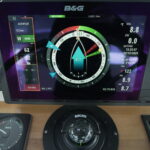
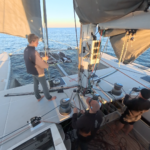
The first sea trials on Paikea after our recent and extensive modifications. We had already taken Paikea out under motor to test the front beam, longeron, rudders, folding propellers, flush skin fittings, and new antifoul paint. Next step was to test how the boat handled sails and the associated loads. We wanted to proof load the rig and the front beam before setting sail.
Another important addition is our headcar gaff lock. This system is inspired by the gaff locks Rigging Projects use on the large performance multihulls. Shayne has machined this headcar gaff lock to allows us to release the head of our square top mainsail and flake it away neatly in it’s sail bag.
Now it’s time to take it all out on the water and see if all these new systems work.
- Apparent Wind vs. True Wind: The Biggest Misconception in Sailing
 Authors: Shayne and Anna Introduction You’re sailing downwind on a beautiful performance catamaran. You glance at the instruments. One display says you’re going upwind at 150 degrees. Another says you’re going downwind. Which one is right? The answer is both. And that confusion is the biggest misconception in sailing. In this guide—filmed onboard the Gunboat… Read more: Apparent Wind vs. True Wind: The Biggest Misconception in Sailing
 - The Art and Science of the Self-Tacking Jib: Why It’s More Complicated Than You ThinkAuthor: Shayne and Anna Introduction If you’ve ever spent a long day on the water tacking up a tight channel, you know the appeal of a self-tacking jib. The promise is simple: ease, simplicity, and the ability to short-hand the boat without a grinders’ pit crew on the rail. But as with anything in sailing,… Read more: The Art and Science of the Self-Tacking Jib: Why It’s More Complicated Than You Think
- Offshore Reality Check: Performance Analysis and Emergency Assessment Mid-AtlanticAuthor: Shayne and Anna Topic: This post provides a professional analysis of an Atlantic upwind passage, demonstrating the Catana 42 Paikea’s performance capabilities with real-time data on wind angles and boat speed. It details the immediate emergency response to a sudden structural bang at sea, outlining the systematic procedure for inspecting daggerboards and hull integrity. The article… Read more: Offshore Reality Check: Performance Analysis and Emergency Assessment Mid-Atlantic
- Ocean Passage Engineering: Systems Analysis and Arrival Planning 40 Miles OffshoreTopic: 40 miles from the Azores after a 14-day Atlantic crossing, we handle mid-ocean gear failure while planning our next jib sheeting system upgrade. This professional analysis covers block replacement, floating ring technology, and track system design for optimal sail control, demonstrating how continuous improvement integrates with routine offshore sailing. We combine practical repair work with… Read more: Ocean Passage Engineering: Systems Analysis and Arrival Planning 40 Miles Offshore
- 30-Knot Atlantic Sailing: Performance Analysis and 17-Knot SurfTopic: Author: Shayne and Anna Introduction The midpoint of an Atlantic crossing often brings the most challenging conditions, and our passage to the Azores delivered 30-knot winds and building seas. These conditions provided the ultimate test of Paikea’s heavy-air capabilities and our family’s offshore systems, from spinnaker management to performance diagnostics in demanding ocean conditions. 1.… Read more: 30-Knot Atlantic Sailing: Performance Analysis and 17-Knot Surf