Author: Shayne and Anna
Key Message: This sea trial proved that true performance isn’t just about strength or weight savings, but about how upgrades transform the sailing experience in real-world conditions. Despite the inevitable “breakdowns” that accompany any major refit, the immediate and tangible improvements—a stiffer, more balanced boat, easier speed, and transformed steering—validated the entire project, turning a messy, choppy day from a slog into a genuine blast and proving the carbon beam’s worth not in a lab, but on the water.
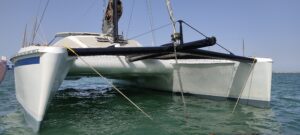
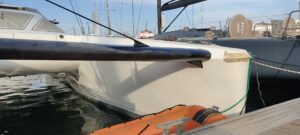
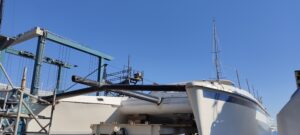
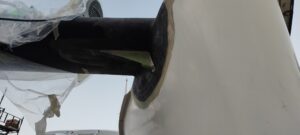
The installation was complete, but the real question remained: how would our new carbon fiber front beam and longerons perform on the water? We didn’t need a gale to find out; we just needed a typical, imperfect day. This week, we found the perfect conditions for our first sea trials—a “lumpy and messy” sea state that provided the ideal real-world stress test.
It wasn’t all smooth sailing. Our shakedown cruise was a classic blend of breakthrough and breakdown, featuring a last-minute sail repair and the persistent nuisance of diesel bug.
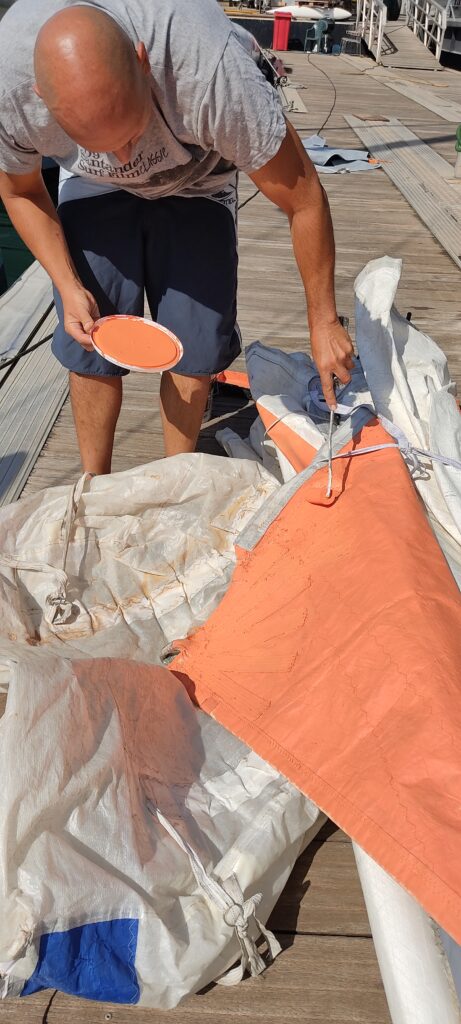
The Midnight Sail Repair
No major upgrade is complete without a cascade of smaller adjustments. For us, it was the mainsail.
Our initial placement for the head webbing was too low for the new rig, causing the cunninghams to sit incorrectly. The solution seemed simple: move the webbing up. What we thought would be a “quick five-minute job” turned into an all-night marathon.
By 2 a.m., we were battling a temperamental sewing machine. By 4 a.m., the stitching was finally done. After a few hours of sleep, we were painting the repair and finishing the leech line by hand. The boat was ready for its test.
The Carbon Beam in a Choppy Sea
We motored out into the “floppy choppy” waves—not storm conditions, but unpleasant and messy enough to reveal any weaknesses. So, how did the new carbon setup hold up?
The improvement was immediately noticeable.
- Transformed Steering: The first comment from the helm was, “Rudders are a big improvement… it definitely steers better.” The boat felt more connected and responsive.
- A More Balanced Boat: Under sail, the boat felt fundamentally more balanced. “It definitely sails better… the boat feels more balanced,” was the verdict. The carbon rig provided a stiffness that translated into smoother handling.
- A Clear Speed Gain: The most exciting result was the speed. Sailing downwind, we were able to drag the apparent wind forward by about 30 degrees—a clear sign of a more efficient and slippery hull. Hitting 10 knots felt easy and sustainable.
The takeaway? A trip that used to take six hours now promised to be significantly faster. The upgrade had turned a slog into a blast.
Lessons from the Shakedown
A successful test always reveals the next items on the list. We noted two key upgrades for the future:
- Non-Skid on the Beam: The sleek carbon surface is effective but can be slippery. Adding non-skid tape is a must for safe foredeck work.
- Rudder Winglets: To further dampen any hobby-horsing in a chop, we plan to add winglets to the rudders.
3D Printed Rudder Winglets
We’re in the middle of a huge project to make our catamaran, Paikea, lighter, so you might be wondering why we just added a heavy 23kg 3D printer to the boat. For us, it’s a powerful tool for creation. We’re using it to design and print custom parts that we can’t easily buy, like our new rudder winglets.
The printer allows us to create the perfect adjustable plastic core for each winglet, which we will then laminate with epoxy and fibreglass cloth to make strong, lightweight, and efficient hydrofoils. So, while the printer itself has some weight, it enables us to build specialized components that will ultimately enhance our boat’s performance.
The Verdict
After an overnight sewing saga and a day contending with diesel bugs and choppy seas, the results were in. The carbon fiber front beam and longerons were a resounding success. The boat is stiffer, faster, and more responsive, making typical, messy conditions not just manageable, but genuinely enjoyable.
It’s these moments—when a tough project culminates in a clear performance win—that make all the hard work of boat life worthwhile.
Want to See More on our Carbon Front Beam Build?
Follow the progress with these posts below:
- The Carbon Fiber Longeron & America’s Cup Rig: Dual Upgrades That Transformed Our Catamaran
 Author: Shayne and Anna Key Topic: While our salvaged America’s Cup rotating rig was a monumental upgrade, the custom carbon fiber longeron stands as its crucial counterpart, fundamentally changing how we sail. This massive central pole—fabricated from the same batch of recycled America’s Cup mast sections—eliminated the need for a clumsy walkway and complex whisker stays.… Read more: The Carbon Fiber Longeron & America’s Cup Rig: Dual Upgrades That Transformed Our Catamaran
 - Carbon Fiber vs. Aluminum Beam: A Catamaran Structural Upgrade
 Topic: We replaced our Catamaran 42’s original aluminum front beam with a custom carbon fiber beam and longeron. This wasn’t just a simple material swap; it was a complete structural redesign. In this deep dive, we break down the critical engineering concept of load paths, explaining how the new system manages the immense forces from the… Read more: Carbon Fiber vs. Aluminum Beam: A Catamaran Structural Upgrade
 - Real-World Test: How Our New Carbon Front Beam Handled a Choppy SeaAuthor: Shayne and Anna Key Message: This sea trial proved that true performance isn’t just about strength or weight savings, but about how upgrades transform the sailing experience in real-world conditions. Despite the inevitable “breakdowns” that accompany any major refit, the immediate and tangible improvements—a stiffer, more balanced boat, easier speed, and transformed steering—validated the… Read more: Real-World Test: How Our New Carbon Front Beam Handled a Choppy Sea
- From America’s Cup to Our Catamaran: Rescuing a Carbon LegendAuthor: Shayne and Anna Key Message: The centerpiece of our rig is a mast with a legendary past: Rig #12 from Team New Zealand’s 2000 America’s Cup campaign. Rescued from a Valencia scrapyard where it was destined to be chopped into pieces, this carbon fiber wing mast represents an incredible piece of sailing history. We simply couldn’t stand… Read more: From America’s Cup to Our Catamaran: Rescuing a Carbon Legend
- Why We Chose Dyneema for Our Catamaran Trampoline (And How to Install It)Author: Shayne and Anna After completing our major carbon fiber front beam transformation, the final piece was installing a trampoline worthy of the upgrade. We chose Dyneema netting—the same high-performance material used for racing halyards—and installed it using professional separate lashing techniques. This approach creates an incredibly tight, safe surface that outperforms conventional trampoline systems in… Read more: Why We Chose Dyneema for Our Catamaran Trampoline (And How to Install It)
- From Racing Mast to Custom Bow Pole: Reincarnating America’s Cup CarbonKey Topic: This upgrade represents the ultimate expression of our refit philosophy: giving the world’s best materials a brilliant second life. We transformed salvaged sections of an America’s Cup mast into a complete, custom carbon fiber bow pole—the final and most rewarding piece of our new front-end system. This post details the final fabrication and fit-out,… Read more: From Racing Mast to Custom Bow Pole: Reincarnating America’s Cup Carbon
- Carbon Fiber Anchor Roller & Stealth Nav Lights – Finishing Paikea’s Front EndKey Message: With the major structural work complete, we’re adding the final functional details to Paikea’s new carbon front end. This post covers the fabrication of a custom carbon fiber anchor roller, the installation of stealth navigation lights hidden within our America’s Cup mast bow pole, and the upgrade to a raised trampoline track system—transforming the bow into a clean, capable, and… Read more: Carbon Fiber Anchor Roller & Stealth Nav Lights – Finishing Paikea’s Front End
- Engineering a Bespoke Forestay Attachment & Mastering “Wet Preg”Key Topic: Replacing our catamaran’s aluminum beam with carbon fiber meant reinventing how critical components attach. For the forestay, this led to a unique engineering solution: a custom transverse pin and slot system that channels load directly into the unidirectional carbon of our recycled America’s Cup mast. This video and post also dive into the professional… Read more: Engineering a Bespoke Forestay Attachment & Mastering “Wet Preg”
- The Vacuum Bag Reveal: Assessing Our Carbon Fiber Beam LaminateKey Message: The de-bagging process confirmed a successful vacuum bag: our complex carbon fiber beam-to-hull joint emerged perfectly consolidated into tight corners, with a peel-ply finish ready for paint after minimal sanding. This technical success, however, came with the sobering reality of high-performance composites—a significant pile of single-use plastic waste, an inherent and unavoidable byproduct… Read more: The Vacuum Bag Reveal: Assessing Our Carbon Fiber Beam Laminate
- The Pre-Splash Push: Integrating Engine Work, Composite Rudder Mods, and Custom FairingsKey Topic: Facing a firm launch deadline, we executed a coordinated final push on our catamaran’s critical systems. This involved servicing the saildrives, preparing new rudders for future winglets by installing a carbon rod backbone, and fabricating custom fairings to improve hull hydrodynamics. With a focus on engineering robust solutions—from reinforcing foils to managing a… Read more: The Pre-Splash Push: Integrating Engine Work, Composite Rudder Mods, and Custom Fairings
- Beyond Flat Panels: Vacuum Bagging a Complex Carbon Fiber Beam-to-Hull JointTopic: Successfully vacuum bagging a structural joint is the true test of composite skill. This guide details the advanced techniques for consolidating a carbon fiber laminate on a complex, multi-dimensional beam-to-hull connection. We break down the entire process, from strategic surface prep and consumable strategy to the critical art of pleating, ensuring a perfect, bridge-free… Read more: Beyond Flat Panels: Vacuum Bagging a Complex Carbon Fiber Beam-to-Hull Joint
- Installing the Carbon Fibre Martingale: Precision Fitting & Engineering NuancesAuthor: Shayne & Anna TOPICS:This post details the final installation of a critical structural component on our Catana 42. It covers the transition from 3D CAD model to physical fitting, the use of specialist adhesives for marine composites, and an in-depth engineering discussion on the importance of pre-tensioning in fixed carbon fibre assemblies. This episode covers… Read more: Installing the Carbon Fibre Martingale: Precision Fitting & Engineering Nuances
- Reinforcing the Front Beam: Engineering a Carbon Fibre MartingaleAuthor: Shayne and Anna Key Topic: This post details the fabrication of our carbon fiber Seagull Striker and Martingale. We explain the engineering logic behind reinforcing the beam and show how we press-molded a high-strength unidirectional carbon strap to replace heavy stainless steel wire. The Seagull Striker and Martingale form the critical backbone of a… Read more: Reinforcing the Front Beam: Engineering a Carbon Fibre Martingale
- Engineering a Carbon Fiber Front Beam & Longeron from America’s Cup MastsKey Message: By repurposing high-modulus carbon fiber from America’s Cup masts, we engineered a custom front-end system that is lighter, stronger, and far more functional than the original, unlocking new sail options and improving overall performance. Author: Shayne & Anna Introduction: A Dual Project Under Pressure This project captures the essence of our refit philosophy: ambitious,… Read more: Engineering a Carbon Fiber Front Beam & Longeron from America’s Cup Masts