Topic: We replaced our Catamaran 42’s original aluminum front beam with a custom carbon fiber beam and longeron. This wasn’t just a simple material swap; it was a complete structural redesign. In this deep dive, we break down the critical engineering concept of load paths, explaining how the new system manages the immense forces from the forestay more efficiently by integrating the beam directly into the hulls. The result is a stronger, stiffer bow that eliminates weak points and the need for extra rigging wires, fundamentally upgrading the boat’s performance and integrity.
Author: Shayne and Anna Young
Why We Swapped Our Catamaran’s Aluminum Beam for Carbon Fiber: An Engineer’s Deep Dive
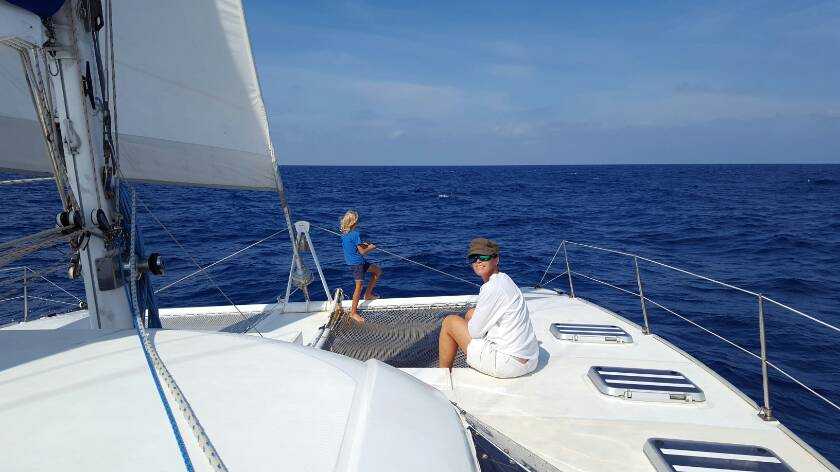
If you’ve ever wondered how much load a catamaran’s front beam actually handles, or questioned the complex forest of wires on some bows, this is for you. We recently undertook a major project: replacing the original aluminum front beam and walkway on our Catana 42 with a fully integrated carbon fiber beam and longeron.
In this post, we’ll break down the why and the how, focusing on the critical engineering concept of load paths and explaining why a fixed carbon structure is a game-changer for performance and strength.
The Problem with the Original Aluminum Beam
The old system was a masterpiece of mechanical connections—pins, plates, bolts, and hinges. While it worked for decades, it had inherent weaknesses when we considered our sailing style and desire for a bulletproof front end.
The core issue was how it managed the immense loads from the forestay. When you have 10 tons of load in the forestay, it doesn’t just pull straight up. It resolves into two primary forces:
- A massive vertical load (approx. 9.5 tons), pulling upwards.
- A significant aft-facing load (approx. 3.1 tons), trying to pull the whole beam backwards.
The old system dealt with these loads separately in a way that was far from optimal:
- Vertical Load: Handled by a large stainless steel fitting connected to the hull with just six M10 bolts. This was its strongest point, but the load was concentrated on a very small area.
- Aft Load: Surprisingly, this was handled by the fiberglass walkway—a non-structural component meant for anchoring duties. This was a clear compromise.
- Torsional Load (The Hidden Killer): The pin connections at each hull allowed the beam to pivot. This was good for a flexible hull but created a major weak point. If the hulls twisted (racking), or under certain rig loads, it induced torsion that could buckle those connection plates.
The Carbon Fiber Solution: A Unified, Integrated Structure
Our new carbon fiber beam isn’t just a stronger material swapped in for aluminum. It’s a complete redesign that transforms the front end of the boat into a single, cohesive structural unit.
Here’s how the new system elegantly solves the old problems:
1. Mastering the Load Path with the Martingale & Seagull Striker
The heart of the new system is how it redirects forestay loads.
- The load travels from the forestay, through a pin in the carbon beam, and into the seagull striker.
- A continuous carbon fiber martingale strap runs over the top of the seagull striker, capturing the upward force.
- This strap then translates the vertical load into a powerful compressive load along the length of the beam, pushing the ends into the hulls.
The Result: Instead of a few bolts resisting an upward tear, the entire beam is now activated to handle the load through compression, a force carbon fiber excels at.
2. Eliminating Weak Points with Bonded Connections
We threw away the pins and bolts. The new carbon beam is directly bonded and tabbed into the hulls in three key locations:
- The outside skin.
- The inside of the hull.
- The outboard side of the hull.
This massive, bonded connection area distributes loads over a much wider section of the hull, eliminating the stress concentrations of the old bolt-on plates. The beam is no longer just a connecting piece; it’s now a major structural stiffener for the entire bow.
3. The Carbon Longeron: More Than a Bowsprit
We replaced the flimsy fiberglass walkway with a substantial carbon fiber longeron. This does two things brilliantly:
- It handles the aft-facing load from the forestay with immense stiffness, making the old walkway solution look primitive.
- It provides a rock-solid platform for launching code zeros and spinnakers. It’s so stiff that we’ve eliminated the need for extra whisker stays or water stays, cleaning up the deck and reducing windage.
Key Takeaways: Why Carbon Fiber Wins
| Feature | Old Aluminum System | New Carbon Fiber System |
|---|---|---|
| Load Management | Separated vertical & aft loads | Unified, efficient load paths |
| Hull Connection | Pinned & bolted (creates pivot points) | Fully bonded & integrated |
| Torsional Strength | Weak; prone to buckling at joints | Excellent; resists hull racking |
| Overall Stiffness | Flexible by design | Extremely stiff, reinforcing the bow |
| Ancillary Benefits | Requires extra stays for sails | Longeron eliminates need for extra stays |
Conclusion
This upgrade wasn’t just about using a “fancy” material. It was about rethinking the fundamental engineering of our catamaran’s front end. By moving from a collection of mechanical parts to a single, integrated carbon fiber structure, we’ve created a system that is:
- Stronger and more reliable.
- Lighter and stiffer.
- Simpler and more efficient.
It’s a modification that gives us total confidence in the boat, whether we’re in a choppy seaway or flying a large downwind sail.
Further Reading on the Project Paikea Refit
To understand the full context of this front beam project, see how it all began:
- The Carbon Fiber Longeron & America’s Cup Rig: Dual Upgrades That Transformed Our Catamaran
 Author: Shayne and Anna Key Topic: While our salvaged America’s Cup rotating rig was a monumental upgrade, the custom carbon fiber longeron stands as its crucial counterpart, fundamentally changing how we… Read more: The Carbon Fiber Longeron & America’s Cup Rig: Dual Upgrades That Transformed Our Catamaran
 - Carbon Fiber vs. Aluminum Beam: A Catamaran Structural UpgradeTopic: We replaced our Catamaran 42’s original aluminum front beam with a custom carbon fiber beam and longeron. This wasn’t just a simple material swap; it was a complete structural… Read more: Carbon Fiber vs. Aluminum Beam: A Catamaran Structural Upgrade
- Real-World Test: How Our New Carbon Front Beam Handled a Choppy SeaAuthor: Shayne and Anna Key Message: This sea trial proved that true performance isn’t just about strength or weight savings, but about how upgrades transform the sailing experience in real-world… Read more: Real-World Test: How Our New Carbon Front Beam Handled a Choppy Sea
- From America’s Cup to Our Catamaran: Rescuing a Carbon LegendAuthor: Shayne and Anna Key Message: The centerpiece of our rig is a mast with a legendary past: Rig #12 from Team New Zealand’s 2000 America’s Cup campaign. Rescued from a Valencia scrapyard… Read more: From America’s Cup to Our Catamaran: Rescuing a Carbon Legend
- Why We Chose Dyneema for Our Catamaran Trampoline (And How to Install It)Author: Shayne and Anna After completing our major carbon fiber front beam transformation, the final piece was installing a trampoline worthy of the upgrade. We chose Dyneema netting—the same high-performance material… Read more: Why We Chose Dyneema for Our Catamaran Trampoline (And How to Install It)
- From Racing Mast to Custom Bow Pole: Reincarnating America’s Cup CarbonKey Topic: This upgrade represents the ultimate expression of our refit philosophy: giving the world’s best materials a brilliant second life. We transformed salvaged sections of an America’s Cup mast into… Read more: From Racing Mast to Custom Bow Pole: Reincarnating America’s Cup Carbon
- Carbon Fiber Anchor Roller & Stealth Nav Lights – Finishing Paikea’s Front EndKey Message: With the major structural work complete, we’re adding the final functional details to Paikea’s new carbon front end. This post covers the fabrication of a custom carbon fiber anchor roller, the installation… Read more: Carbon Fiber Anchor Roller & Stealth Nav Lights – Finishing Paikea’s Front End
- Engineering a Bespoke Forestay Attachment & Mastering “Wet Preg”Key Topic: Replacing our catamaran’s aluminum beam with carbon fiber meant reinventing how critical components attach. For the forestay, this led to a unique engineering solution: a custom transverse pin and… Read more: Engineering a Bespoke Forestay Attachment & Mastering “Wet Preg”
- The Vacuum Bag Reveal: Assessing Our Carbon Fiber Beam LaminateKey Message: The de-bagging process confirmed a successful vacuum bag: our complex carbon fiber beam-to-hull joint emerged perfectly consolidated into tight corners, with a peel-ply finish ready for paint after… Read more: The Vacuum Bag Reveal: Assessing Our Carbon Fiber Beam Laminate
- The Pre-Splash Push: Integrating Engine Work, Composite Rudder Mods, and Custom FairingsKey Topic: Facing a firm launch deadline, we executed a coordinated final push on our catamaran’s critical systems. This involved servicing the saildrives, preparing new rudders for future winglets by… Read more: The Pre-Splash Push: Integrating Engine Work, Composite Rudder Mods, and Custom Fairings
- Beyond Flat Panels: Vacuum Bagging a Complex Carbon Fiber Beam-to-Hull JointTopic: Successfully vacuum bagging a structural joint is the true test of composite skill. This guide details the advanced techniques for consolidating a carbon fiber laminate on a complex, multi-dimensional… Read more: Beyond Flat Panels: Vacuum Bagging a Complex Carbon Fiber Beam-to-Hull Joint
- Installing the Carbon Fibre Martingale: Precision Fitting & Engineering NuancesAuthor: Shayne & Anna TOPICS:This post details the final installation of a critical structural component on our Catana 42. It covers the transition from 3D CAD model to physical fitting, the… Read more: Installing the Carbon Fibre Martingale: Precision Fitting & Engineering Nuances
- Reinforcing the Front Beam: Engineering a Carbon Fibre MartingaleAuthor: Shayne and Anna Key Topic: This post details the fabrication of our carbon fiber Seagull Striker and Martingale. We explain the engineering logic behind reinforcing the beam and show… Read more: Reinforcing the Front Beam: Engineering a Carbon Fibre Martingale
- Engineering a Carbon Fiber Front Beam & Longeron from America’s Cup MastsKey Message: By repurposing high-modulus carbon fiber from America’s Cup masts, we engineered a custom front-end system that is lighter, stronger, and far more functional than the original, unlocking new sail… Read more: Engineering a Carbon Fiber Front Beam & Longeron from America’s Cup Masts
Want More?
Become a member to get exclusive access to our behind the scenes videos on projects and technical deep dives on all our composite work and sailing tutorials Get Full Access Here