Author: Shayne & Anna
TOPICS:
This post details the final installation of a critical structural component on our Catana 42. It covers the transition from 3D CAD model to physical fitting, the use of specialist adhesives for marine composites, and an in-depth engineering discussion on the importance of pre-tensioning in fixed carbon fibre assemblies.
This episode covers the mammoth job of installing our new carbon fibre martingale. For each new project on Paikea, Shayne first creates a 3D model in Solid Edge. This is enormously helpful for visualising the finished product and planning the work, especially since no original plans exist for this era of Catana catamarans.
Precision Installation: From CAD Model to Carbon Fibre
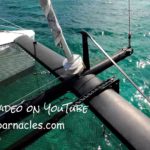
The installation was a lesson in precision. The process began with “lots and lots of measuring and drawing and CAD modelling” to determine the exact position and angle for the slot in the top of the beam. The goal was to ensure a snug fit for the martingale strap without an “crazy oversized” hole, a critical factor for maintaining structural integrity.
The final dry fit confirmed everything was aligned correctly before the permanent bonding began.
The Glue: Why Rubber-Toughened Epoxy?
For this critical secondary bond, we used SpaBond 445, a rubber-toughened epoxy.
- What it is: A high-strength, gap-filling adhesive designed specifically for bonding composite parts.
- Why we used it: Its rubbery, chewy consistency creates a incredibly strong, impact-resistant joint, perfect for handling the dynamic loads a martingale will experience.
- The Trade-off: As seen in the video, it’s notoriously difficult to mix, especially in cooler temperatures, but the performance benefits are worth the effort.
The Engineering Debate: To Pre-Tension or Not to Pre-Tension?
In the rush of installation, we faced a moment of self-critique: we didn’t pre-tension the martingale.
- The Theory: On large catamarans, it’s common practice to pre-tension removable martingales by deflecting the beam downward under load before pinning the strap. This pre-load raises the natural frequency of the assembly, making it less likely to hum or vibrate annoyingly when anchored or sailing.
- Our Reality: With our substantial, fixed carbon fibre design, the need was less clear. “I wasn’t even thinking of pre-tensioning it because it’s so solid,” Shayne notes. However, a simple test with body weight showed that even a small deflection significantly changes the strap’s tension.
The Verdict: While the rigging tension from the forestay will likely keep the martingale tight during sailing, we may experience some harmonic humming at anchor. The fix? A simple piece of shock cord to dampen any vibration—a common solution even on America’s Cup boats with carbon rigging.
Finishing Strong: Protection and Final Laminates
The final step was laminating protective cover layers. After the main structure was bonded, we added a layer of woven cloth over the double-bias carbon. This is a practical tip to prevent the underlying fibres from getting “nicked, scratched, touched, banged, or whatever,” which could cause them to tear and delaminate over time.
Explore the Full Technical Deep-Dive
This post and the video show the installation. For more of the technical stuff, join the Youngbarnacles Members Hub.
Dive further into the front beam modifications with the following posts:
- The Carbon Fiber Longeron & America’s Cup Rig: Dual Upgrades That Transformed Our Catamaran
 Author: Shayne and Anna Key Topic: While our salvaged America’s Cup rotating rig was a monumental upgrade, the custom carbon fiber longeron stands as its crucial counterpart, fundamentally changing how we sail. This massive central pole—fabricated from the same batch of recycled America’s Cup mast sections—eliminated the need for a clumsy walkway and complex whisker stays.… Read more: The Carbon Fiber Longeron & America’s Cup Rig: Dual Upgrades That Transformed Our Catamaran
 - Carbon Fiber vs. Aluminum Beam: A Catamaran Structural UpgradeTopic: We replaced our Catamaran 42’s original aluminum front beam with a custom carbon fiber beam and longeron. This wasn’t just a simple material swap; it was a complete structural redesign. In this deep dive, we break down the critical engineering concept of load paths, explaining how the new system manages the immense forces from the… Read more: Carbon Fiber vs. Aluminum Beam: A Catamaran Structural Upgrade
- Real-World Test: How Our New Carbon Front Beam Handled a Choppy SeaAuthor: Shayne and Anna Key Message: This sea trial proved that true performance isn’t just about strength or weight savings, but about how upgrades transform the sailing experience in real-world conditions. Despite the inevitable “breakdowns” that accompany any major refit, the immediate and tangible improvements—a stiffer, more balanced boat, easier speed, and transformed steering—validated the… Read more: Real-World Test: How Our New Carbon Front Beam Handled a Choppy Sea
- From America’s Cup to Our Catamaran: Rescuing a Carbon LegendAuthor: Shayne and Anna Key Message: The centerpiece of our rig is a mast with a legendary past: Rig #12 from Team New Zealand’s 2000 America’s Cup campaign. Rescued from a Valencia scrapyard where it was destined to be chopped into pieces, this carbon fiber wing mast represents an incredible piece of sailing history. We simply couldn’t stand… Read more: From America’s Cup to Our Catamaran: Rescuing a Carbon Legend
- Why We Chose Dyneema for Our Catamaran Trampoline (And How to Install It)Author: Shayne and Anna After completing our major carbon fiber front beam transformation, the final piece was installing a trampoline worthy of the upgrade. We chose Dyneema netting—the same high-performance material used for racing halyards—and installed it using professional separate lashing techniques. This approach creates an incredibly tight, safe surface that outperforms conventional trampoline systems in… Read more: Why We Chose Dyneema for Our Catamaran Trampoline (And How to Install It)